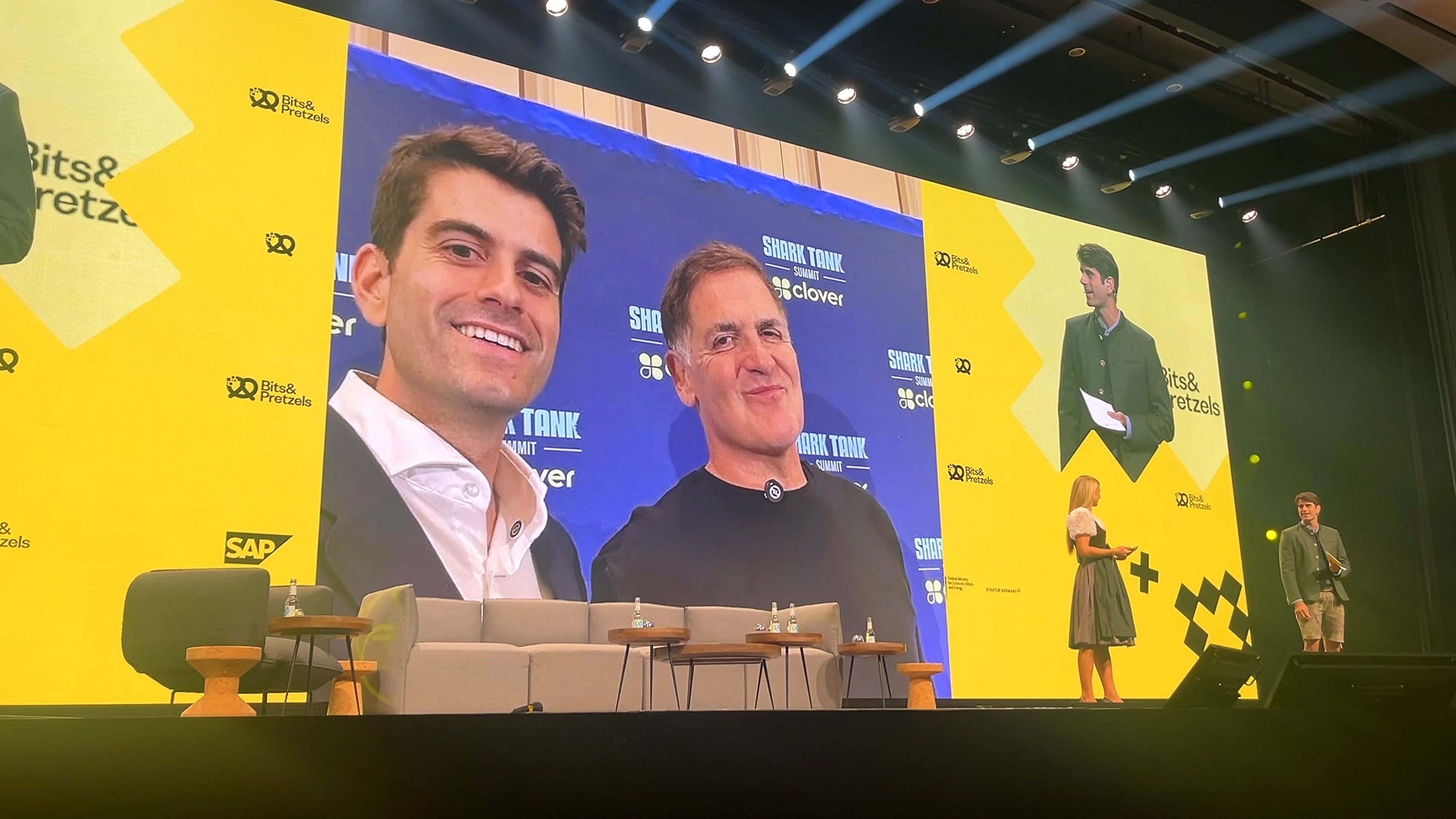
Yesterday I hosted the Inspiration Stage at Bits & Pretzels in Munich, together with Lara Sophie Bothur.
Bits & Pretzels is the founder festival that takes over Munich every year during Oktoberfest: three days, 7,500 founders, investors and operators, and a main stage that this year looked like a list of the companies Europe is most proud of.
In a single day, on one stage, we had:
André Schürrle, 2014 World Cup winner and co-founder of the hydration brand DRYLLDara Khosrowshahi, CEO of UberSteven Bartlett, founder of FlightStory and host of The Diary of a CEOMax Junestrand, co-founder and CEO of LegoraJan Oberhauser, founder and CEO of n8n
And many others!
Here is how the day opened:
📹 I recorded every conversation and pulled out what is worth your time: who is speaking, what their company actually does, and the handful of ideas from each talk that you can take back to your own company.
Inside you will find:
André Schürrle: Why a World Champion Walked Away at 29
How Far We Really Are From Superintelligence
Black Forest Labs: How a Team of 10 Reached $100M ARR in a Year
n8n: How to Get AI Automation Trusted Inside the Enterprise
Isar Aerospace: Why They Built the Factory Before the Rocket Reached Orbit
Legora: How to Go From $0 to $200M ARR in 24 Months
Quantum Systems: The Term Sheet Mistake That Almost Killed an $8B Drone Company
Klaus Hommels: The Four Convictions Behind Skype, Klarna and Helsing
Helsing x General Catalyst: Why Europe Is Spending Its Defense Budget on the Wrong Systems
Dara Khosrowshahi: Why the CEO Is Always the Last to Know
Steven Bartlett: The 40-Hour Hiring Week Behind The Diary of a CEO
Let’s begin!
Who he is
Won the 2014 World Cup with Germany, then retired in 2020 at 29, with no injury and no plan
Co-founded
DRYLLin 2025 with entrepreneur David Rost: an electrolyte drink with no sugar and no caffeine, sold in cans and as powderDRYLL just turned one and is already on the shelves of large German supermarkets
He was interviewed by Max Wittrock, co-founder of mymuesli and now of the non-alcoholic beer brand zeroLabs.
What he said
After retiring he spent about a year and a half in what he calls “the empty room”: he had left the footballer behind and had no idea yet what came next. He said no to every offer, and slowly started saying no to every difficult thing in his life too
The turning point was an ice hike in the Polish mountains: half naked, minus 22 degrees, winds over 100 km/h. Twenty minutes from the summit there was a warm hut, and every signal in his head said stop. He kept going, and that summit changed how he looks at limits
His lesson: meaning comes from the hard things, and above all from the things you fear
On the 3 a.m. doubts every founder knows: he believes you usually already know the right decision, and the anxiety disappears the moment you take it. The mistake is postponing it for weeks
DRYLL started from his own frustration: he was importing sugar-free electrolyte drinks from the US because nothing good existed in Germany
Growth is almost entirely community: runs, gym activations and sports events. In August alone the team ran around 130 events, across running, padel, football, volleyball and niche Olympic sports
2025 was meant to be an “awareness year” with no retail plan. The events created so much noise that supermarket buyers started calling them
Right now he is saying no to big distribution deals the team cannot manage properly, and the main job is hiring people who already know the beverage industry
The takeaway: a new category brand can buy awareness with community before it has a retail strategy, as long as it says no to the growth it cannot yet serve.
Who was on stage
Noah Hollmann, CTO of Prior Labs. Prior Labs builds foundation models for tabular data, the rows and columns of spreadsheets and databases that run most businesses. SAP completed its acquisition in July 2026 and committed more than €1 billion over four years to turn it into a frontier labMatthias Niessner, CEO of SpAItial and co-founder of Synthesia. SpAItial builds “world models”: AI that generates 3D environments that behave like the real world. It raised a $13M seed led by EarlybirdTim Rocktäschel, co-founder of Recursive, which is building AI that improves itself, starting by automating AI research. It came out of stealth in May 2026 with $650M at a $4.65B valuation
The panel was moderated by Andre Retterath of Earlybird.
What they said
All three pushed back on the claim that there is a 10% chance AI kills everyone by the end of the decade. Their view: real risks exist, such as cyberattacks and biosecurity, but an extraordinary claim needs evidence, and nobody has shown it
Hollmann’s definition of superintelligence: the moment a human can no longer add anything to the system. In narrow areas this is already here. His models already beat any human at predicting from tabular data
Rocktäschel expects AI to become a large part of the pipeline that builds frontier models within one to two years. Early versions are already running: labs use AI to generate their own training environments and to improve the agent “harness” wrapped around the model
Niessner argued language is a poor way to describe the physical world. Try describing left and right to someone sitting across from you. Machines talking to machines would never choose language
Rocktäschel took the opposite side on purpose: human progress over the last centuries came from the scientific method, and that runs on precise language. For robots in your kitchen, though, text alone won’t be enough
Nobody believes in one monolithic model. Expect a mix of specialized, cheaper, faster models, which is also safer
Rocktäschel’s strongest line: the field is stuck in “a multi-trillion dollar local optimum”. Everyone is scaling the same transformer architecture, while the human brain learns in a very different way
What limits progress today: for Niessner it is the willingness to take risky bets against something that already works, for Rocktäschel compute and energy, for Hollmann having the right ideas for experiments
The takeaway: the people building the frontier think the current architecture is not the last one, and a startup’s real edge is being willing to bet on what comes next.
Who he is
Robin Rombachis co-founder and CEO of Black Forest Labs. During his PhD at LMU Munich he co-created latent diffusion, the method behind Stable Diffusion, which started the open image generation waveHe left Stability AI in 2024 to start BFL, which makes the Flux image models
BFL reached roughly $100M in annualized revenue within about a year of its first release, and raised a $300M Series B at a $3.25B valuation in December 2025
He was interviewed by Andre Retterath of Earlybird.
What he said
Stable Diffusion happened when three things arrived together: a new algorithm (latent diffusion), accessible compute and accessible data. Even on small compute, the early models showed that 8x or 30x more compute gave clear improvements
The launch strategy for Flux 1 was the growth engine: an open-weights model that was the best available at the time, plus better models sold only through a paid API. Developers adopt the open model, then pay for the best one
His advice for a team of ten to fourteen people: you have to find a way to get distribution, and open source is one way to do it
The founding team had worked together for years. One co-founder was his master’s thesis supervisor. In this field, a team that already knows how to work together is part of the product
BFL started in Freiburg and San Francisco at the same time. He dislikes the “Europe versus US” framing and thinks the best results come from combining both
BFL is moving from images to video, audio and “world action models”: models trained on visual data that can act as the brain of a robot and predict its actions
The next scaling step is closing the loop: robots run the model, interact with the world, and the results become training data
How many people can play at this level? “On the order of a hundred” worldwide, which is why they all know each other
On open versus closed he wants both: open weights for sovereignty, transparency and ecosystem, closed models for the business
The takeaway: a small team can compete with Big Tech by releasing something open that is good enough to spread on its own, and charging for the version that is better.
Who he is
Jan Oberhauseris founder and CEO of n8n. Before that he spent more than a decade in visual effectsn8n is a Berlin platform where you build automated workflows and AI agents by connecting apps on a visual canvas
1.7 million monthly active builders, more than 1,400 enterprise customers and over a third of the Fortune 500
In May 2026 SAP made a strategic investment that doubled n8n’s valuation to $5.2B, and it will embed n8n in its AI agent builder
He was interviewed by Ben Fletcher of Accel.
What he said
The promise of “connect everything” is old. What changed is AI: before, you could automate maybe 20% of the work, because systems couldn’t understand an email or a document. Now almost all of it can be read and acted on
The winning recipe mixes three pieces: AI where the data is messy, fixed rules where the input and output are known (cheaper, faster and more reliable), and a human approval step for decisions that can’t be undone
Example: you can let an agent write an email, and be 100% sure it can’t send it without a person approving it first
Enterprises choose n8n for work where failure is not an option, such as security operations and customer support
A real case: Vodafone built 33 workflows for threat intelligence, avoided about £2.2M in costs and keeps saving around £300k a month
The path into the enterprise was bottom-up: a free, fair-code product that people bring into their company, plus a visual interface that makes every automation easy to inspect
How they land big deals: start with one painful use case, show impact fast, then expand department by department. Never try to transform the whole organization at once
As models get cheaper and more alike, he believes value moves to the layer where companies own and run their automations
How he stays focused as CEO: stay as close as possible to the tools. He runs Friday workshops and builds things himself, and that directly shapes the roadmap
The takeaway: in the enterprise, trust sells, and trust comes from letting the customer see and control exactly what the AI is allowed to do.
Who he is
Daniel Metzlerco-founded Isar Aerospace in 2018 with two fellow students from TU Munich, where he led the student rocketry groupIsar builds Spectrum, the first fully privately financed European orbital rocket
In September 2026 Spectrum reached orbit on its second flight, from Andøya in Norway: the first orbital launch by a commercial company from continental Europe
In June 2026 Isar raised a €270M Series D, for roughly €870M in total funding
He was interviewed by Felix Haas, chairman of Bits & Pretzels.
What he said
The first flight lasted about 30 seconds. The press called it “German rocket blows up”. Inside the company it was a success: the main goal was to not destroy the launch pad, and they got a lot of data
A launch pad costs a nine-digit sum to replace, far more than the rocket. It works like a chemical plant that controls the rocket for the first ten hours of the countdown
The second flight took five attempts: a stuck valve, a fishing boat entering the restricted zone, two fluid system issues. Each time they chose to stand down, even when people criticized them for it
Before the first launch, a Red Bull performance coach and a former Navy SEAL trained the team to handle pressure with breath-holding. The team average went from under a minute to over three minutes in ten minutes of practice. His point: Europeans underestimate what they can do
The key decision: they started building a new factory three years ago, investing hundreds of millions before the rocket had reached orbit. A factory takes three years, and rocket companies have died after reaching orbit because they couldn’t scale production
Scale gap: the European space industry, excluding Isar, launches about five rockets a year. The US does about 185, around 160 of them by SpaceX
One launch is a press release. A customer who needs a thousand satellites in orbit needs a company that can manufacture many rockets
The head of the Canadian Space Force called them to build a spaceport in Canada. Because Isar is not bound by US export controls, 25 countries asked for a launch pad in the last year alone
The takeaway: if a milestone will unlock demand you can’t serve yet, start building the capacity before the milestone, because the lead time will kill you after.
Who he is
Max Junestrandis co-founder and CEO of Legora, an AI platform for lawyers, founded in Stockholm in 2023Legora launched publicly in October 2024 and passed $100M ARR in April 2026 with over 1,000 customers. On stage he confirmed it has now crossed $200M
In March 2026 it raised a $550M Series D at a $5.55B valuation, led by Accel
He was interviewed by Ben Fletcher of Accel.
What he said
At launch the go-to-market team was Max and five other people, with no process. Revenue doubled every quarter, and at some point they had to turn the art into a repeatable machine
His first sales leader was a founder who had just sold his company for $50M and said “absolutely no way”. Max says “nagging is an underappreciated form of negotiation”. He kept asking until the founder joined
Legora has around 3,000 demo requests it hasn’t been able to answer yet. The hard part is hiring fast enough without breaking the culture
How they open countries: people from Germany, Italy and Spain move to Stockholm, take their market to a set revenue number, then go home to open the local office. The German team just opened in Munich
In 2023 the product was essentially “a compliant ChatGPT with nicer document parsing”. Today it runs 17 different models, and its own model router, which picks the best model for each task, is where much of the IP lives
Legora was the first in its market to charge by consumption. After its agent product launched, the top 1% of users used vastly more than the median, and a flat fee stopped making sense
He calls fine-tuning your own model a bad idea: you spend $200M to end up behind the labs, which improve every few months. Legora instead builds a context layer each customer owns and can plug into any model
When Anthropic launched Claude for legal work, legal software stocks fell and demand for Legora shares went up. His argument: it works for simple tasks, but a litigation case with 300,000 files is where generic tools break
“In legal, it’s not enough to be right. You need to be exhaustive.” Code can be tested. A legal mistake shows up when you are already in court
His rule for scaling: hire people smarter than you and let them tell you what to do
The takeaway: in a vertical, your moat is the model routing, the workflow and the last 30% of delivery, and you can let the big labs spend the money on the models.
Who he is
Florian Seibelserved 15 years in the German armed forces as a military pilot and flight instructor, then co-founded Quantum Systems in 2015Quantum Systems builds reconnaissance drones and, more and more, uncrewed systems for land and sea
In July 2026 it raised a $1.2B Series D at about an $8B valuation
He was interviewed by Felix Haas, who first invested backstage at Bits & Pretzels in 2017.
What he said
The first thing he did after the round: buy a helicopter. It’s for testing how to protect helicopters from drones, and how to launch drones from them
Quantum…