I’ve written about The New York Times enough this year that I wasn’t particularly interested in writing about it again. I despise that rag. In May, I went back more than 80 years for The New York Times Has a Jewish Problem. It Always Has. In Old Trick, New Byline, I followed the sourcing behind a Nicholas Kristof column and what readers weren’t told. In Who Watches the Watchmen?, I looked at how reporting from a major newsroom gets repeated across the media until the original framing becomes accepted fact.
All of that was done from the outside. This time we have a glimpse inside.
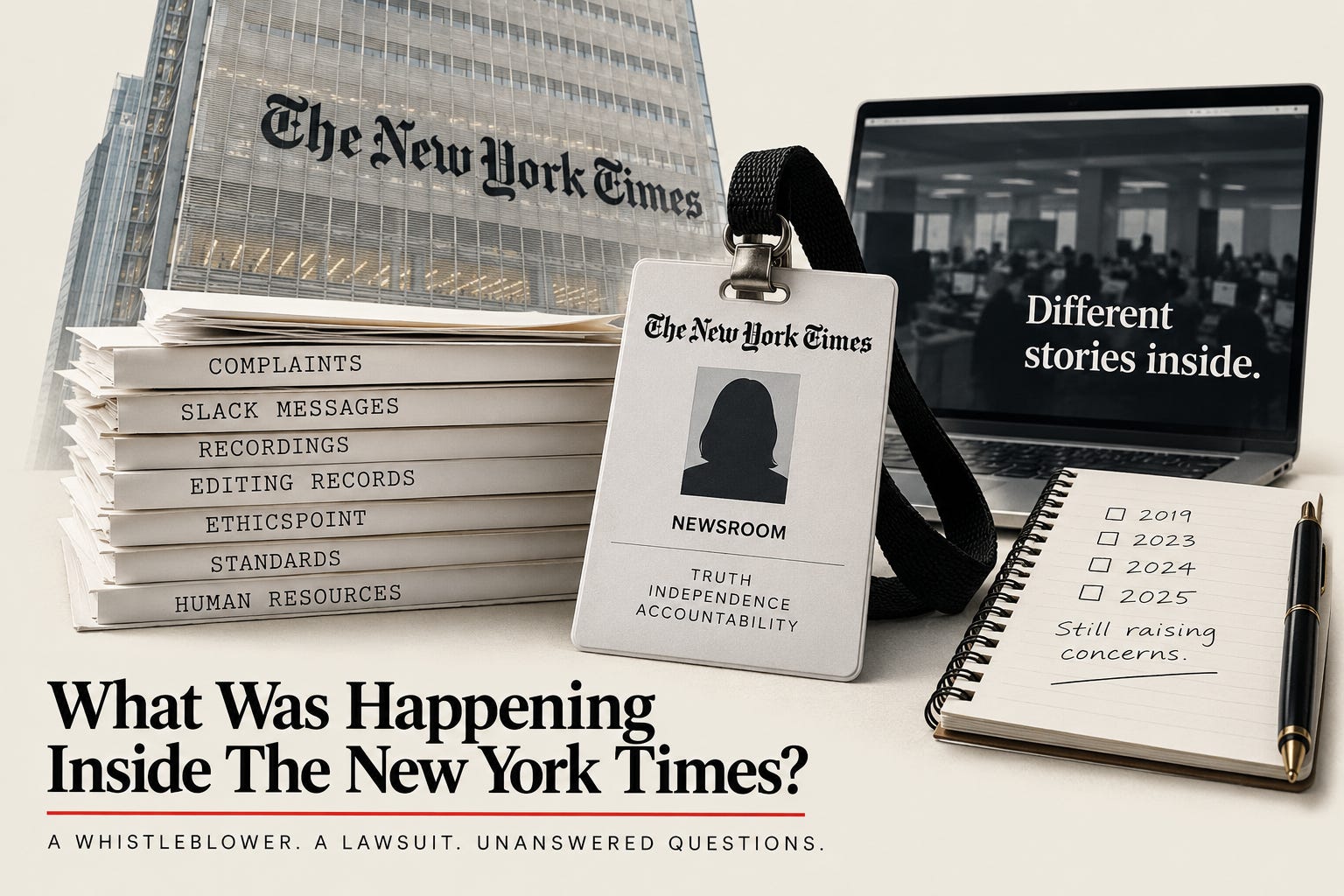
A Jewish employee who spent nearly a decade on the Times video desk says she spent years warning editors, Standards and human resources about antisemitism and anti-Israel bias in the newsroom. According to a lawsuit filed Wednesday in New York County Supreme Court, she raised concerns at least 15 times between 2019 and March 2026. She filed EthicsPoint complaints, saved Slack messages and editing records, recorded conversations and eventually assembled a 26-slide presentation for a deputy Standards editor.
The Free Press broke the story Wednesday after interviewing the former employee, who has remained anonymous because she fears for her family’s safety. I went through the 48-page petition filed by the State Board of Administration of Florida and the National Center for Public Policy Research because I wanted to know what else was there. Quite a bit, as it turns out.
On October 18, 2023 Times Standards circulated guidance about casualty figures coming from Gaza. Employees were told to identify the Palestinian Health Ministry as the Gaza Health Ministry or explain that the ministry was run by Hamas. According to the petition, members of the video desk resisted applying that guidance to a video already in production. The finished report referred instead to “Health officials.” When the employee later showed the exchange to Deputy Standards Editor Mike Abrams, the petition says he called it “a display of groupthink on the video desk.”
The explosion at Al-Ahli Arab Hospital produced another internal argument. Early reports blamed Israel and protests erupted across the Middle East. Evidence soon challenged that account. Israel said a failed Palestinian Islamic Jihad rocket caused the explosion, while U.S. intelligence assessed that Israel wasn’t responsible. Palestinian authorities continued blaming Israel. According to the petition, a Times employee asked on October 19 whether footage of the anti-Israel protests should still be included now that the allegation behind them was doubtful. The answer described in the internal exchange was yes because the footage was powerful and showed how people had reacted.
Six days later, the Times was preparing an account of the Hamas terrorist attack on Ofakim. Editing records cited in the petition say the word “terrorists” was changed twice, once to “assailants” and once to “men.” Standards had reportedly asked that repeated use of “terrorists” be reduced. The petition says the video desk chose “men.”
There were other fights over language and context. One Times video referred to approximately 130 Israelis “believed to be held hostage in Gaza.” The employee questioned the qualifier and the wording was changed. Another video used figures for journalists killed in Gaza without telling viewers that some of the people included in those counts had reportedly been identified as combatants. According to the petition, she objected and the video ran without the additional information.