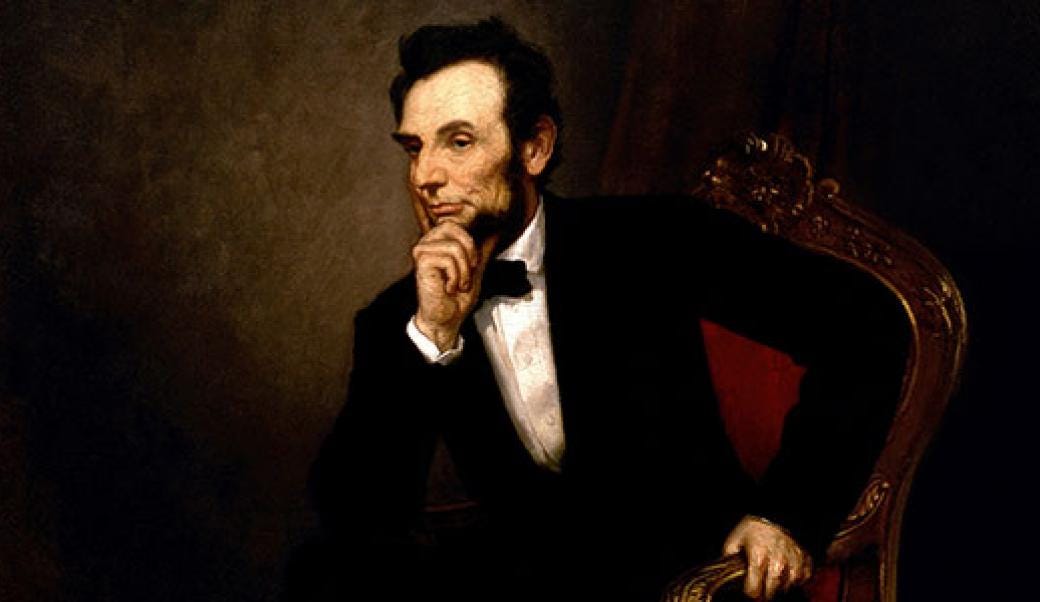
President Trump loves to compare himself to Abraham Lincoln. In his own recent rankings of the greatest presidents, Lincoln came in just below the top slot, which, you can probably guess, was reserved for Trump himself.
Of all the things that Trump has given himself credit for, his handling of the current war in Iran stands as one of the greatest military achievements in the annals of American history, at least in his telling. Not a week passes without the public being told that Iran’s military has been completely obliterated, only to find that somehow it has come back to life and been obliterated again.
Trump may hold the record for destroying the same foreign military more times than any previous president.
All this boasting brings Lincoln to mind, and his experience as commander-in-chief during four long years of bloody civil war. Much of that experience was defined not by triumph but my military failure and setbacks, and by Lincoln’s willingness to acknowledge it.
We are all familiar, Antietam aside, with the string of defeats that marked the Army of the Potomac’s early years, from First Bull Run in July 1861 through Chancellorsville in May 1863. Throughout that stretch, Lincoln struggled in his relationships with generals, George B. McClellan most of all. Historian Ken Noe has cautioned against reading too much into this about Lincoln’s military judgement.
After the defeat at Chancellorsville, Lincoln reportedly cried out, “My God! My God! What will the country say? What will the country say?” Witnesses at the time noted that the president appeared profoundly shaken, with one close friend describing Lincoln as never having looked “so broken, so dispirited, and so ghostlike.”
Following the victory at Gettysburg in early July 1863, Lincoln excoriated General George Gordon Meade, in a letter that he ultimately chose not to send, for failing to pursue Lee’s retreating army more vigorously.
In the spring of 1864, Lincoln endured the staggering casualty numbers of the Overland Campaign, accepting them as the price of ultimate victory.
But 1864 was also an election year and Lincoln had real doubts that the people would give him and his party a second term. On August 23, 1864, Abraham Lincoln wrote a private not, later known as the “Blind Memorandum,” stating that it seemed exceedingly probable his administration would not be reelected.
Even after victory looked likely, Lincoln remained humble in anticipating it, as he made clear in his Second Inaugural Address:
Neither anticipated that the cause of the conflict might cease with or even before the conflict itself should cease. Each looked for an easier triumph, and a result less fundamental and astounding. Both read the same Bible and pray to the same God, and each invokes His aid against the other. It may seem strange that any men should dare to ask a just God’s assistance in wringing their bread from the sweat of other men’s faces, but let us judge not, that we be not judged. The prayers of both could not be answered. That of neither has been answered fully. The Almighty has His own purposes. “Woe unto the world because of offenses; for it must needs be that offenses come, but woe to that man by whom the offense cometh.” If we shall suppose that American slavery is one of those offenses which, in the providence of God, must needs come, but which, having continued through His appointed time, He now wills to remove, and that He gives to both North and South this terrible war as the woe due to those by whom the offense came, shall we discern therein any departure from those divine attributes which the believers in a living God always ascribe to Him? Fondly do we hope, fervently do we pray, that this mighty scourge of war may speedily pass away. Yet, if God wills that it continue until all the wealth piled by the bondsman’s two hundred and fifty years of unrequited toil shall be sunk, and until every drop of blood drawn with the lash shall be paid by another drawn with the sword, as was said three thousand years ago, so still it must be said “the judgments of the Lord are true and righteous altogether.”
With malice toward none, with charity for all, with firmness in the right as God gives us to see the right, let us strive on to finish the work we are in, to bind up the nation’s wounds, to care for him who shall have borne the battle and for his widow and his orphan, to do all which may achieve and cherish a just and lasting peace among ourselves and with all nations.
My point is not to place Lincoln on a pedestal, but to mark the distance between a president who refused to look away from the reality of war and the current occupant of the White House, who seems to have little grasp of reality at all.
I need not sketch out the consequences of that gap. We are living it in real time. But it is worth sitting with the contrast a moment longer. Lincoln governed as though the war’s outcome, and the nation’s judgement of him, were not fully in his hands, and that humility did not weaken his leadership. It steadied it and gave it direction.
A president who can admit “what will the country say” is a president still capable of hearing the country when it speaks. One who insists the record already favors him, before the war he claims to be winning is even over, has stopped listening for an answer.