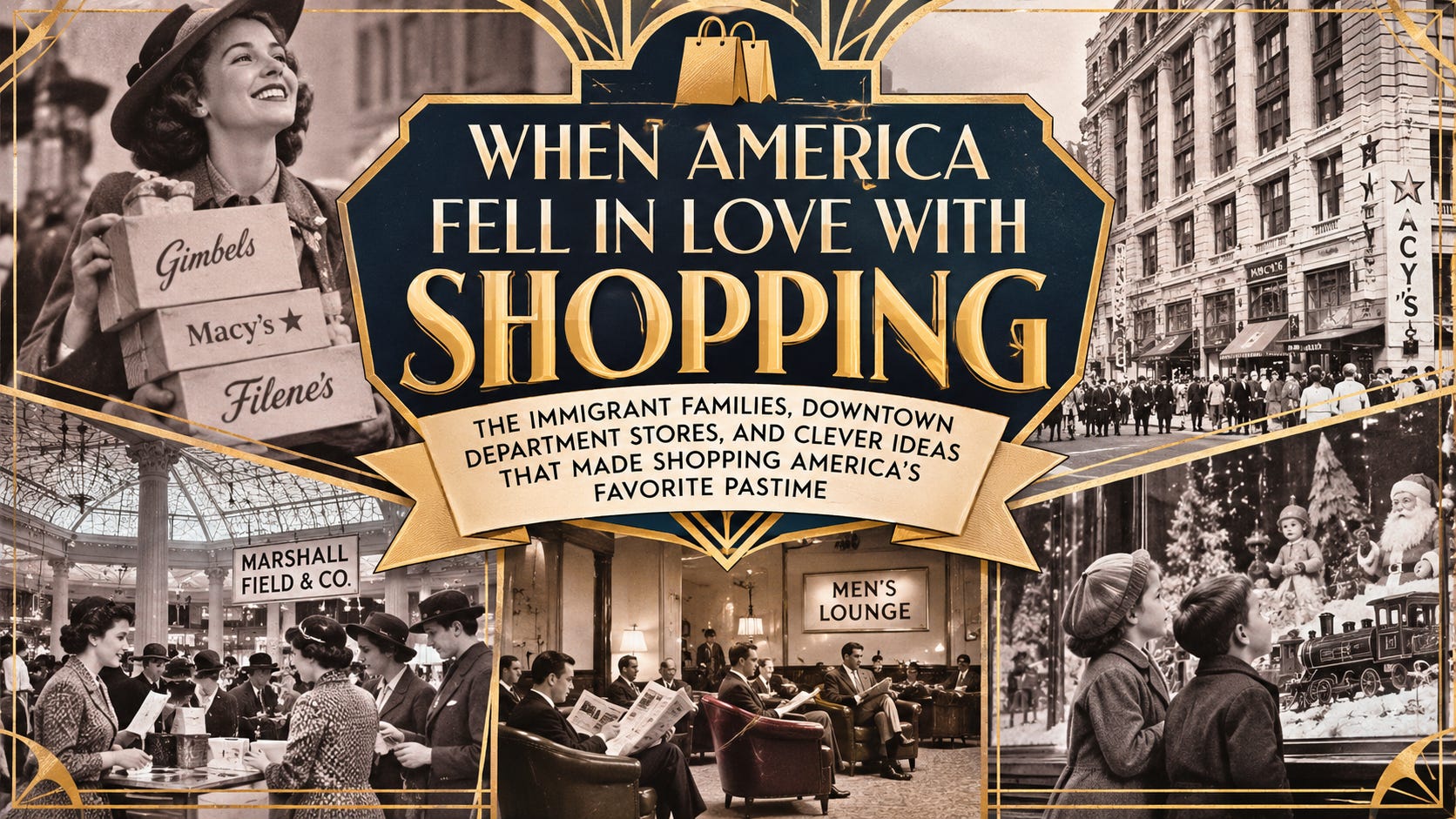
There are few words in the English language more dangerous, more dread-inducing to a husband’s weekend afternoon than “Honey, let’s go shopping.”
He knows how this works. She says she only needs one thing, maybe a new dress for an upcoming event, or shoes because she doesn’t already have 6,000 pairs in her closet. Three hours later, she’s trying on her tenth outfit; he’s holding her purse and his lap, tapping his thumbs against its leather while staring into the void. And…they’re nowhere near finished. At some point, she’ll ask which dress he likes better. He’ll point to one, she’ll explain why she likes the other one better, and he’ll groan inwardly (at least he thinks she can’t hear it. But she does. She does), and wonder why she even bothered asking his opinion in the first place.
The funny thing is, we don’t even need a reason to go shopping anymore. We call a friend, make plans for lunch, wander through a few stores, and come home with three shopping bags containing absolutely nothing we thought we needed. Sometimes we don’t buy anything at all. We just want to see what’s new, try things on, and get out of the house for a few hours.
Our great-great-grandmothers would have found the idea rather foreign. Buying things used to involve more effort. If you needed a dress, you bought fabric and either made it yourself or paid a dressmaker. Shoes came from one shop, hats from another, and household supplies might take several stops around town.
Most merchants kept their goods behind counters, tucked into drawers or stacked on shelves. You told the clerk what you needed, and he brought out whatever he had. Ask to see six different pieces of fabric, and he might have to retrieve six bolts, unroll them across the counter, and put them all away again. After all that work, you could thank him and leave without spending a penny. Shopkeepers had little reason to encourage customers who wanted to look around without buying.
American cities were growing, though, and factories were turning out ready-made clothing and household goods in quantities earlier generations could scarcely have imagined. Merchants began opening larger stores, bringing different kinds of merchandise together and making it easier for customers to examine their choices.
Among the families helping to build this new American retail business were Jewish immigrants who had started with a few dollars and a pack of goods to sell. Some would go on to own stores whose names became as familiar as the streets they stood on.
In 1835, eighteen-year-old Adam Gimbel arrived in America from Bavaria. He was Jewish, had little money, and needed to earn a living. Like many Jewish immigrants of his generation, he began selling merchandise as a traveling peddler.
Peddlers traveled between farms and settlements carrying fabric, clothing, sewing supplies, and household goods. For families living miles from the nearest town, a visit from a traveling merchant could mean the chance to buy buttons, needles, work shirts, or a length of cloth without making a long trip themselves. The merchant needed to know what people wanted, what they could afford, and whether they were likely to buy from him again.
Gimbel traveled along the Mississippi and Ohio rivers before settling in Vincennes, Indiana, in 1842. He opened a dry-goods shop that became known as the Palace of Trade, a rather royal name for a business in a small river town.
He married Fridolyn Kahnweiler in 1847, and the couple had fourteen children. Seven sons survived to adulthood, and they grew up around the family business. There were shipments to unpack, inventory to count, accounts to keep track of, and customers who expected the merchant to remember what they’d purchased the last time they came in.
The sons took the business into larger cities. Gimbels opened in Milwaukee in 1888, Philadelphia in 1894, and New York in 1910. The little shop Adam had started in Indiana had grown into a retail company capable of competing with Macy’s in Manhattan.
Other Jewish immigrant families were following similar paths. In Columbus, Ohio, Simon Lazarus opened a clothing store in 1851. His business grew into F&R Lazarus, a name Ohio shoppers would know for generations. In Atlanta, Morris Rich, a Jewish immigrant from Hungary, borrowed $500 from his brother and opened a dry-goods shop in 1867. Rich’s would become one of the South’s most popular department stores.
Brothers worked beside brothers, sons and daughters learned from fathers, and relatives helped run businesses that sometimes occupied little more than a single room. Children grew up around counters, ledgers, packing crates, and the everyday work of keeping a store running. As American households bought more manufactured goods, these merchants expanded their selections to include ready-made clothing, shoes, furniture, kitchen equipment, and other conveniences that earlier generations had often made for themselves.
In 1876, John Wanamaker opened his Grand Depot in Philadelphia, taking over a former railroad freight station and filling it with merchandise. Wanamaker wasn’t Jewish, but his approach to retail helped shape the department-store business that Jewish immigrant families were expanding across the country.
Customers who were very used to small shops could now stroll leisurely through departments selling clothing, furnishings, household goods, and gifts. Instead of visiting several merchants, they could do much of their shopping under one roof. Fixed prices became more common, and stores advertised returns, exchanges, and attentive service.
The buildings themselves began competing for attention. Window displays featured mannequins wearing the latest fashions, tables adorned with china and silverware, and toys arranged to catch a child’s eye. Inside, polished counters held perfumes and jewelry, while elevators carried shoppers between floors of merchandise.
Marshall Field’s in Chicago became known for the beauty of its State Street store. In 1907, a Tiffany glass dome was installed above the interior, its thousands of glass pieces catching the light overhead. The building featured marble, decorative ironwork, and floors lined with merchandise ranging from clothing to furniture and china. It was a tourist attraction; even people who didn’t plan to shop stopped in to admire the building's beauty.
Women could take the streetcar downtown and spend the morning looking at clothes, comparing fabrics, or visiting the household-goods department. There were restrooms, seating areas, and restaurants where they could have lunch without leaving the building. For many women, these stores provided a comfortable place to spend time outside the home without needing a husband or male relative to accompany them.
They also provided jobs. Saleswomen helped customers select merchandise, assisted with fittings, and learned the fashions and products in their departments. Some advanced into buying positions, choosing clothing and accessories that would appear on the sales floors the following season.
The stores had learned how to keep customers interested long after they’d found what they came to buy. For husbands accompanying their wives, that presented a small problem.
A man might be perfectly happy to buy a new suit or pick up a hat, especially if he knew exactly what he wanted. Watching his wife disappear into a fitting room with an armful of dresses was another matter. He could stand beside the counter holding her purse, but there was no telling how long she’d be gone.
Department stores began providing places where men could ~~twiddle their thumbs~~ pass the time while their wives continued shopping. By 1914, Marshall Field’s had separate lounges for men and women, and other retailers offered reading rooms, smoking rooms, barbers, and comfortable chairs.
When Lord & Taylor opened its Fifth Avenue flagship in New York in 1914, its men’s department offered clothing, shaving, and manicure services. The layout even allowed gentlemen to enter, shop, and leave without passing through the women’s clothing departments. A man could buy a suit, get a shave, and be on his way without ever having to look at a dress.
For those begrudgingly dragged along with their wives in the name of “spending quality time together,” the lounges at least offered a newspaper and a comfortable place to wait. Marshall Field’s Walnut Room gave shoppers another reason to stay, with wood-paneled walls, white tablecloths, and dishes such as Mrs. Hering’s chicken pot pie.
A woman who couldn’t quite decide between two coats could obsess about it while she ate, then return to the clothing department for another look. Her husband might finish his lunch, check his watch, and assume they were finally heading home. Unfortunately, she still needed shoes.
Rowland Hussey Macy opened his New York dry-goods store in 1858. His first day’s sales totaled $11.06, hardly an indication that his name would someday appear above one of the busiest department stores in Manhattan.
Macy wasn’t Jewish, but the family that helped build his business into a retail giant was. Lazarus Straus had brought his family from Germany to Georgia before the Civil War. They later moved to New York, where his sons Isidor and Nathan developed a successful business selling imported china and glassware.
In 1874, the brothers began operating the china and glassware department inside Macy’s. Their business prospered, and in 1888 they became partners in the store. The Straus family later took ownership, and Macy’s moved to its Herald Square location in 1902.
The store stood on 34th Street, surrounded by one of Manhattan’s busiest shopping districts. Inside were floors of clothing, furniture, china, and household goods, while newspaper advertisements kept customers informed about sales and new merchandise.
Isidor Straus also served in Congress, and his brother Nathan devoted considerable time and money to charitable work and public health. In April 1912, Isidor and his wife Ida died aboard the Titanic, a tragedy that brought the family name into newspapers around the world.
Gimbels opened its New York store near Herald Square in 1910, and the two businesses became fierce competitors. Both advertised sales, stocked a wide selection of merchandise, and developed loyal customers who had strong opinions about which store offered better prices.
A woman could visit Macy’s, cross over to Gimbels, and compare what she’d seen without making another trip downtown. If a coat was cheaper at one store but came in a prettier color at the other, she had a decision to make. The rivalry became so familiar that it found its way into Miracle on 34th Street, the 1947 Christmas film in which Macy’s and Gimbels both play important roles.
New Yorkers also had Bloomingdale’s, founded by Jewish brothers Joseph and Lyman Bloomingdale. They opened their East Side Bazaar in 1872, selling a variety of European fashions, and moved to 59th Street and Lexington Avenue in 1886. Between Macy’s, Gimbels, and Bloomingdale’s, shoppers had plenty of choices, particularly when it came to deciding which store deserved their money.
In Boston, the Filene family found a way to add suspense to shopping. William Filene was a Jewish immigrant from Prussia who built a retail business in Massachusetts. His sons Edward and Lincoln took over in 1890 and expanded the family enterprise.
In 1909, Filene’s opened its Automatic Bargain Basement, where unsold merchandise from upstairs was offered at reduced prices. The longer an item remained in the basement, the lower its price became. Customers could wait for the next markdown, but there was always a risk that somebody else would buy it first.
A woman might find a winter coat that was still a little more than she wanted to spend. She could take it home that day or wait and hope it was still hanging on the rack when the price dropped again. If she returned to find it gone, there was nothing to do but wish she’d bought it when she had the chance.
Shoppers learned the markdown schedule and returned to check on things they’d been watching. The basement drew crowds searching through racks of discounted merchandise, hoping to find a dress, coat, or pair of shoes at a price they could afford.
The Filene brothers also introduced health services, insurance programs, and paid vacations for employees, while Edward became a leading supporter of America’s credit union movement. But generations of Boston shoppers remembered Filene’s for the Bargain Basement. Finding a beautiful dress at half price was satisfying enough. Getting to tell your sister how much you saved made the purchase even better.
In 1907, Carrie Marcus Neiman, her husband, Al Neiman, and her brother, Herbert Marcus, decided that Dallas needed a luxury clothing store.
Carrie and Herbert came from a German Jewish immigrant family, and Carrie had already worked in the clothing business. She knew fabrics, understood fashion, and had an eye for the difference between a dress that looked great on a hanger and one that a customer would actually want to wear.
Wealthy Texas women often traveled to New York or ordered clothing from elsewhere. Carrie believed Dallas had enough customers who wanted fashionable, ready-made clothing without leaving the state.
The family had previously operated a successful sales-promotion business in Atlanta. When they sold it, they reportedly chose $25,000 in cash rather than an opportunity to invest in a young soft-drink business called Coca-Cola. The cash helped finance Neiman Marcus, which opened in September 1907.
The country was entering a financial panic, Carrie was recovering from a miscarriage, and Herbert was ill with typhoid fever. Neither sibling could attend the opening. The store survived, and Carrie developed a reputation for knowing what Dallas women wanted to wear.
Neiman Marcus offered carefully chosen clothing, personal attention, and fitting services suited to its expensive merchandise. Its buyers brought fashions to Dallas that customers might otherwise have sought in New York or Paris.
The store later became known for its extravagant Christmas catalog. Alongside luxury clothing and household goods were fantasy gifts so expensive that most people could only dream about buying them. People could sit at home, turn the pages, and decide what they’d buy if money were no object.
By the early twentieth century, department stores had become landmarks in American cities. Families knew where to buy school clothes, where to find a good winter coat, and which store had the prettiest Christmas windows.
Chicago had Marshall Field’s, Pittsburgh had Kaufmann’s, Atlanta had Rich’s, and Baltimore had Hecht’s and Hutzler’s. Memphis had Goldsmith’s, Birmingham had Pizitz, and Portland had Meier & Frank. Many of these businesses were founded or developed by Jewish immigrant families. Their names appeared on shopping bags, hatboxes, advertisements, and charge accounts.
Children grew up visiting the same stores their mothers and grandmothers had known, sometimes buying their first grown-up outfits from saleswomen who had waited on the family for years.
In Hartford, Connecticut, the Fox family built G. Fox & Co. into a major retail business. Gerson Fox had opened his store in 1848, and his granddaughter Beatrice Fox Auerbach took over in 1938 after her father’s death.
Auerbach became one of America’s most successful female department-store executives. She expanded employee benefits, opened opportunities for women and Black employees, and expected her staff to know their merchandise and treat customers well. Under her leadership, G. Fox became the largest privately owned department store in the country.
Detroit had its own busy shopping district along Woodward Avenue. J.L. Hudson’s, founded by English immigrant Joseph Lowthian Hudson in 1881, grew into one of the country’s largest department stores. Its downtown building had restaurants…