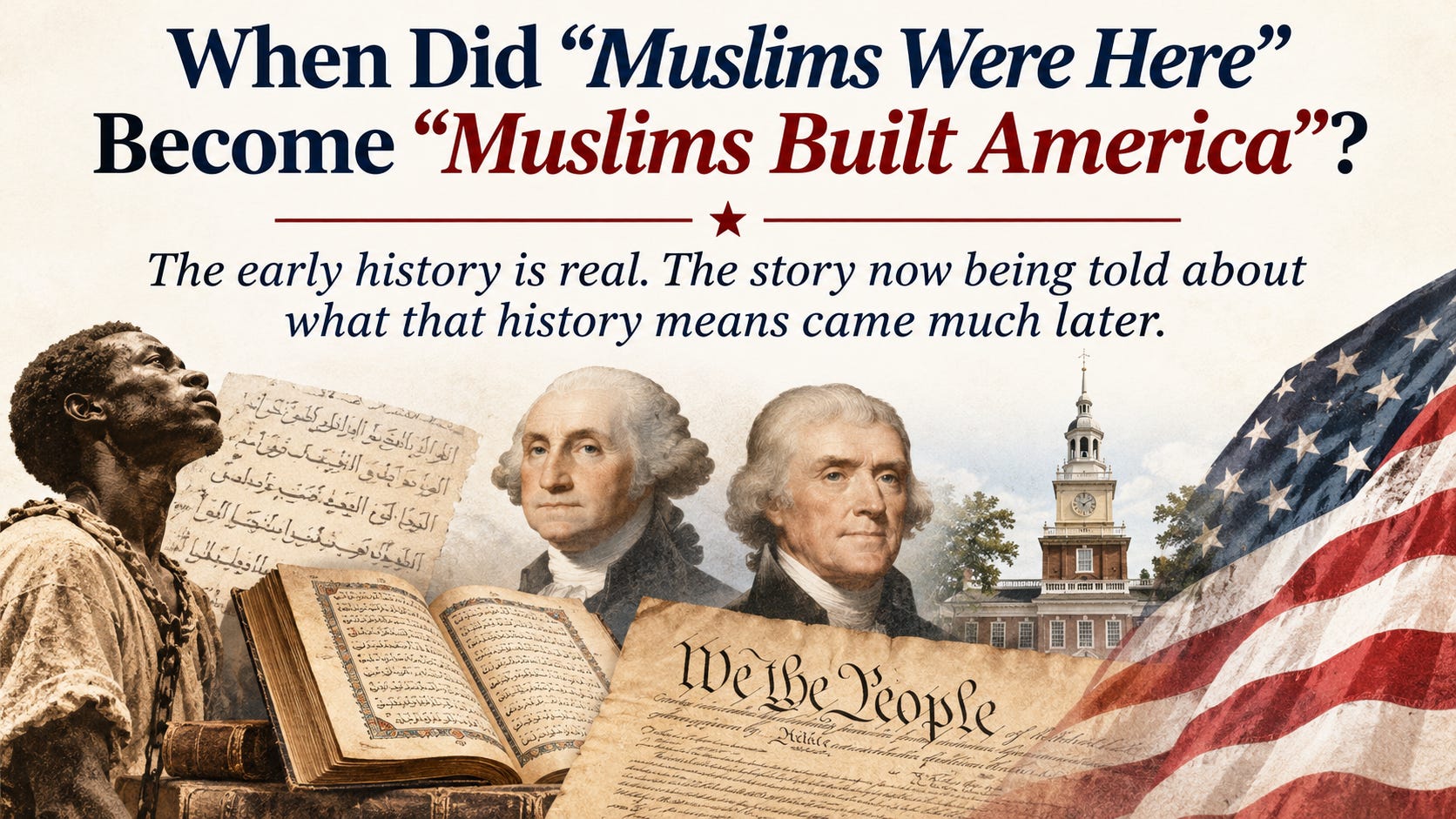
There were Muslims in early America. That isn’t in dispute.
How many? That’s much harder to figure out. Religion wasn’t routinely recorded for enslaved Africans brought to the colonies, so historians have had to piece together what they can from Arabic writing, places of origin, religious practices and the handful of people whose faith was clearly recorded. The Library of Congress has estimated that around the time of the American Revolution there may have been hundreds, perhaps thousands of Muslims living in what became the United States, overwhelmingly enslaved Africans.
For the sake of argument, give the estimate every benefit of the doubt and call it a few thousand. That establishes something…Muslims were here. It doesn’t, by itself, establish that Muslims helped found the United States, influenced the political system the Founders created, formed an organized Muslim community that continued through the generations, or played an essential role in creating the country. Contrary to what the new narrative is that is being pushed.
One of the clearest examples comes from 1734. There was a small book published in London about an African Muslim named Ayuba Suleiman Diallo, known in English as Job ben Solomon. He’d been enslaved in Maryland. He could read and write Arabic, prayed regularly, refused pork and wine, and tried to hold on to his religion while enslaved.
Nearly a century later, Omar ibn Said left his own written account. Captured in West Africa and brought to South Carolina in 1807, he wrote his autobiography in Arabic in 1831 which is in the Library of Congress. There was no need to guess whether these men were Muslim based on their names or where they’d been born, it is recorded for posterity.
There were other African Muslims in early America, although identifying them becomes harder when the evidence is thinner. Some wrote Arabic. Some were described praying or fasting. Some tried to follow Islamic dietary rules. Their stories are in the history of slavery in America.
Today, much bigger claims are being made from that history. The Smithsonian’s National Museum of African American History and Culture says African Muslims were an “integral part of creating America.” Baylor University Press describes Muslims as having played an “essential role in the creation and cultivation of the United States.” Emgage calls enslaved West Africans “The First Muslim Americans” and says they “laid a strong foundation for Islam in America.”
Somewhere between Muslims were here and Muslims were integral to creating America, the story changed.
George Washington mentioned Muslims in a letter from Mount Vernon on March 24, 1784. He needed a house joiner and bricklayer and told Tench Tilghman he didn’t particularly care where the men came from.
“If they are good workmen, they may be of Asia, Africa, or Europe. They may be Mahometans, Jews or Christian of any Sect, or they may be Athiests.”
Washington wanted good workers and from there, it didn’t matter who they were.
Thomas Jefferson included Muslims when talking about religious freedom. In his 1821 autobiography, Jefferson looked back at the Virginia Statute for Religious Freedom and recalled an attempt to insert “Jesus Christ” into the bill. Legislators rejected it. Jefferson wrote that the protection was intended to include “the Jew and the Gentile, the Christian and Mahometan, the Hindoo, and infidel of every denomination.”
Jefferson also owned George Sale’s English translation of the Qur’an, a detail that now seems to show up again and again when the early history of Islam in America is told. Fact is…Jefferson collected books on so many different topics…Christianity, Judaism, other religions, law, philosophy, government, history, languages and science. Nothing he left behind credits the Qur’an with shaping the Virginia Statute for Religious Freedom, the Declaration of Independence, or the American system of government.
Jefferson and John Adams did write about the Qur’an in 1786, but the circumstances were very different. They were in London dealing with the Barbary states and met with Tripoli’s ambassador, Sidi Haji Abdrahaman. They wanted to know why Tripoli believed it could attack nations that had done it no harm.
According to their report to John Jay, the ambassador said the claim was “founded on the Laws of their Prophet,” was “written in their Koran,” and gave them the right and duty to make war against nations that didn’t acknowledge their authority and to enslave prisoners.
The United States was also establishing diplomatic relations with Muslim-ruled countries. Morocco and the United States signed a treaty of peace and friendship in 1786. A decade later, the United States signed another treaty with Tripoli.
Article 11 of the English version of the Treaty of Tripoli declared:
“the Government of the United States of America is not, in any sense, founded on the Christian religion”
It continued by saying the United States had no hostility toward the “laws, religion or tranquility of Musselmen” and that religious differences shouldn’t interfere with peace between the two countries.
The treaty was signed in 1796 and ratified in 1797. The Constitution had been written in 1787 and ratified in 1788. Whatever Article 11 tells us about the young country’s willingness to deal peacefully with a Muslim state, it came years after the Constitution was written. It can’t be evidence that Islam helped shape the Constitution.
Muslims also appeared in the debates over religious tests. At the 1788 North Carolina ratifying convention, Henry Abbot worried that without a religious test, “pagans, deists, and Mahometans” could hold federal office. William Lancaster warned that “Papists may occupy that chair, and Mahometans may take it.” James Iredell defended the Constitution’s prohibition on religious tests.
A Muslim didn’t have to help write the Constitution to be protected by it. Neither did a Jew, Catholic or atheist. The federal government wasn’t going to make adherence to a particular religion a condition of holding office.
There are also some claims that a few Muslim soldiers fought in the American Revolution. This information gets much, MUCH murkier.
Names including Bampett Muhamed, Yusuf ben Ali and Joseph Saba appear as possible Muslim Revolutionary soldiers. Their names may point toward Muslim backgrounds…but not definitively.
Then there’s Peter Salem who is an * especially* useful example. Salem was a formerly enslaved Black soldier who fought at Bunker Hill and served in the Continental Army. His name has sometimes been used to suggest a “Muslim connection.” But a surviving church record shows that on August 16, 1760, when he was still a boy, he was admitted to the Congregational church in Framingham under its half-way covenant.
Salem Poor was another Black Revolutionary hero. His service is pretty well documented. But there is zero evidence identifying him as Muslim. Nothing about it has not been found.
None of that diminishes what these men did during the Revolution. It does mean that a Muslim-sounding name isn’t proof of a Muslim Revolutionary presence.
The letters, convention debates, congressional proceedings and writings left by the Founding generation don’t show Muslims participating in the Constitutional Convention, drafting the Declaration or Constitution, forming an identifiable Muslim political group during ratification, or providing an Islamic model of government that the Founders said they were following.
Muslims were here, and the freedoms written into the new American system covered them. It’s quite a stretch to say Muslims helped create those freedoms.