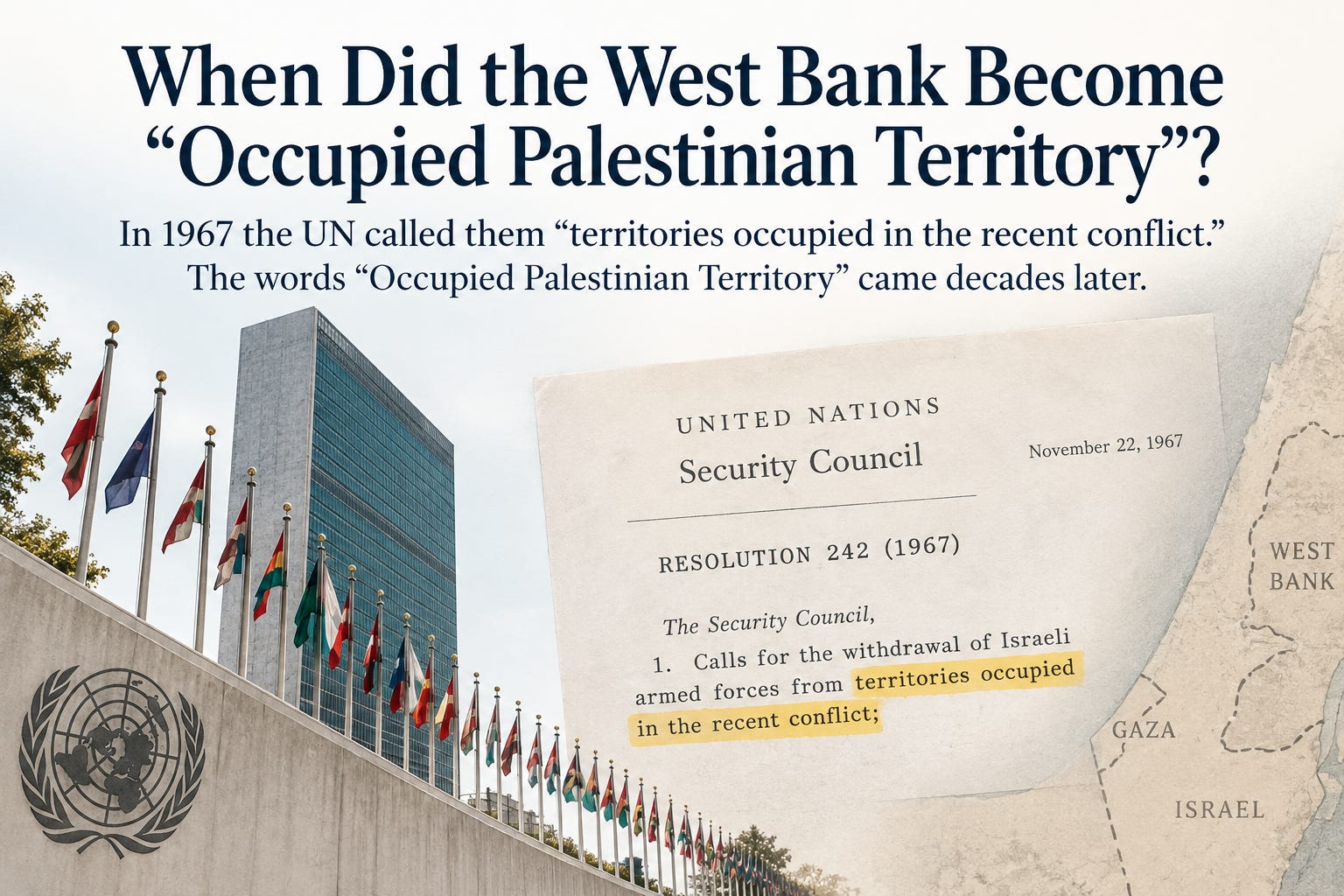
On November 22, 1967, five months after the Six-Day War, the United Nations Security Council adopted Resolution 242. Israel had captured the West Bank and East Jerusalem from Jordan, Gaza and Sinai from Egypt, and the Golan Heights from Syria. The resolution called for the withdrawal of Israeli armed forces “from territories occupied in the recent conflict.”
It didn’t call them Palestinian territories. For years afterward, UN documents used “occupied territories,” “occupied Arab territories,” and “Arab territories occupied since June 1967.” During those same years, the General Assembly increasingly recognized Palestinian national rights, and the PLO gained international standing. Eventually those two histories would collide into three words: Occupied Palestinian Territory. It took more than 20 years.
On June 4, 1967 Jordan controlled the West Bank and East Jerusalem. It had formally annexed the West Bank in 1950, although the annexation received little international recognition. Egypt administered Gaza but had never annexed it. There wasn’t any Palestinian government ruling either territory.
Israel had spent years prepping for the possibility that another war might leave its army responsible for territory beyond the armistice lines. Much of that work fell to Meir Shamgar, Israel’s Military Advocate General, the army’s senior legal officer. Shamgar had held the post since 1961 and would later serve as Israel’s attorney general and president of its Supreme Court. Before the Six-Day War, his legal corps studied the Hague Regulations and Fourth Geneva Convention. They prepared military proclamations, courts, and an administrative system Israel could use if its forces ended up controlling territory beyond the lines it had held since 1949.
That’s exactly what happened. Israel kept much of the existing local law in place after the war. Jordanian law continued in the West Bank alongside older Mandatory and Ottoman law, all subject to Israeli military orders. Gaza retained much of the legal system that had operated under Egyptian administration.
The lawyers were already arguing about what all of this meant. Jordan’s annexation of the West Bank had never won broad international recognition, while Egypt had made absolutely no sovereign claim to Gaza. In 1968 Yehuda Zvi Blum, an Israeli professor of international law who later became Israel’s ambassador to the United Nations, described the problem as the “missing reversioner.” Traditional occupation law assumed an army was temporarily controlling territory belonging to another sovereign. Blum’s question was pretty basic: what happens when the state displaced by the war didn’t have generally recognized sovereign title to the territory in the first place?
Shamgar was making a parallel argument. The territories, he argued, had a unique legal status. Israel disputed the de jure (as a matter of law) application of the Fourth Geneva Convention while agreeing to observe its humanitarian provisions. Stephen Schwebel, an American international lawyer who later served as president of the International Court of Justice, approached the issue from another angle, arguing that territory captured in a defensive war from a state that had previously seized it unlawfully couldn’t simply be treated like ordinary conquest.
There was disagreement inside Israel’s government too. Theodor Meron, the international-law specialist serving as legal adviser to Israel’s Foreign Ministry, wrote a confidential opinion in September 1967 concluding that civilian settlement in the newly controlled territories would conflict with the Fourth Geneva Convention. This was only a few months after the war. Israel’s lawyers were already fighting over what law applied and what Israel could legally do with the territory it now controlled.
Israel’s arguments about the territories’ unusual status didn’t win international acceptance. Foreign governments treated Israel as an occupying power, and Israeli courts would apply the law of belligerent occupation to the West Bank. But there was still another question sitting there: Whose sovereign territory was Israel occupying?
Go back to 1948 and things get messy pretty quickly. In November 1947 the United Nations General Assembly recommended partitioning Mandatory Palestine into a Jewish state and an Arab state, with Jerusalem under a separate international regime. Resolution 181 drew proposed boundaries for both states, but the plan never went into effect as written. The Arab side rejected partition, war followed, and no Arab Palestinian state emerged alongside Israel.
When Israel declared independence on May 14, 1948, its declaration didn’t define the new state’s borders. Eleven minutes later, President Harry Truman recognized Israel’s provisional government as the de facto authority of the new State of Israel. His recognition statement didn’t define Israel’s borders either.
Truman did support the partition boundaries as American policy. In October 1948 he said he approved Israel’s claim to the boundaries described in Resolution 181 and believed any changes should happen only with Israel’s agreement. But that wasn’t what the United States had recognized on May 14. It recognized the State of Israel, without attaching borders to that recognition.
The war produced a different map. Israel and its Arab neighbors signed armistice agreements in 1949, creating the lines that later became known as the Green Line. The agreements went out of their way to say those lines weren’t final borders. The Israel-Jordan agreement said its demarcation lines were established “without prejudice to future territorial settlements or boundary lines.” The Israel-Egypt agreement stated: its armistice line was “not to be construed in any sense as a political or territorial boundary.”
So when Israel crossed the Green Line in 1967, it crossed a line. The argument is over exactly what kind of line it crossed.
There’s another legal principle in this fight…* uti possidetis juris.* The name is a mouthful. The idea is much simpler. When a colonial territory becomes independent, its existing administrative boundaries generally become the borders of the new state. The International Court of Justice described the principle in 1986, although the doctrine itself goes back much further.
Law professors Abraham Bell and Eugene Kontorovich later applied it to Israel. Their argument is pretty straightforward: if uti possidetis juris applies to Mandatory Palestine, Israel inherited the Mandate’s boundaries when Britain left in May 1948. Follow that argument through, and the West Bank, East Jerusalem, and Gaza fall inside the territory Israel inherited. The Golan Heights doesn’t.
Article 5 of the Mandate gets much more concrete. Britain was required to prevent the ceding, leasing, or placing under the control of a foreign power of the territory of Palestine. Bell and Kontorovich use that as part of their argument that Britain was administering a territorial unit whose boundaries mattered when the Mandate ended.
David Kretzmer, professor emeritus of international law at Hebrew University, says Bell and Kontorovich are wrong. He argues that Israel’s leaders accepted partition and didn’t claim the entire territory of the Mandate when Israel declared independence. In his reading, uti possidetis juris can’t be used decades later to give Israel borders its leaders weren’t claiming in 1948.
David Kretzmer, professor emeritus of international law at Hebrew University, says Bell and Kontorovich are wrong. He argues that Israel’s leaders accepted partition and didn’t claim the entire territory of the Mandate when Israel declared independence. In his reading, uti possidetis juris can’t be used decades later to give Israel borders its leaders weren’t claiming in 1948.
So there’s a real legal fight here. Nobody has to settle it to see the problem with treating the pre-1967 map as though Israel crossed a universally accepted international border and entered the sovereign territory of an existing Palestinian state. The 1949 lines were armistice lines, and the agreements said so. Jordan controlled and later annexed the West Bank, but most of the world never recognized that annexation. Egypt administered Gaza without annexing it. No Palestinian state governed either territory.
Israel occupied territory in 1967. Whose sovereign territory was it? That question never had the simple answer the language would eventually suggest.