This week, I’m changing the channel in this space because I need a break from all things White Christian Nationalist dark-and-radicalized-heavy.
But I am also addressing several troubling trends in the lead-up to the midterms. My goal is to give more Americans discernment and resilience to navigate what’s coming.
Today, I cover a piece of what I believe to be that psy-op. It means writing about myself more than usual. If hearing about me is not your jam, here’s your ticket to move along.
It’s a good week to upgrade, because **PAID SUBSCRIBERS are welcome to a special Substack LIVE chat with ME. TOMORROW. 2 September 2026. Noon eastern. **These events are a way to thank you for supporting this work by giving you a special piece of my day. Click the button below and upgrade to paid to join.
You understand para-social connections, right? You feel like you know a celebrity personally because you love their movies. You connect with a politician on a screen and want to have a beer with her. You pick your information sources and are fiercely loyal because, gosh-darn-it, you like them.
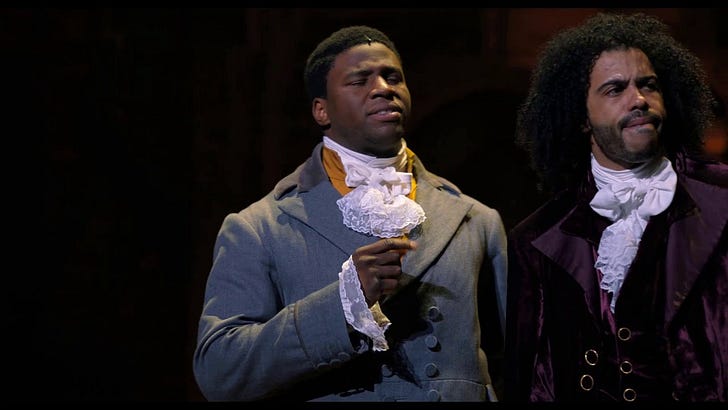
Lin-Manuel Miranda wrote about this phenomenon in the song The Election of 1800 from the Tony-award-winning musical Hamilton.
For almost everyone here, your connection TO ME is para-social. Very few of you know me in real life. I might have thirty or forty subscribers who’ve spent time with me one-on-one.
I like this person in a para-social way often translates to *this person is a credible source of information. *Conversely, I don’t like this person in a para-social way becomes this person isn’t credible and it’s okay to personally attack them.
This classification system isn’t very sophisticated. It works the same way for most people. Let’s look at some ways this system has applied to me over the course of my writing career.
I can’t stand her nasally voice. She doesn’t sound credible.
I listen to her because she reads all of her own stuff in her own voice. It adds authenticity to her work.
Her southern accent is the sound of racism. I can’t hear it without thinking she’s a big old racist.
I love how passionate she is about her subject. I think it’s admirable.
She’s too passionate. She gets scary and intimidating when she gets worked up, and it turns me off.
Women shouldn’t be allowed to talk on the internet. Or anywhere. This woman (expletives deleted) is an example as to why.
I love how brave she is to share the things she’s sharing. It must be tough to relive so many abominable experiences to educate others.
My fourth grade English students are better writers than she is.
I keep coming back because of the quality of her writing. Her voice is unique, and I relate to her because of it.
She’s an overweight woman who exaggerates. Nobody should listen to her.
I love to watch Unholy Ground because she and Sam are hot.
I knew her twenty years ago and haven’t seen her since, but she’s an awful person in real life.
We grew up together. I haven’t seen her in decades, but I know she’s telling the truth.
She talks about herself too much. Why does she have to make everything about herself to write?
She doesn’t talk about herself enough, so I feel like I really don’t know her and can’t connect with her.
She does too many videos, and in too many of them, she looks like she was rode hard and put up wet. She should care more about her appearance.
I like how down-to-earth and natural she is in her videos. I relate to how someone could be too busy to brush her hair before a live show.
She claims to have had all these experiences, but she doesn’t have any verifiable expertise. Like trad-published books on her subject or academic pedigrees or someone I respect telling me to listen to her.
She worked hard enough to get her memoir on the NYT bestseller list without an agent or a traditional publisher. That kind of work ethic means more to me than academic books or graduate degrees.
NOTE: I have paraphrased and combined some of the above statements, but they all represent real things people have said about me.
Which is the point of today’s piece.
I believe a current psy-op in the lead-up to the midterms revolves around getting Substackers to personally attack and demean each others’ work. The drama this creates diminishes the VALUE OF SUBSTACK’S INDEPENDENT VOICES, especially for those of us with smaller platforms.
The goal of such a psy-op would be to frustrate users enough to stop coming here, prioritize corporate media over independent media, and/or choose to follow only famous names because a purple checkmark might mean less drama.
Everything above further diminishes smaller voices, many of whom are providing vital information in the lead-up to the midterms.
Here’s one example from the past week:
A group of Substackers with opaque ties to PAC monies attack another writer.
That Substacker writes a researched attack on a member of that group.
Multiple Substackers pick sides and write missives to praise or diss one or more of those involved.
In comments, other Substackers are named. If they’re young/white/reasonably attractive men, some women fall all over themselves to defend these men from attacks because for some reason they just like these men so freaking much.
SO MUCH DRAMA ensues. I feel like asking so many of these people what grade we are in, because the energy feels like junior high school. (And I especially hated junior high school.)
Users get fed up and assign this entire episode to everyone below a certain level on Substack, and they look elsewhere for information.
I don’t want to lose anyone, but I don’t want readers who are only here for some mystical para-social connection. I want you to be here because - whether you like me or not - you believe I provide valuable, necessary information.
We don’t have to like the people who educate and inform us. We don’t need to feel a cosmic connection through a screen or a set of earbuds. Often, we’re not going to feel warm-and-fuzzy about people who tell us not what we want to hear but WHAT WE NEED TO HEAR.
Please keep this newsletter in mind as you consume online information in any space. Personal attacks and para-social spats are designed to draw your attention away from the information you should be absorbing, whether they’re happening intentionally or organically.
Help more people grasp what they’re seeing online. Share this newsletter with your connections by clicking the button below.