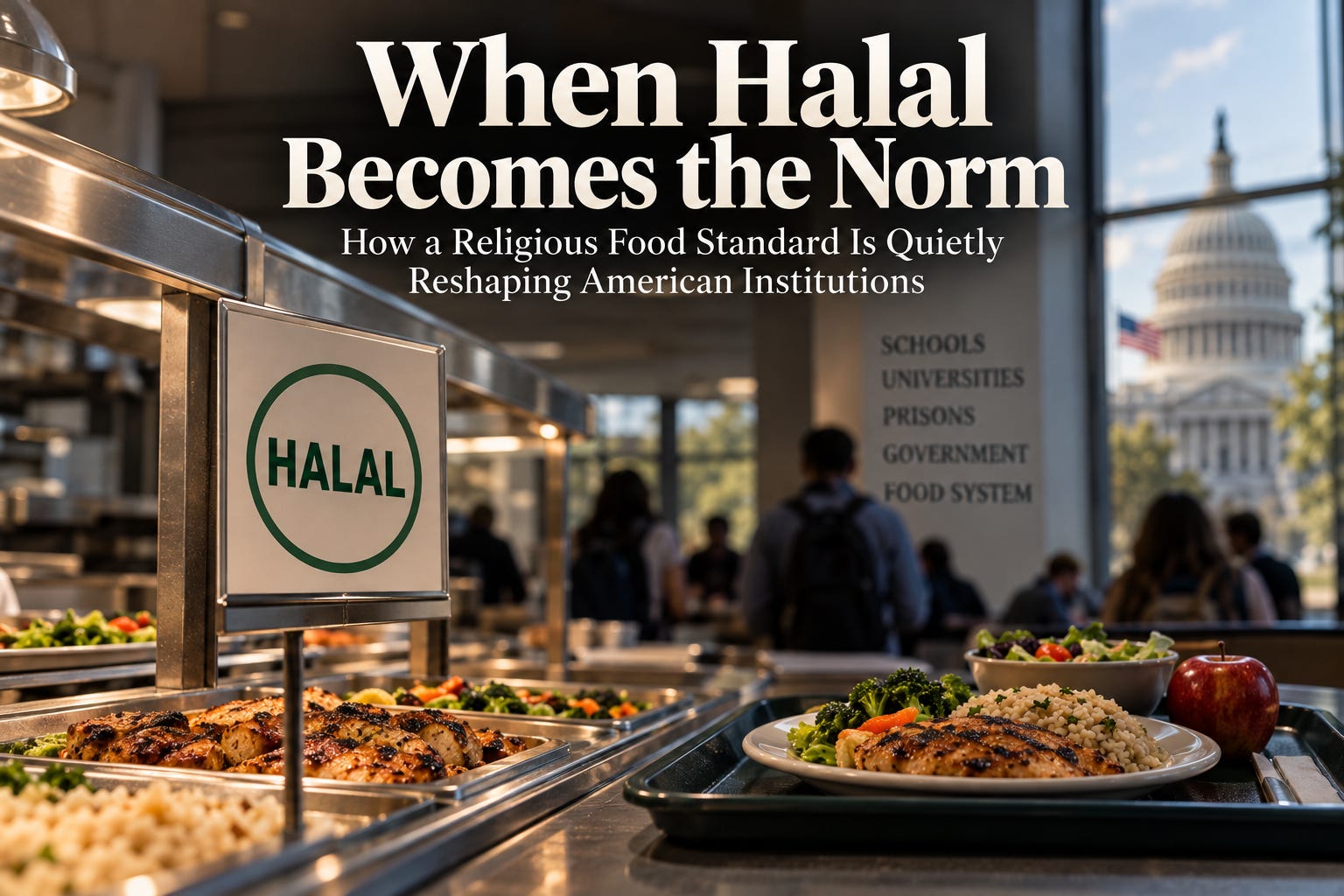
Walk into a George Washington University dining hall and order chicken. You don’t have to be Muslim or request a religious meal. The university says 100 percent of its non-precooked chicken across campus is halal-certified. At Smith College, all fresh chicken served in its dining rooms is halal with limited exceptions for tenders and nuggets. Washington State University expanded its halal chicken offerings in 2026, including chicken breasts and thighs used in soups, salads, and other dishes throughout the academic year.
Muslims make up 1.2 percent of American adults, according to Pew Research Center’s latest Religious Landscape Study. Christians make up 62 percent, while 1.7 percent identify as Jewish by religion. Muslims aren’t even a little close to being a majority of the country. Yet meat prepared according to Islamic dietary requirements is being purchased and served throughout American institutions to people who never requested it.
Making sure a Muslim student has something he or she can eat is a religious accommodation. Buying halal meat for an entire dining operation goes much further. The Christian student didn’t request it. The Jewish student didn’t request it. The atheist didn’t request it. They don’t have to know anything about halal because the decision was made before they reached the cafeteria.
What looks like a change to a lunch menu reaches backward through purchasing departments, distributors, processors, slaughterhouses, suppliers, and religious certifiers.
Halal didn’t begin in American public schools, college dining halls, or hospital cafeterias. For much of the country’s history, Americans who kept halal relied on Muslim butchers, specialty stores, or products they knew met Islamic dietary rules.
The American Muslim population grew after the Immigration and Nationality Act of 1965 changed the country’s immigration system. More Muslim Americans meant more demand for food that met Islamic requirements, but industrial food presented a problem. A consumer looking at chicken, gelatin, enzymes, flavorings, cheese, or processed foods often had no simple way of knowing whether the product met those requirements.
Certification provided an answer. In 1980, Muslim scholars, scientists, and food-industry executives met to create an organization that could help American Muslims identify halal products. They published their first halal food and nutrition newsletter in 1981. In 1982, the Islamic Food and Nutrition Council of America, better known as IFANCA, incorporated in Illinois.
Certification changed what was possible. Ingredients could be reviewed, manufacturing plants inspected, slaughter and processing procedures approved, and products certified through national and international supply chains.
Exports gave American companies another reason to build that capacity. Muslim-majority countries represent valuable markets for American meat, and many impose halal requirements on imports. A processor didn’t need a large Muslim population surrounding its American plant to benefit financially from halal production. Certification could open overseas markets containing millions of consumers.
By the time halal began appearing more frequently in American schools, universities, hospitals, prisons, restaurants, and corporate cafeterias, much of the machinery was already there. Slaughterhouses knew how to produce for halal markets. Certifiers could approve them. Processors made halal products. Distributors could move them around the country.
The way Americans eat helped bring that system into everyday life. More than half of American food spending is now on food away from home. Schools, universities, restaurants, hospitals, hotels, corporate cafeterias, and other institutions control a tremendous amount of what Americans eat.
A person standing in a supermarket chooses the package. A student eating in a dining hall usually doesn’t choose the supplier. Neither does a hospital patient or a child eating a school lunch.
CAIR’s involvement becomes more significant when the food campaigns are viewed alongside the rest of its institutional work.