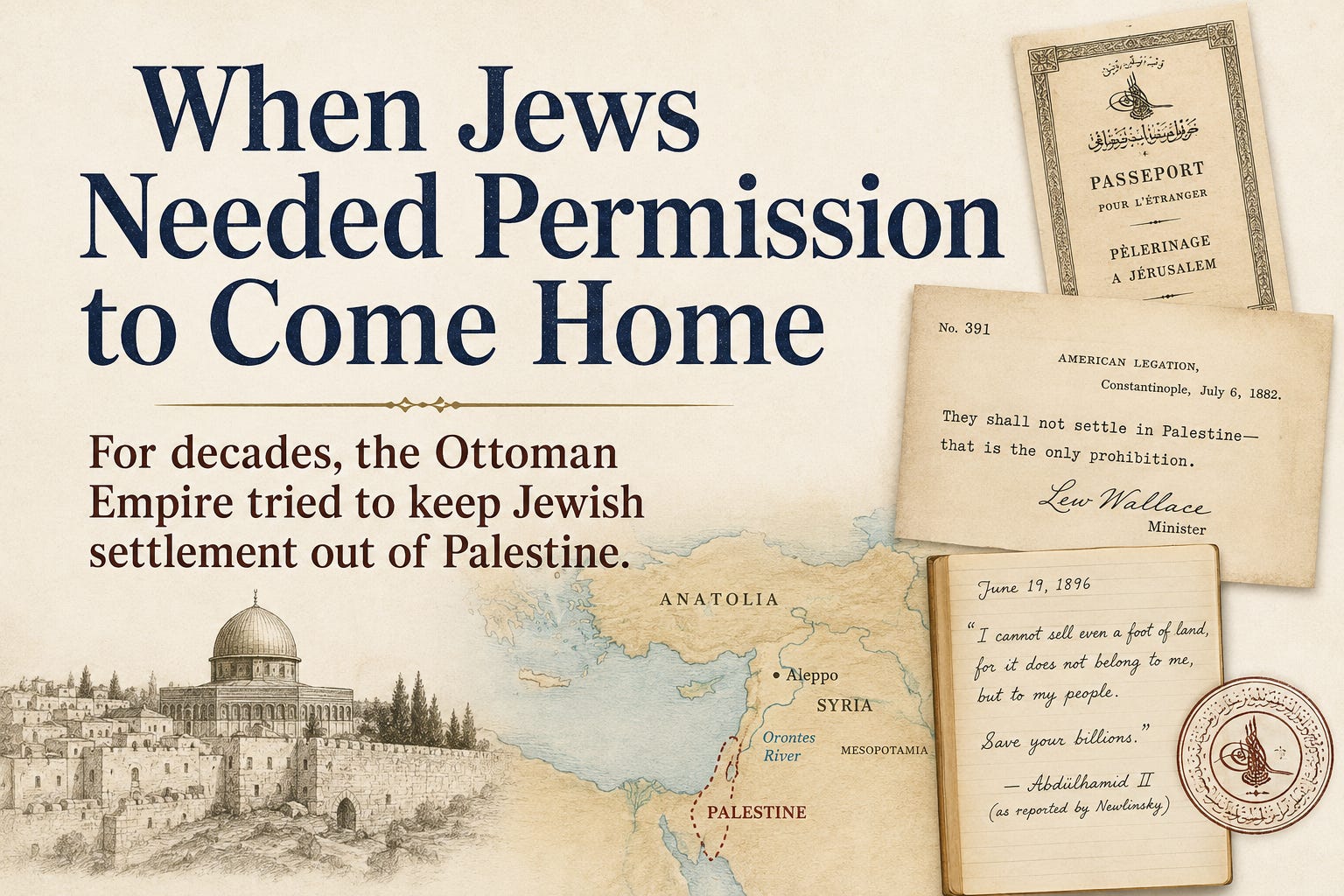
In the summer of 1882, Jewish refugees fleeing persecution in Russia and Romania were looking for somewhere to go. Some had made it as far as Constantinople, where reports described refugees struggling to survive. A British writer and political adventurer named Laurence Oliphant brought their situation to Lew Wallace, the American minister to the Ottoman Empire. Yes, Ben-Hur Lew Wallace.
Wallace agreed to help. Two Jewish representatives came to the American legation on behalf of 49 committees in Romania, seeking permission for Jewish refugees to establish agricultural communities within the Ottoman Empire. Oliphant and another intermediary would organize the settlement if Wallace could persuade the Ottoman government to accept them.
The answer Wallace received is preserved in the U.S. diplomatic files. Jewish refugees could come to the Ottoman Empire and settle on available land around Aleppo, in Mesopotamia and along the Orontes River. They could establish communities of two hundred or two hundred fifty families, but they needed to become Ottoman subjects and live under Ottoman law. The Ottoman immigration law even offered government land and temporary tax exemptions to qualifying colonists.
Palestine was excluded.
Wallace reported the answer to Washington:
“They shall not settle in Palestine—that is the only prohibition.”
This was 1882. Theodor Herzl wouldn’t publish Der Judenstaat for another fourteen years, and the first Zionist Congress wouldn’t meet until 1897. The Ottoman government was already dealing with Jews who wanted to settle in Palestine and was already directing them somewhere else.
Over the next twenty years, that policy worked its way into ports and passport offices, land registries and consulates. American and European diplomats protested it. Ottoman officials complained that Jews kept finding ways around it. People entered as pilgrims and stayed, while others managed to buy property despite attempts to stop them. By the time Herzl arrived in Constantinople hoping to negotiate with Sultan Abdülhamid II, the fight over Jewish settlement had been going on for years.
Jewish life in Ottoman Palestine didn’t begin with the refugees of 1882. Jews had lived in Jerusalem, Safed, Tiberias and other communities for centuries, part of a Jewish presence in the land that had survived every change of ruler since antiquity.
For much of Ottoman history, Jews and Christians had lived under the dhimmi system. A dhimmi was a protected non-Muslim living under Islamic rule. Jewish communities could practice Judaism and maintain communal institutions, but Muslims held the higher legal status. Non-Muslims historically paid the jizya, a special tax, and faced other restrictions that varied by time and place.
The Ottoman reforms of the nineteenth century changed that legal structure. The Reform Edict of 1856 promised greater equality between Muslim and non-Muslim subjects, and the Ottoman nationality law of 1869 moved further toward a common Ottoman citizenship. By the time the refugees in this story began arriving, the empire had formally moved away from much of the older dhimmi system.
Changing the law didn’t erase centuries of social hierarchy. The nineteenth-century Ottoman world still produced anti-Jewish discrimination, blood libels and outbreaks of violence, even as Jewish communities continued building businesses, schools, synagogues and communal institutions throughout the empire.
That was the world into which the Ottoman government was offering to settle new Jewish refugees while trying to keep them from settling in Palestine.
A popular version of this history proclaims Jews and Arabs lived peacefully together for centuries until Zionism arrived and destroyed the relationship. The nineteenth-century record tells a very different story.
In 1834, decades before Herzl was born, the Jewish community of Safed was attacked during the Peasants’ Revolt. Jewish homes and synagogues were plundered, property was destroyed, and Jews fled or hid while the violence continued. Six years later, the Damascus Affair began with the disappearance of a Christian monk and his servant. Jews were accused of ritual murder, suspects were imprisoned and tortured, and the blood libel became an international crisis.
Aleppo belongs in this history because it was one of the places Ottoman officials offered the Jewish refugees in 1882. Only seven years earlier, in 1875, Aleppo’s Jewish community had faced another blood libel after an Armenian boy disappeared. The accusation collapsed when the boy was found alive.
Religious hostility in the region didn’t come only from Muslims. In 1888, Oscar Straus, the Jewish American minister to the Ottoman Empire, reported a conversation with the Ottoman Grand Vizier about Jerusalem. The Grand Vizier described Easter as a period when tensions could become so dangerous that Jews sometimes remained inside their homes out of fear that Christians might:
“attack them and perhaps murder them.”
Long periods of ordinary coexistence were also part of Jewish life under Muslim rule. Jewish communities traded with their neighbors, built institutions and created rich religious and intellectual cultures across the Ottoman world. Peaceful periods existed alongside legal inequality, discrimination and episodes of persecution. Zionism didn’t create that history, and Herzl certainly didn’t create it.
The refugees of 1882 were escaping persecution in Europe, and the Ottoman government was willing to settle them in groups of hundreds of families around Aleppo, in Mesopotamia and along the Orontes. The empire’s immigration law offered qualifying colonists land and years of exemption from taxes and military service. They could build villages and agricultural communities there.
The government wasn’t telling Jews they couldn’t live in the Middle East. It was willing to help them establish new communities there.
Palestine was the exception.
Jewish immigration into Palestine continued despite the restrictions, and Ottoman officials were trying to stop organized groups of foreign Jews from turning entry into permanent settlement.
The rules became especially visible in 1888. Ottoman instructions targeted Jews arriving to emigrate and settle in groups, while Jewish travelers could still enter Palestine temporarily. Their passports needed to identify a visit to Jerusalem as:
“in the performance of a pilgrimage”
rather than for business or permanent residence. The permitted stay, which had previously been one month, was extended to three. Once they arrived, visitors received Ottoman papers carrying the same time limit.
The scope of the policy became the subject of diplomatic argument that year. In October, the Ottoman government clarified that the prohibition applied to Jews “emigrating in a body,” rather than imposing a categorical ban on every individual Jew entering Palestine. The distinction didn’t alter the government’s broader policy: organized Jewish immigration and permanent settlement in Palestine were what Constantinople sought to prevent.
The United States refused to cooperate with a passport system that treated American citizens differently because they were Jewish. Oscar Straus protested directly to the Ottoman government.
He reported that the restrictions were being enforced in Palestine and at ports along the Syrian coast. Jewish arrivals could be made to provide security guaranteeing that they’d leave when their three months were up. Those who couldn’t provide it, Straus wrote:
“are thrown into prison.”
Straus called the policy an “objectionable and arbitrary discrimination against certain of our citizens.” Britain and France protested too, arguing that their Jewish citizens had treaty rights that couldn’t disappear because of their religion.
The Ottoman restrictions were only part of the story. After the empire collapsed, the fight shifted from restricting Jewish settlement to opposing Jewish sovereignty. The Fight Against a Jewish State Started in 1919, Not 1948 follows that next chapter.