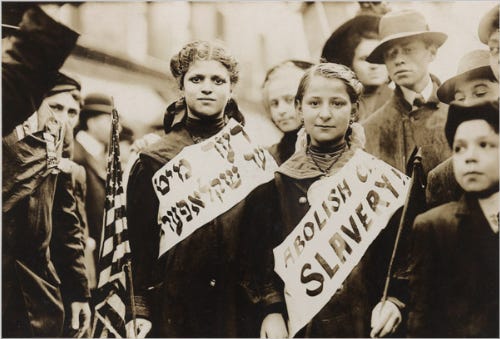
On the evening of November 22, 1909, thousands of garment workers packed the Great Hall at Cooper Union in New York City. They had come to talk about conditions in the city’s shirtwaist factories where young women worked long hours for low wages in crowded shops under bosses who controlled nearly every minute of the day.
The speeches went on for hours. Samuel Gompers, president of the American Federation of Labor, spoke. Other labor leaders followed. The workers listened until 23-year-old Clara Lemlich decided she’d heard enough.
Lemlich was a Jewish immigrant who had arrived in New York with her family five years earlier after leaving the Russian Empire, where Jews faced pogroms and legal persecution. She worked in the garment trade and had become an organizer with Local 25 of the International Ladies’ Garment Workers’ Union. Her union work had already cost her. Police had arrested her during strikes, and hired men had beaten her badly enough to break several ribs.
That night, Lemlich made her way to the platform and spoke to the crowd in Yiddish.
“I am a working girl, one of those who are on strike against intolerable conditions,” she told them.
She said she’d listened to the speakers and had no patience left for more talk. She wanted the workers to vote on a general strike. They did.
The crowd raised their hands and swore an old Jewish oath of solidarity. By the following morning, thousands of shirtwaist makers had left their machines and joined the strike that became known as the Uprising of the 20,000.
One of the largest strikes by women in American history had begun with a 23-year-old Jewish immigrant speaking Yiddish.
By the time Lemlich stood up at Cooper Union, New York’s garment industry and its Jewish immigrant population had become deeply intertwined.
Beginning in the 1880s, waves of Jewish immigrants reached the United States as pogroms, persecution and poverty drove families out of the Russian Empire and other parts of Eastern Europe. New York’s Lower East Side became home to one of the largest Jewish communities in the world, and newcomers who needed wages quickly found an industry hungry for workers.
Many went into the garment trade.
Jewish immigrants cut cloth, sewed seams, pressed garments, made buttonholes and produced clothing for a growing American market. Some worked in factories. Others worked in tenement apartments and small shops under what people of the time called the “sweating system,” the origin of the word sweatshop.
The name wasn’t an exaggeration. Workers spent long days in cramped rooms with poor ventilation and few protections against fire. Employers could charge workers for supplies they needed to do their jobs. Supervisors controlled bathroom breaks. A lost job could put an immigrant family that lived week to week in immediate trouble.
Women made up the lowest-paid end of much of the industry. Many were teenagers or in their early twenties, and employers could pay them less than men doing similar work.
So they organized.
The International Ladies’ Garment Workers’ Union had been founded in New York in 1900. Jewish immigrants became a large part of its membership and of the garment labor movement growing throughout the city.
Much of that organizing happened in Yiddish. Union meetings, speeches and debates took place in the language many of the workers spoke at home. Socialist and labor politics filled the Yiddish press. The Forverts, or Jewish Daily Forward, founded in New York in 1897, became part newspaper, part advice desk and part guide to life in a country its readers were still learning how to navigate.
Arguments over wages, hours, strikes and unions weren’t political theory to the people reading those pages. They determined what happened at work the next morning and how much money came home at the end of the week.
The shirtwaist makers who walked out in November 1909 had plenty to lose. The strike eventually involved tens of thousands of workers at hundreds of garment factories, and many of those on the picket lines were young Jewish women.
Factory owners fought them with the tools available to employers at the time. Police arrested picketers. Judges fined strikers. Employers hired replacement workers, private guards and men who harassed and assaulted women on the lines. Families that depended on every paycheck watched weeks pass without one.
The strike continued into February 1910. It didn’t produce everything the workers had demanded, and some companies refused to sign union agreements, but many employers accepted shorter hours, higher wages and other concessions.
It also settled an argument that had followed women into the labor movement. Some union leaders had doubted that young immigrant women could organize large numbers of workers or hold a strike together long enough to force employers to negotiate.
They had their answer.
Five months later, tens of thousands of cloakmakers, many of them Jewish men, walked off their jobs during the Great Revolt of 1910. The garment unions were growing, and Jewish workers had become central to organized labor in New York.
One of the companies that resisted the union was the Triangle Shirtwaist Company.
Triangle occupied the eighth, ninth and tenth floors of the Asch Building near Washington Square. Its workers had participated in the 1909 strike, but owners Max Blanck and Isaac Harris resisted the union’s demands.
On Saturday afternoon, March 25, 1911, fire broke out inside the factory. Fabric scraps, paper patterns and other combustible material helped the flames spread through the workrooms while employees rushed toward the exits.
Some escaped by elevator while others reached the roof. Many couldn’t get out.
One exit door was locked. The exterior fire escape collapsed under the weight of fleeing workers, and fire department ladders couldn’t reach the upper floors. People in the street watched workers appear at the windows as smoke and flames closed in behind them. Some jumped rather than burn.
The fire killed 146 people.
Most were young immigrant women and girls. Many were Jewish; many others were Italian immigrants. Some victims were only 14 years old.
The dead came home to the same neighborhoods that supplied New York’s garment factories with workers. Families went looking for daughters, sisters and wives who hadn’t returned after their Saturday shift, while organizers who had spent years warning about factory conditions faced exactly the kind of disaster they had feared.
Eight days after the fire, thousands gathered for a memorial meeting at the Metropolitan Opera House. Rose Schneiderman, another Jewish immigrant garment worker and labor organizer, stood before them.
Schneiderman had been born in Poland and came to New York with her family as a child. After her father died, she left school and went to work to help support the family. She eventually entered the garment trade, joined the labor movement and became an organizer for working women.
At the memorial, she refused to offer comfort where she believed anger belonged.
“I would be a traitor to these poor burned bodies if I came here to talk good fellowship,” she told the audience.
Then she turned directly on the people who had watched workers plead for better conditions before the fire.
“We have tried you good people of the public and we have found you wanting.”
Workers had warned people about unsafe conditions, she said. Women had already been injured and killed. Organizers had asked for help, gone on strike and been arrested for doing it.
Now 146 people were dead.
Frances Perkins, a young social reformer who had witnessed the Triangle fire, was among the people listening to Schneiderman. Perkins would spend much of her career working on labor reform, and more than two decades later Franklin Roosevelt appointed her secretary of labor, making her the first woman to serve in a presidential Cabinet.
New York lawmakers faced pressure to act as well. The state created the Factory Investigating Commission, whose members and investigators examined fire hazards, sanitation, ventilation, working hours and conditions inside factories. Their work helped produce dozens of new workplace laws.
The politicians hadn’t discovered dangerous factories after Triangle. Garment workers had been describing them for years. After 146 deaths in the middle of Manhattan, ignoring them became considerably harder.
Clara Lemlich and Rose Schneiderman belonged to a much larger Jewish labor story.
Samuel Gompers was born into a Jewish family in London in 1850 and began making cigars alongside his father as a boy. His family immigrated to New York in 1863, where Gompers entered the labor movement and eventually helped found the American Federation of Labor. In 1886, he became its first president and would lead it for most of the next four decades.
Jewish workers organized far beyond the women’s garment factories. Bakers, painters, furriers, barbers, shoemakers, waiters, typesetters, bookbinders, laundry workers, carpenters, plumbers, metalworkers and drivers formed and joined unions. They raised strike funds, built mutual-aid organizations, published newspapers and debated what workers should demand and how far the labor movement should go.
There was plenty of disagreement. Gompers clashed with socialist labor organizers over ideology and strategy. Jewish employers sometimes sat across the bargaining table from Jewish workers. Max Blanck and Isaac Harris, the owners of the Triangle Shirtwaist Company, were Jewish immigrants themselves.
Jewish labor history was never a simple story of a community moving together in one political direction. It was the story of immigrants arguing over what work, citizenship, capitalism, socialism, unions and opportunity should mean in their new country.
The Forverts covered labor so heavily because its readers lived in that world. At its height, it became the largest Yiddish newspaper in the world and one of the most widely read non-English newspapers in the United States. Its pages carried news, politics, literature and advice alongside the daily problems of immigrants learning their way around America.
Work was part of that adjustment. So were unions. And both became part of the story of American Jews.
Labor Day has changed considerably since those years. For most Americans now, it’s a long weekend marking the unofficial end of summer, filled with barbecues, sales and one last Monday away from work.
For generations of American Jews, labor had a much more literal meaning. Their grandparents and great-grandparents sat behind sewing machines, rolled cigars, pressed coats, baked bread, cut cloth and carried home wages that often had to support an entire family. Some of them organized because work consumed most of their waking hours and because missing even one paycheck could mean falling behind on rent or food.
The people who fought those battles didn’t arrive in America with much power. Many were young immigrants earning a few dollars a week in factories where even a locked door could become a death sentence. They organized anyway, and their fights over hours, wages and workplace safety helped change what Americans could demand of an employer.
Tomorrow, most of us won’t go to work. Somewhere in the history of that day off are Jewish garment workers who once had to fight for something as basic as the right to leave work alive.
As an Amazon Associate, I earn from qualifying purchases. This doesn't affect the price you pay.
Annelise Orleck, Common Sense and a Little Fire: Women and Working-Class Politics in the United States, 1900–1965
David von Drehle, Triangle: The Fire That Changed America
Leon Stein, The Triangle Fire
https://trianglefire.ilr.cornell.edu/primary
https://trianglefire.ilr.cornell.edu/primary/letters
https://aish.com/jews-the-shmatte-business
https://www.myjewishlearning.com/article/the-international-ladies-garment-workers-union-strike
https://www.myjewishlearning.com/article/jewish-workers-and-trade-unions
https://forward.com/culture/427480/clara-lemlich-union-labor-garment-strike-1910-triangle-fire-remembered