We are afraid of the wrong thing. We are afraid of the shock — the disruption, the lost trade, the machine that does our work, the intelligence that does our thinking. But the record says the shock was never the thing that broke us. What broke us, every time, was meeting the shock with the old answer and then blaming the shock for the failure.
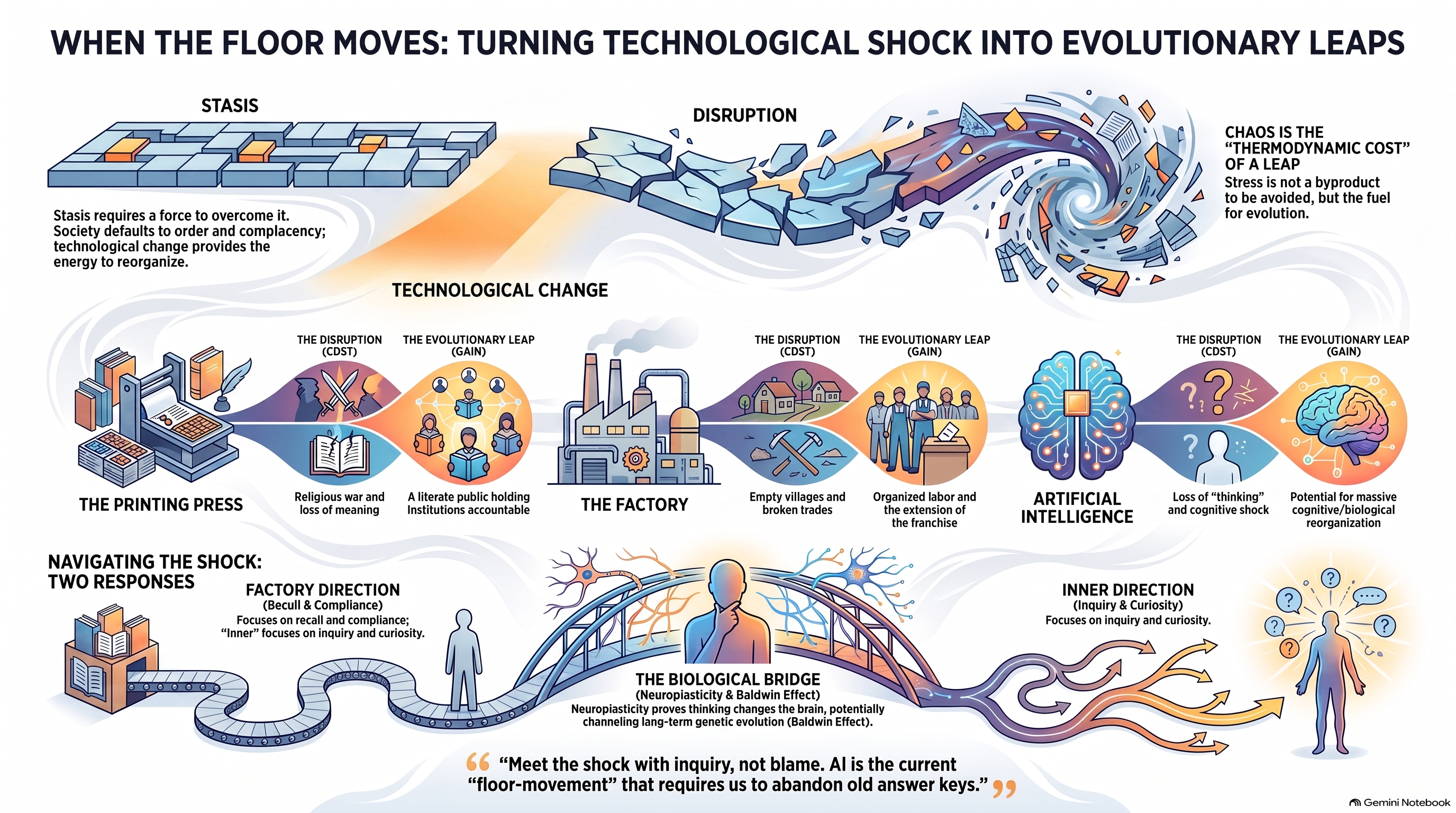
Read the history backward and a second current appears beneath the well-known wreckage. The printing press shattered the Church’s hold on meaning and lit a century of religious war — and within a few generations produced a literate public that could hold an institution accountable to its own texts. The factory emptied the villages, broke the trades, and also produced a working class that learned to organize, negotiate, and extend the franchise. The chaos is the cost. The leap, when it comes, is what the chaos bought. We know the cost by heart. We almost never ask what it bought.
This essay is a citizen-scientist’s proposal to read that quieter current as a pattern: long runs of order and complacency interrupted by shorter bursts of technological change that drive large leaps in cognitive and cultural evolution — and, speculatively, in biology. Artificial intelligence is the current burst. The question is not whether the floor is moving. It is whether this society will let the energy do its evolutionary work, or burn it in blame.
-
Why upheaval produces leaps rather than wreckage — the thermodynamics of cultural change
-
The contested bridge — from neuroplasticity to heritable biology
-
The one thing we never get better at — why each shock arrives fresh
4.** Factory direction or inner direction** — two responses when the floor moves
-
**The proposal **— an evolutionary map laid over the history of invention
-
What I am claiming, and what I am not — status labels and a falsifier
Evolutionary change of any kind requires a force strong enough to overcome stasis. In the biological record this is the lesson of punctuated equilibrium — the observation, due to Eldredge and Gould, that species sit in long stable runs and then change, branch, or disappear in comparatively short bursts. Stasis is the default; change wants an energetic reason.
In culture, the energetic reason is exactly what a new technology supplies: a pressure that makes the inherited answer stop working, that rewards whoever can think differently and punishes whoever cannot. Stress and chaos are not, on this reading, mere byproducts to be regretted. They are the thermodynamic cost of the leap — the energy that has to enter the system to push it out of its stable basin. A society in perfect equilibrium has no reason to reorganize its mind.
Here is the difficult step, and I mark it as such.
Neuroplasticity is real and established: changes in thinking and behavior demonstrably reshape the brain. Literacy rewires the visual word-form area; navigation reshapes the hippocampus; the demands of a new tool reorganize the circuits that serve it. The brain is not fixed hardware; it is shaped by what a culture asks it to do.
The bridge that remains open — and must not be crossed carelessly — is whether a lifetime of plasticity-driven change reaches the germline and helps drive long-term biological evolution. There is a respectable name for one possible route: the Baldwin effect, the proposal that learned behaviors, by changing the selective landscape, can channel later genetic evolution without requiring traits to be inherited directly. There is also the contested suggestion that human biological change has accelerated in recent millennia, with agriculture and settlement reshaping selection pressures. Neither mechanism is settled science. What we have is a hint: plasticity proves that thinking changes the brain, and that is enough to keep the larger question open without pretending it is answered.
Perhaps the most striking feature of the pattern is that we never get used to it. Our history is punctuated by these bursts of rapid technological change, and we are no better prepared to meet the next one than we were to meet the last. The shock arrives fresh every time — the fear, the scapegoating, the demand for someone to blame, the paralysis alternating with euphoria. It is the same posture, century after century.
What we might learn is not to be less afraid but to be less directed by the fear. The difference between an upheaval that produces a cognitive leap and one that produces only wreckage is not the size of the shock. It is the specification a society brings to it.
When the floor moves, two responses are always on offer. One is factory direction: retreat to the answer key, score recall and compliance, train people to pass a fixed test in a world the test no longer describes. The other is inner direction: the capacity to state, unprompted, what would change your mind, to hold a question open inside the chaos, to convert stress into inquiry rather than into verdict.
Artificial intelligence is the current perturbation — a large one, arriving fast — and the same old posture is already forming around it. The question is not whether the shock will come; it has. The question is whether this society will meet it with the answer key or with genuine inquiry, and whether it will let the energy do its evolutionary work or burn it in blame. Nothing is assured about the outcome. The leap is possible, never guaranteed.
**What I am proposing is a way of seeing. Read human evolution as long periods of order and complacency interrupted by shorter periods of technological progress that drive large leaps in cognitive and cultural evolution — and, speculatively, in biology. Then overlay the successive advances of science and invention onto that pattern of cognitive and cultural change. When the two are laid over one another, a significant evolutionary map appears: the bursts of invention line up with the bursts of cognitive reorganization, and the long quiet runs line up with the long stable basins.
The map is not a prediction and not a destiny. It is a directional reading — the same status I hold for the mathematical models elsewhere on this site, which show how fast a turn could happen and never that it will. After a long enough run of this pattern, nothing serves alone — but seeing the pattern clearly is the beginning of meeting the next floor-movement with inquiry rather than panic.
Status. The disruption caused by major new technologies is Established as a historical pattern. The acceleration of cultural evolution during such periods is Asserted — a defensible reading of the record, not yet a quantified law. The transfer of the stasis-and-leap shape from paleontology to culture is Analogical, borrowing the shape not the substrate. The claim that technology-driven cultural change feeds back into biological evolution is Speculative, with the Baldwin effect and the recent-acceleration hypothesis as named candidate mechanisms, none of them settled. The evolutionary-map proposal is a directional reading, not a prediction.
The cultural claim is falsified if, across a representative set of major technological transitions, the post-transition period shows no measurable acceleration of cognitive or cultural reorganization relative to the calm runs before them — that is, if the leaps turn out to be noise rather than a pattern. The biological claim is sharper and harder: it is falsified (or decisively weakened) if, once confounds of population growth and diet are controlled, no population-level signal of selection correlated with the cognitive demands of a new technology can be detected on the relevant timescale — meaning the plasticity that reshapes the brain never reaches a heritable channel. The map proposal itself survives only so long as the overlay of invention and cognitive change keeps lining up; if the two series diverge for a sustained stretch, the map is not a map and the proposal is withdrawn.
I hold the biological claim under a status label deliberately. Evolution answers no one’s hopes on a schedule. To declare what evolution is destined to make of us is the ordination fallacy, and it loses the argument the moment it is spoken.
The full essay, with the complete argument and the named falsifiers, is here:
Human Evolution and Technology — the full essay