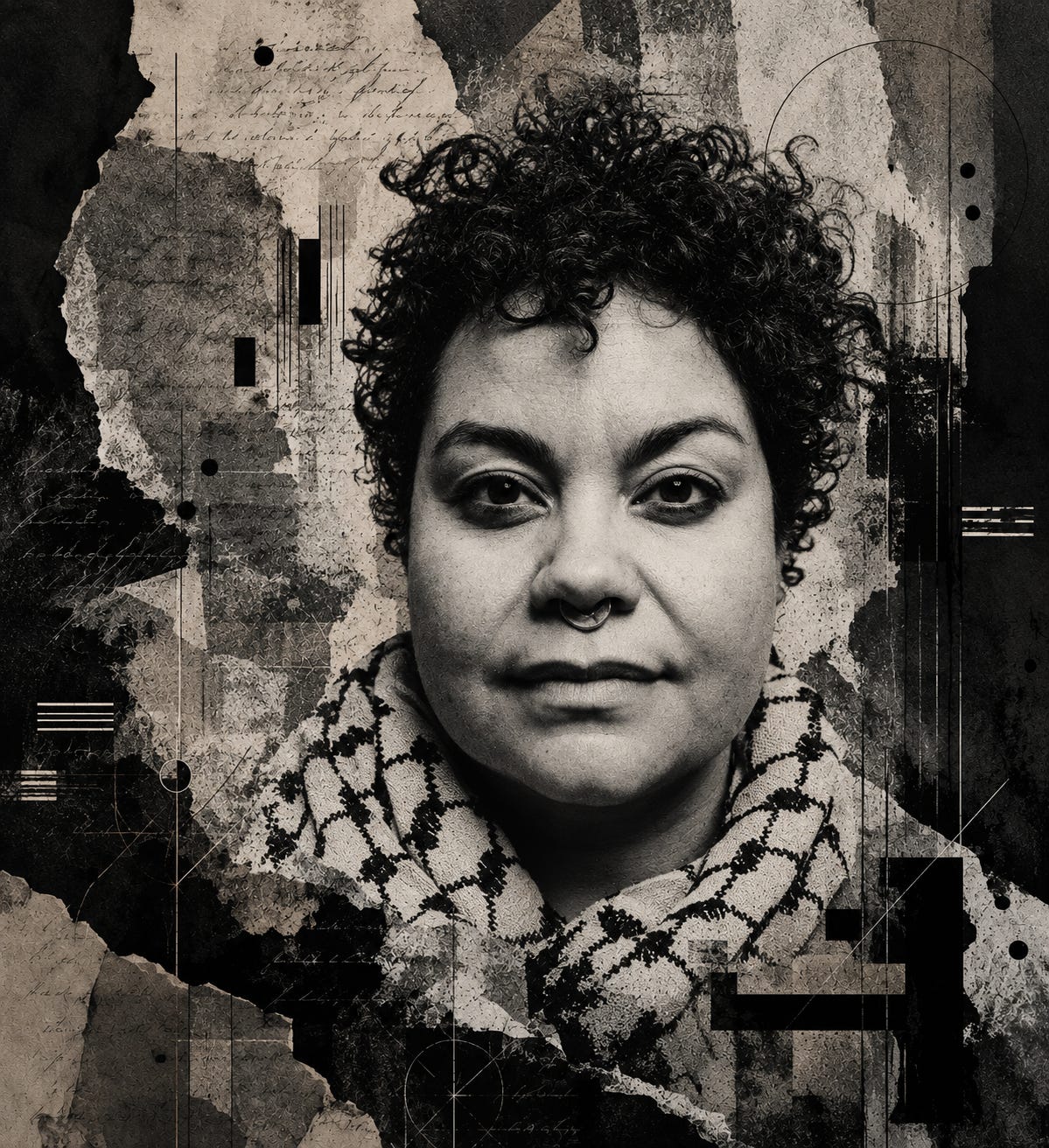
This is the fourth installment of Conversations in Existential Health, a series in which I place my developing work in Existential Health into conversation with thinkers whose ideas unsettle, deepen, or complicate how we understand the experience of being human.
The series began with Bayo Akomolafe and ** The World Is Still in the Middle of Itself**, exploring what becomes possible when we stop treating reality as something already settled. I then turned to Sir Anthony Kenny in
There is a thread running through all three conversations: How do we live when the world is not finished, certainty is unavailable, and no external authority can relieve us of the responsibility of participation?
That question brings me to adrienne maree brown.
Her work on emergent strategy approaches this territory from a different direction. Brown asks us to pay attention to change itself: to adaptation, interdependence, relationship, small patterns, and the unpredictable realities that emerge when living systems interact. Reading her alongside Existential Health raises a question I increasingly believe matters far beyond personal well-being: What kind of human capacity is required to participate responsibly in a world we cannot fully predict or control?
This conversation begins where the map runs out and the work of participation begins.
“We can’t get to a new destination without shifting who and how we are.”
adrienne maree brown is a writer, activist, facilitator, and movement strategist whose work explores how people and communities navigate change, relationship, power, and transformation. Drawing from complexity science, biomimicry, social movements, and the speculative fiction of Octavia E. Butler, brown developed the framework of emergent strategy as a way of understanding how small patterns of relationship and action shape larger systems.
She is the author of several books, including ** Emergent Strategy: Shaping Change, Changing Worlds**,
There is a particular kind of relief that comes from believing someone has already figured out how life works. A religion offers a cosmology. A political ideology explains history. A psychological framework gives names to our wounds. An institution tells us where we belong. An identity provides coordinates. Even our personal stories arrange the disorder of experience into something resembling a plot.
Human beings need orientation. I have no interest in romanticizing confusion or pretending that every structure is a prison. Maps matter when we are trying to find our way. The trouble begins when we become so dependent upon the map that we lose our capacity to encounter the territory.
This is where brown’s work has become particularly interesting to me. Emergent Strategy, published in 2017, grew from decades of movement work, somatics, engagement with ** Octavia E. Butler**, and attention to patterns in the natural world. Brown describes emergent strategy as a way of getting into “right relationship with change.” Adaptation, interdependence, decentralization, iteration, resilience, and fractal patterns become ways of thinking about how transformation actually happens in living systems.
Brown approaches these questions primarily through movements for social transformation. I come to them through another doorway: the development of Existential Health as a framework for understanding our relationship with the fundamental conditions of being human. Meaning, identity, belonging, mortality, agency, uncertainty, spirituality, and self-trust are not problems we solve once. They are dimensions of existence we continually inhabit.
Putting these bodies of thought into conversation has raised a question I cannot shake:
What if existential health has less to do with finally knowing how to live and more to do with developing the capacity to participate in a life whose next form cannot be known in advance?
That question changes the map.
“Change is constant. (Be like water.)”
Much of modern life is organized around arrival. We imagine a future point at which uncertainty will finally resolve and we will understand ourselves more completely. Our beliefs will become clearer, our wounds sufficiently healed, and the right community, relationship, vocation, philosophy, spiritual practice, or political framework will give our lives the coherence we have been seeking. Somewhere beyond the present, we imagine the pieces settling into place and granting us the clarity required to begin living properly.
I write about this in a recent article, ** There Is No Final Version of You**.
I understand the appeal of this fantasy because I have lived versions of it myself. Religious certainty once gave me an extraordinarily comprehensive map. It told me where human beings came from, what had gone wrong with us, what life meant, what death meant, who God was, what truth required, and where history was headed. Leaving that world was not simply changing my mind about a collection of doctrines. It meant discovering how much psychological and existential weight the map had been carrying.
What followed was not the acquisition of another equally comprehensive map. It was the slower and more demanding work of learning how to live without requiring one.
This has become central to my understanding of Existential Health. The goal is not to eliminate frameworks. We could hardly function without them. The deeper task is to hold our frameworks loosely enough that reality still has something to teach us.
Brown’s work on emergence enters precisely here. She defines emergence as the way complex systems and patterns arise through multiple relatively simple interactions, emphasizing relationships, responsiveness, and the ways local patterns become consequential at larger scales. Her language emerged partly through observing nature and partly through years of organizing, where rigid plans routinely collide with living human systems that refuse to behave according to the plan.
The implication reaches well beyond organizing. Life itself is emergent. We participate in conditions we did not choose, make decisions with incomplete information, encounter people who alter us, experience losses we could not anticipate, and become people our earlier selves could not fully imagine.
The fantasy of arrival tells us that uncertainty is a temporary inconvenience on the way to clarity. Emergence suggests something more unsettling and more liberating: uncertainty is part of the structure of participation.
“Less prep, more presence.”
One of the concepts I have been developing within Existential Health is Reality Contact. By this I mean the capacity to remain in relationship with what is actually happening, including those dimensions of reality that contradict our expectations, identities, explanations, and preferred narratives.
This sounds obvious until reality becomes expensive.
It is relatively easy to value truth when truth confirms the world we already inhabit. Reality Contact becomes difficult once evidence threatens belonging or experience contradicts doctrine. A relationship may no longer fit the story we have told about it. Our body may refuse an identity constructed around productivity. A worldview that once held life together may simply stop making sense.
At such moments, frameworks reveal their hidden function. They have not merely been helping us interpret reality. Sometimes they have been protecting us from having to encounter it.
Brown’s understanding of adaptation offers a useful corrective. In her writing about emergent strategy, adaptation is not passive surrender to circumstances. It involves becoming responsive to changing conditions while remaining attentive to agency: where we are moving, where we are being moved, and how we respond to what arrives.
Existentially, this means reality must retain the right to surprise us.
A healthy worldview therefore needs some permeability, while identity must retain room for revision. Communities need enough openness to survive information that complicates their assumptions, and spirituality enough humility to encounter mystery without immediately converting it into doctrine.
The alternative is not convictionlessness. It is the difference between having convictions and requiring reality to obey them.
“No one is special, and everyone is needed.”
The language of self-authorship has become important in my work, particularly for people emerging from highly authoritative religious environments. When authority has been located outside the self for decades—in scripture, clergy, doctrine, family systems, communities, or divine commands—the recovery of personal authority becomes essential.
But self-authorship contains its own danger if we misunderstand it.
Taken superficially, it sounds like the sovereign individual standing apart from the world and announcing, “I decide who I am.” That is not how human beings work. None of us created the raw materials from which a self develops. We inherit bodies, languages, histories, families, cultures, social locations, temperaments, wounds, possibilities, limitations, and worlds already underway before we arrive.
Other people become part of us. Experiences alter the range of what we imagine possible. Grief reorganizes the landscape. Love exposes dimensions of ourselves unavailable in solitude. Aging changes the questions. Failure removes identities we mistook for permanent. Sometimes a conversation rearranges something we thought had already been settled.
Brown’s emphasis on interdependence helps correct the caricature of self-authorship as self-creation. Emergent strategy treats relationship as constitutive rather than incidental. ** The Emergent Strategy Ideation Institute** describes interdependence and decentralization as one of the framework’s central elements, alongside adaptation, iteration, resilience, fractal relationship, and possibility.
This gives me another way to state something I have been trying to articulate for years: self-authorship is not self-invention; it is participation in emergence.
We are authors, but we are not writing on blank pages. We are participants in an unfinished reality that acts upon us even as we act within it. Agency is real, but it is situated. Freedom matters, but freedom is never exercised outside relationship, history, embodiment, and consequence.
Existential maturity involves learning to participate consciously in this process. Recognizing what has shaped us does not require allowing it to determine us. Choice remains possible without control over outcomes, and responsibility for the life that is ours includes recognizing how profoundly it is entangled with other lives.
Self-authorship, understood this way, is neither obedience nor sovereignty. It is responsive participation.
“There is always enough time for the right work.”
This is where emergence intersects with another distinction I have been developing: the difference between capability and capacity.
Capability concerns what we are able to do. Capacity concerns what we are able to hold.
Modern civilization is obsessed with the first. We measure ourselves through production, innovation, acceleration, scale, computation, technological power, institutional reach, and the ability to manipulate increasingly complex systems. Our capabilities are expanding at breathtaking speed.
Our capacity has not necessarily kept pace.
Extraordinary tools for communication have not made us particularly good at remaining in conversation with people who see the world differently. Unprecedented access to information has arrived alongside growing vulnerability to manipulation, outrage, and interpretive tribalism. Meanwhile, technologies capable of transforming civilization are advancing faster than the emotional and existential maturity required to reckon with what they set in motion.
This is what I have elsewhere described as the Capacity Gap: the growing distance between what human beings are capable of producing and what we are capable of responsibly holding.
Emergence makes that gap especially consequential because complex systems do not remain under the control of their creators. Once technologies, institutions, cultures, markets, movements, and networks reach sufficient complexity, effects emerge that no individual participant designed. Human capability therefore increases our exposure to outcomes we cannot completely predict.
The traditional response is to seek greater control. More data. Better prediction. Tighter systems. Stronger management. More sophisticated algorithms.
Some of this is necessary. Yet no amount of control eliminates emergence from human life. At some point the question changes from How do we guarantee the outcome? to Who must we become to remain present, discerning, relational, and responsible when the outcome cannot be guaranteed?
That is a question of existential capacity.
“Small is good, small is all. (The large is a reflection of the small.)”
One of the most provocative aspects of brown’s framework is her use of the fractal. In emergent strategy, the relationship between the small and the large matters because patterns repeat across scale. The Emergent Strategy Ideation Institute summarizes the idea simply: the large reflects the small. Brown’s earlier writing similarly emphasizes that the quality of connections between parts influences the patterns that emerge from the whole.
This has significant implications for Existential Health.
We often imagine existential questions as private matters. Meaning is personal. Identity is personal. Spirituality is personal. Self-trust is personal. Yet the ways people inhabit these dimensions inevitably become relational and institutional.
A person who cannot tolerate uncertainty does not leave that intolerance at home when entering an organization. A leader whose identity depends upon being right creates structures that protect certainty. A community unable to survive disagreement gradually develops mechanisms of conformity. An institution frightened by ambiguity produces rules designed to contain it.
The reverse is also true. People capable of remaining present to complexity create different relational environments. Leaders who do not require omniscience distribute authority differently. Communities that understand belonging as something deeper than agreement are less threatened by difference. Institutions capable of acknowledging mistakes become capable of learning.
This is why I am increasingly interested in organizations as existential environments. Every institution, whether it recognizes it or not, is shaping relationships to agency, belonging, identity, authority, uncertainty, and meaning. Culture is not something floating above individuals. It emerges through thousands of interactions in which people learn what is safe to say, what must remain hidden, whose knowledge counts, how disagreement is handled, and whether belonging depends upon compliance.
Existential health therefore does not stop at the boundary of the individual. It moves outward into relationships, organizations, communities, and eventually the cultures we construct together.
The civilization we create will reflect, in magnified form, something about the humans creating it.
“What you pay attention to grows.”
There is a danger in the language of emergence.
It is easy to make emergence sound inherently wise, natural, or benevolent. Nature becomes teacher, decentralization becomes virtue, adaptation becomes maturity, and whatever emerges begins to acquire an aura of inevitability.
Human history gives us no reason for such confidence.
Destructive systems emerge too. Authoritarian movements grow from accumulated interactions among frightened and disoriented people. Cults emerge around relationships o…