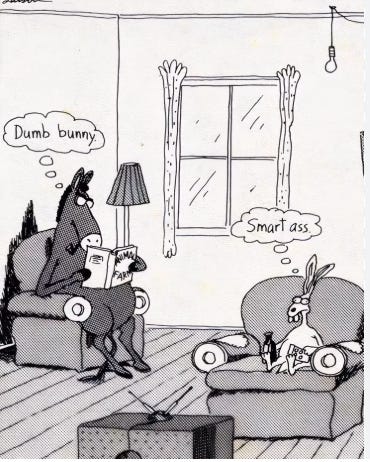
"Isn't it enough to see that a garden is beautiful without having to believe that there are fairies at the bottom of it too?"** Douglas Adams**
For those of us old enough to remember, this commercial tag line lives fondly forever in our memory. Wendy’s ran the ad in 1984; Clara Peller, eighty-one years old, three feet of outrage in a pillbox hat, staring into a competitor’s bun and demanding to know where the meat had gone. Four words. It outlived the burger, the campaign and most of the people who approved it, because it turns out the culture had been waiting for a short way to say
the packaging is enormous and the contents are not.‘Beef ’ means two different things: one you eat. One you have with somebody. Luckily fo readers,
, and so is the third meaning, which is the one Clara was after.both are on the tape this morningStart with the kind you eat. American beef got expensive, as anyone who has bought a ribeye ( or my beloved hamburgers) lately will tell you, and the administration’s answer was to go and buy beef from..Argentina. Quadruple the quota, ship it north, break the price. The ranchers who form a good chunk of the constituency were, let us say, ‘unenthusiastic’ about being rescued from their own margins. And the ribeye did not get cheaper, because a tariff-rate quota is a gesture and a cattle herd is a supply curve with a three-year gestation period. As with most of the grandiose policy announcements with which we have been inundated, you cannot import your way out of a cycle in eighteen months. You can announce that you are going to.
Now the kind you have with somebody. Tucker Carlson, who did as much as any single broadcaster to assemble this coalition, has spent the last stretch dismantling the man he helped install, and has now gone as far as using his own show to
call for impeachment. Not a policy disagreement. Not a grumble about staffing. Impeachment, from inside the tent, on the microphone he built there. His latest podcast, on the beef moves, was led by this picture:
I continue to believe that Tucker is seriously considering a run for President in 2028; if not, he will be the major influence and power-behind-the-throne for any JD Vance run. Ignore his opinions ( and rantings) at your peril.
The rest of the week’s hijinks runs on the same fuel. Refiners hauled in behind closed doors and pressed to make more gasoline before November. Drug price deals struck with nine manufacturers, timed to the same November. A stopgap through December 11 that punts every difficult number past the midterms, passed 370 to 48 by two parties who agree on exactly one thing: nobody wants to campaign during a shutdown. The FTC and twenty-two states suing Amazon over a secret ad surcharge. Seventeen Venezuelan oil fields on
*hundred-year concessions to an operator 35 percent owned by the Pentagon,*with State holding the right to buy a fifth of the crude at cost.Every one of those is a supply gesture aimed at a price. Not one of them arrives before the election. Big bun.
Which brings me to our real beef, the one that actually costs money.
Overnight, the United States hit Iran for the second time in three days. Radars, air defense, mine-laying gear along the southern coast. Tehran fired back at American positions in five countries. Iran’s parliament speaker said nobody would be exporting anything. Two seafarers were killed on a Saudi tanker in the Strait. Brent printed 96.99.
It is now 94.48. Below yesterday’s close. Down on the day.
Gold, on the morning after the world’s largest military bombed a major oil producer twice inside seventy-two hours, sits at 4,361.60, which is five point one percent BELOW its own two-hundred-day average. The benign read on that is simply that gold ran to 5,626 earlier in the year and is still working off the hangover, which would make the two-hundred-day the wrong yardstick rather than a signal. Fair. Notice that it is down 0.79 percent on the session anyway. Rate volatility will not get above 80. The VIX is 16.81, which is the sixteenth percentile of its own fifty-two week range.
**THE PREMIUM IS BEING REFUSED, NOT PAID.**Brent made 96.99 in the overnight and sits at 94.48, under yesterday’s close, after the second strike round in three days. Fade, not spike.**POLICY, WEARING A SUPPLY COSTUME.**Since 26 August the 2Y did 20bp and the 30Y did 9. 2s10s went 47 to 40. Supply shocks steepen curves. This one flattened.**ONE BET, SIX TICKETS.**The sheet runs through the front end six ways and the energy and long-end legs are one inflation expression at its cap. Concentrated, and stated rather than dressed up.I’M WRONG IFFriday’s payroll moves the 30Y more than it moves the 2Y. One print, and it settles the whole argument.
Brent 94.48, below its 94.65 prior close, after trading 96.99 overnight on a second round of US strikes and a threat to shut the Strait.
The curve flattened while every desk called it a supply shock. 2Y 4.19 to 4.39 since 26 August, 30Y 5.18 to 5.27, 2s10s 47bp to 40bp.
Gold 4,361.60, five point one percent under its two-hundred-day, on the morning after the second strike round.
Rate vol 77.88, still under the 80 line. VIX 16.81, the sixteenth percentile of its own year.
Inside financials on 1 September, investment banking +0.16% against consumer credit services -1.43%. 158 basis points of dispersion on a session the sector averaged minus 57.
One idea organizes this note, and it is the same question Clara asked. The bond market is undergoing its largest repricing since 2008, and almost every explanation on offer this morning points to a barrel of oil. The barrel is not cooperating. Neither is the curve. Strip out the fairies, and the garden is still doing something, just not the thing the story says.
**START WITH THE ARITHMETIC, because it is the load-bearing number in the piece and it deserves its construction shown.**Take the Treasury settle series for the last four sessions, 26 August through 1 September. The two-year went 4.19 to 4.39. The ten-year went 4.66 to 4.79. The thirty-year went 5.18 to 5.27. Twenty basis points, thirteen, and nine. The front end did more than twice the work of the long end. 2s10s came in from 47bp to 40. 2s30s came in from 99 to 88.
A supply shock steepens a curve. It has to ... the compensation has to get paid somewhere, and it gets paid out the back. An oil-driven inflation impulse lands on the long end because that is where the compensation for holding duration through an unknown price path is paid, and it does relatively little to a policy rate the market already expects to rise. The tape did the opposite shape. Front end led. Back end lagged. Curve compressed from both directions at once.
Which is a policy repricing. Futures-implied odds on a hike at the 15 to 16 September meeting sit near seventy percent, up from thirty-seven a week ago. Call that what it is: one implied-probability calculation off a futures board, carrying its own assumptions about how a meeting-date step gets priced. A slight favorite, and not a settled fact. The move in it dates to a Jackson Hole speech in which Kevin Warsh called two percent “a firm, fixed target,” said price stability “is not self-executing,” and put sixty-five months of elevated inflation squarely on his own institution. A governor followed on Monday saying the committee should act decisively if inflation is not moderating. PCE is running 3.7 percent.
**THE CASE AGAINST ALL OF THIS, and it is not weak.**The thirty-year has been above 5% for 55 consecutive sessions, the longest run since 2006. A curve can flatten inside a term premium regime for the dullest possible reason, which is that the long end has already gone and has run out of buyers to shock.
Gilts at 5.29 percent and Bunds at 3.39 are both multi-decade highs and neither has a Federal Reserve in it.
The move could also be one global bid for compensation that happens to have hit the American front end last rather than first.
Where I part company with that read is the internals: a global term premium event does not sort the American financials complex by front-end sensitivity, and on Tuesday it did, which I take apart below with the numbers.
**THE OTHER READ ON INFLATION ITSELF, which nobody wants this week.**Core PCE on a two-month annualized basis has rolled to roughly 1.7 percent, and the three-month sits near the same place, while the year-over-year prints 3.2 and change. The backward window is hawkish and the forward window is dovish, and a committee that has just spent a summer being told it was too slow will look at the backward one. Two months is two months, and the series has whipsawed this way three times since 2024 without the trend breaking, so I am not calling the top in inflation off it. The honest version: the Fed is very likely to hike into a disinflationary impulse that its own preferred series is already showing, and it will do so because the credibility cost of being wrong the other way is the thing that got the chair his job.**NOW THE ACTUALLY NON-CONSENSUS PART.**Underneath all the hawkish theater, theFederal Reserve has added roughly 344 billion dollars of Treasury bills to its balance sheet in twelve months, and grown the balance sheet by about 90 billion this calendar year, 29 billion of bills in August alone.The innocent read, and it is the standard one, is that bill buying is reserve management rather than stimulus: keep reserves ample as the Treasury account and the reverse repo facility slosh, and buy the shortest, most liquid instrument to do it. Which may simply be correct. Also a distinction the bond market does not get to collect on, because reserves are reserves, whatever the intent was.
A central bank whose chair calls the target firm and fixed, and whose balance sheet is expanding, is running two policies at once. The front end prices the first. Nothing prices the second. And the second is why a genuine funding accident is less likely here than the term premium story implies. Thinner than the rhetoric selling it.
**WHY THE BARREL MATTERS AND WHY IT DOES NOT.**Brent is up more than half this year and the war is real. Seventeen million barrels crossed Hormuz on Monday, the most since this began, and tanker attacks resumed the same week. Diesel is 5.688 a gallon, a whisker under the April peak. None of that is in dispute. What is in dispute is whether the marginal buyer pays up for the NEXT headline, and for three sessions running the answer has been no. 96.99 to 94.48 inside seven hours, low of 94.11. The 95 close that arms the energy setup sits 52 cents away and has sat roughly there for a week without printing.The gestures explain part of it. Chevron is investing $7 billion over five years to double Venezuelan output from Carabobo to 600,000 barrels a day by 2031. Real, and not a barrel of it arrives this quarter, which is exactly why it is announced now.
An administration eight weeks from a midterm needs the forward curve to hear about supply even if the spot market never sees any. The market has heard. The market has also declined to bid gold ... which is the cleanest read available that we are in a ‘real rate’ event and not a debasement one.**Flight Check:**gold offered, bonds offered, the yen bid, the dollar bid. The two asset havens are being sold and the two funding havens are being bought, which is a discount-rate rotation rather than fear. Nobody is buying protection this morning. They are repricing the price of money.**THE WAR HAS A JOB IN THIS NOTE AND THE JOB IS DURATION, not direction.**Three things landed in the last thirty-six hours and all three argue the same way. An investigation into leaked Russian correspondence and travel records describes a multiyear covert program, C430L, in which Russian missile specialists have been helping Iran build a ramjet propulsion system, the engine that lets a cruise missile hold several times the speed of sound. Anti-ship, in a strait.
Separately, Pezeshkian sat next to Putin in Bishkek and thanked him for wartime support, and Putin said out loud that Russia is supplying essential goods.
And Germany formally blamed Russia for the explosive drone found near a Ukrainian cargo aircraft at Leipzig, closing a consulate over it.
Add a Gaza ceasefire that Hamas says is close to collapsing after an Israeli raid, and the off-ramps are all closing at once.
**POLICY ILLEGIBILITY IS TERM PREMIUM, and it is the one thing keeping me short the long end at all.**A government that answers a beef price with an Argentine quota, a gasoline price with a closed-door meeting, and a Venezuelan reserve base with a hundred-year concession part-owned by the Pentagon is a government whose fiscal path a thirty-year buyer cannot underwrite. Scott Bessent doubled the buyback program on 19 August, buying about eight days of relief. The thirty-year is back at 5.27, which is where it sat moments before he announced it. The tool worked, but the problem was never the tool.
**10:00 ET, factory orders and the durable goods final.**Survey +0.7 percent after minus 0.3. Capital goods shipments ex-air is the line that matters, because it is the arithmetic underneath every AI infrastructure number in the market.**After the close, Broadcom.**Consensus 3.24 adjusted against 1.69 a year ago, 29.4 billion of revenue. Options imply something close to a 139 billion dollar swing in market value. It decides whether Monday’s four percent break in Korea was information or a positioning unwind.
**FCX, 72.47, down 4.32 percent on 1 September.**Copper the metal closed UP 0.38 the same session. Twenty-three-analyst consensus target sits at 72.05, below the last price, after a 113 percent year.**So what:**an equity that breaks four percent while its own commodity is green has stopped trading as a metal proxy and started trading as a cyclical, and the marginal buyer of that copper is financed through a hundred-billion-dollar special purpose vehicle with a 35 billion junior tranche. A levered marginal buyer is a price-sensitive one.**EIX, 58.80, up 8.93 percent.**California adjourned without passing wildfire liability reform, taking away the statutory risk the stock had discounted through a 24 percent August drawdown.**So what:**one session prices the removal of a binary. It does not price the re-rating that follows when a name can be underwritten as a utility again rather than as a legal claim with a rate base attached. Weeks of model revisions, not one afternoon.**DELL, up about 11 percent pre-market.**Full-year revenue raised 25 billion to roughly 192, with 74 of it AI servers against a prior 60.**So what:**the capex cycle is not slowing, which cuts directly against the copper short above. Honest tension. Stated, not buried.
The financials sort that gives the front-end argument its internals, including the 158 basis points of subsector dispersion on 1 September and the 93 basis points between reinsurance and life that explains why.
Two intra-sector expressions, one of them a stand-down with an armed trigger. The full sheet, twenty-two live lines with the factor each one monetizes and the condition that kills it, the netting arithmetic in units against the caps, and the falsification matrix.
The positioning picture, which is the momentum complex 23 percent under its own two-hundred-day while the index sits 2.4 percent off its high. And the decision tree, with weights that moved.
Subscribe at marketmusing.com.
Disclaimer: Opinions are mine alone and may change. It does not constitute an offer to buy or sell or a solicitation of an offer to buy or sell any security, loan or asset or to participate in any trading strategy. It is not intended to form the basis of any investment decision, should not be considered a recommendation, and does not constitute an offer or solicitation with respect to the purchase or sale of any investment, nor is it a confirmation of such terms.