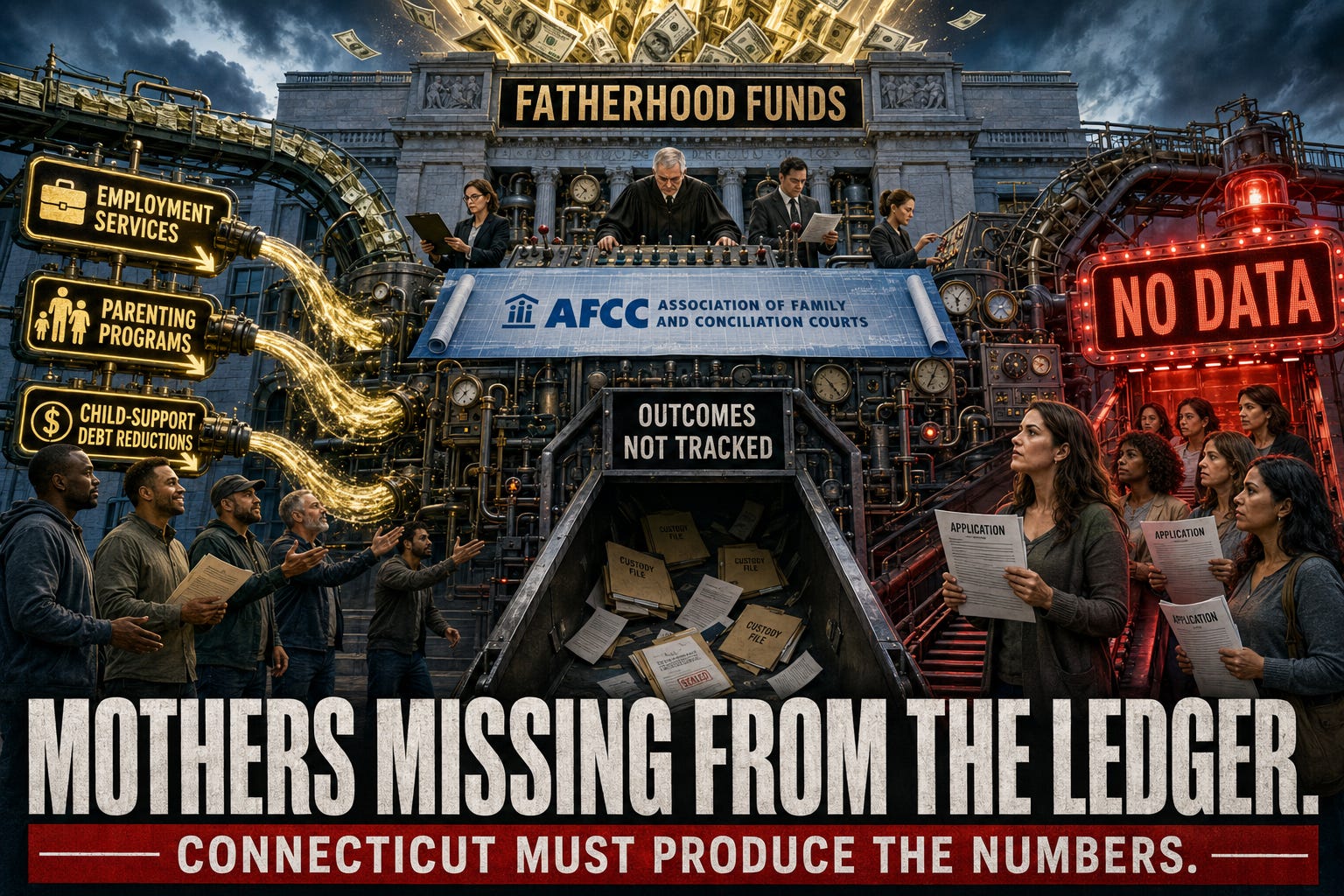
LUTHMANN NOTE: Connecticut says the program is inclusive. Margaret Sullivan asks the right questions. Show me the ledger. How many mothers applied? How many were admitted? How many completed the curriculum? How much state-owned child-support debt did Connecticut erase for women compared with men? Then open the family-court books and identify which parents lost custody, received supervised visitation, or disappeared from their children’s lives. Government cannot spend decades engineering access for fathers while refusing to measure what happens to mothers. AFCC helped redesign the screening machinery. Judicial Branch officials remained connected to the fatherhood network. The system overlaps. The documents establish that. Now Connecticut must disclose who benefits and who gets crushed. This piece is “Who Does Connecticut Serve?” first available at The Family Court Circus.
For more than two decades, Connecticut has invested public money and institutional resources in programs designed to strengthen fathers’ involvement with their children. Those efforts include employment assistance, child-support intervention, parenting education, court navigation, and access-and-visitation support. Children benefit when safe and responsible fathers remain meaningfully involved, and many fathers face serious barriers involving poverty, unemployment, incarceration, support debt, and limited contact with their children.
The investigation begins with the benefit Connecticut rarely advertises: the same state has built a fatherhood network that dispenses employment services, court assistance, and reductions of state-owned child-support debt, yet it has not publicly demonstrated whether similarly situated mothers receive those benefits on equal terms.
That question reaches across the Connecticut Fatherhood Initiative, the Department of Social Services, Judicial Branch Family Services, contested custody outcomes, and Connecticut’s longstanding relationship with the Association of Family and Conciliation Courts, known as AFCC.
The public record already establishes the central contradiction. Connecticut law directs money toward programs serving low-income fathers. State regulations say certified Parenthood Programs must assist male or female noncustodial parents. DSS says mothers have participated. Some certified providers still market their programs exclusively to men. Connecticut has created a formally inclusive rule and a father-branded delivery system without publishing the outcome data needed to show that mothers actually receive equal access.
The Connecticut Fatherhood Initiative is codified in Conn. Gen. Stat. §§ 17b-27b and 17b-27c. The statutory scheme establishes an Office of the Connecticut Fatherhood Initiative inside DSS and directs the state to promote fathers’ positive involvement with their children.
The grant language is explicit. Section 17b-27c authorizes the DSS commissioner to award available federal and private funds to organizations providing “employment and training opportunities for low-income fathers to increase the earning capacity of such fathers.” The statute also funds parenting and financial-literacy classes, economic-stability programs, and services promoting communication between fathers and their children.
Those services are valuable. They are also ordinary social and economic services that low-income mothers may need just as urgently.
Connecticut’s own Fatherhood Initiative Strategic Plan acknowledges that noncustodial fathers resemble the custodial mothers already using state and local systems because both groups confront similar educational, employment, and social-service needs. The state nevertheless preserves sex-specific language when it distributes grant money for employment and training.
DSS further complicates the picture through its Fatherhood Initiative FAQ. The agency says certified fatherhood programs have “no eligibility requirements,” identifies fathers and “family-men” as the target population, and adds that programs “have also served noncustodial mothers.” That statement confirms some maternal participation. It does not reveal how many mothers applied, how they learned they were eligible, whether providers admitted them consistently,y or whether they received the same services and financial benefits as men.
The provider network sends mixed signals. Community Renewal Team’s DSS-certified Real Fathers, Real Men program describes itself as an all-male support group for fathers and men. Other providers use broader language. The state’s own rule may be inclusive, but the front door is still marked for men.
That matters because these programs are not private coffee circles. Certified providers offer case management, employment assistance, financial education, parenting instruction, child-support intervention, court-document assistance, systems navigation, and access to Connecticut’s State-Owed Arrearage Adjustment Program.
Connecticut’s State-Owed Arrearage Adjustment Program allows eligible child-support obligors to reduce debt owed to the state after completing approved programming and meeting continuing payment requirements.
The governing DSS regulations are sex-neutral. They define an eligible participant as a “noncustodial parent or obligor,” and the certification rule requires participating programs to maintain a service plan assisting “male or female noncustodial parents.” Successful completion produces a one-time adjustment equal to 10% of the starting state-owed arrearage. Continued compliance can generate further adjustments tied to current support payments.
On paper, a noncustodial mother qualifies. In practice, she must enter through a certified fatherhood network whose state FAQ identifies fathers and family men as its target population and whose individual providers may advertise male-only programming.
A written regulation does not answer whether the benefit is administered equally. Connecticut should be able to produce the numbers: female applicants, female participants, female completions, female denials, and arrearage reductions granted to women compared with men.
Without those records, DSS asks the public to accept formal eligibility as a substitute for demonstrated access. It is not.
Two public-records requests have been submitted to DSS seeking enrollment data, eligibility policies, participant information by sex, arrearage-reduction figures, funding records, referral practices and nondiscrimination policies. Those records will show whether women receive the benefit in meaningful numbers or remain an invisible exception inside a program built, branded and promoted for men.
The father-specific employment language traces to Public Act 09-175, “An Act Concerning Responsible Fatherhood and Strong Families.”
The 2009 legislative record shows lawmakers responding to poor noncustodial fathers who were unemployed, accumulating child-support arrears, disengaging from their children, and struggling to navigate state systems. Those concerns were real.
Lawmakers also knew that mothers could be noncustodial parents and support obligors. During the Feb. 26, 2009, public hearing, Elaine Zimmerman of the Connecticut Commission on Children acknowledged that the noncustodial parent could “be the mother or the father.” The legislation used sex-neutral terms such as “obligor” and “noncustodial parent” in several provisions while reserving employment and training opportunities for “low-income fathers.”
The distinction was deliberate. The legislature knew how to draft a neutral provision and did so elsewhere in the same statutory structure.
Connecticut modernized the initiative through Public Act 22-138. The General Assembly repealed the old John S. Martinez Fatherhood Initiative statute, created the current CFI office and council, and carried the father-specific employment language into the replacement law.
The state had another opportunity to ask whether employment training, financial literacy, and economic-stability services should turn on the sex of the parent. It preserved the distinction.
Connecticut can operate programs addressing barriers that disproportionately affect fathers. Incarceration, reentry, child-support enforcement,t and father-child disengagement can justify targeted outreach and specialized services.
The constitutional problem begins when the state attaches ordinary public benefits to sex.
Employment training is not inherently male. Financial literacy is not inherently male. Parenting education is not inherently male. Court navigation is not inherently male. Parenting-time assistance is not inherently male. Reduction of debt owed to the state is not inherently male.
Government classifications based on sex receive heightened constitutional scrutiny. Under * United States v. Virginia*, the government must supply an “exceedingly persuasive justification” for sex-based classifications and show that the distinction substantially serves an important governmental objective.
A state program that provides employment assistance or debt reduction to a father while denying the same benefit to a similarly situated mother creates an equal-protection problem. Connecticut’s sex-neutral arrearage regulations recognize that reality. The unresolved question is whether the fatherhood network follows the regulation in actual practice.
Equal treatment requires more than a sentence buried in a regulation. It requires an accessible program, consistent provider policies, neutral intake standards, ds and measurable results.
The inquiry extends beyond fatherhood programming. Connecticut has devoted decades of public policy to removing barriers between fathers and their children. The state has not shown comparable urgency in measuring whether mothers lose custody or meaningful parenting time in highly contested family cases, particularly when domestic violence, coercive control, child abuse or parental-alienation claims enter the courtroom.
Connecticut lawmakers and task forces have received testimony warning that mothers who report abuse can be recast as obstructive, unstable or unwilling to foster the child’s relationship with the father. A 2016 task-force report includes testimony describing mothers’ safety concerns being characterized as alienation, paranoia or hostility. That testimony represents the witnesses’ experience and analysis, but Connecticut has never answered it with comprehensive outcome data.
The Judicial Branch publishes family caseload figures and data showing the extraordinary rate of self-representation. In 2024, at least one party lacked counsel in 86% of custody cases and 94% of visitation cases. Its published statistics do not identify which parent obtained custody, whose parenting time was restricted, or whether the outcome followed abuse or alienation claims.
The public cannot determine from those reports whether mothers or fathers are more likely to lose primary custody, receive supervised visitation, suffer a custody transfer, have contact suspended, or become effectively erased from their children’s lives after contested hearings.
That data gap protects the system from evaluation.
Older custody statistics can create a distorted picture because most family cases never become fully litigated custody wars. Parents may agree on custody, one parent may not seek primary custody, cases may resolve through mediation, or the parties may settle without a contested evidentiary hearing.
The meaningful comparison begins when both parents actively seek custody or substantial parenting time.
Who loses meaningful contact with the children? What happens when domestic violence is raised? What happens when a child reports abuse? How often does the accused parent answer with a claim of interference, gatekeeping, or parental alienation? How frequently does the court transfer custody, impose supervision, or order reunification services?
Connecticut cannot evaluate sex disparities while refusing to count the outcomes that matter.
A separate administrative-records request has been prepared for the Judicial Branch seeking custody and parenting-time results by parent sex or gender, together with information concerning supervised visitation, custody transfers, GAL and AMC appointments, Family Services involvement, domestic-violence indicators, child-abuse allegations and parental-alienation claims.
If the Judicial Branch maintains those records, it should release them. If it does not, the absence is an indictment of the state’s quality-control system. Connecticut cannot credibly claim to monitor fairness while declining to track who loses children, who receives supervision, and which accusations precede the result.
The third branch of the investigation concerns the Association of Family and Conciliation Courts.
AFCC describes itself as an interdisciplinary international organization whose members include family-court judges, attorneys, administrators, mediators, mental-health professionals, evaluators, researchers and policymakers. It provides education, professional standards and policy-oriented projects within family-court systems.
Connecticut’s relationship with AFCC reaches back decades. Anthony “Tim” Salius served as director of the Family Division of the Connecticut Superior Court for 36 years and became the only two-term president in AFCC history. Robert Tompkins served as deputy director of Connecticut’s Family Division and as AFCC president from 1993 to 1994.
In 1998, the Connecticut Office of Legislative Research consulted Salius and Tompkins while examining father-to-father programs and policy options. The resulting OLR report discussed child-support enforcement, access to children, stereotypes about noncustodial fathers and a possible fatherhood grant program. That policy work occurred immediately before Connecticut established its statewide Fatherhood Initiative in 1999.
The record establishes an institutional intersection: senior family-court administrators with AFCC leadership histories helped shape Connecticut’s early fatherhood-policy discussion. It does not establish that AFCC wrote the law. The evidence shows influence, proximity, and continuity.
The relationship moved from professional overlap to a direct state contract in 2002.
Connecticut’s Court Support Services Division Family Services Unit awarded AFCC a contract to develop an empirically based screening instrument. AFCC’s project team included Peter Salem, Robin Deutsch, Janet Johnston, Andrew Schepard and Marsha Kline Pruett. Connecticut’s team included Stephen Grant, Debra Kulak, Kathy Ceruti and Joseph DiTunno.
According to AFCC’s own project history, its personnel studied Connecticut’s Family Services system, visited court locations, observed operations, evaluated exi…