Good morning and welcome to Vittles! Today we’re publishing the lead feature from our third print issue, The Influencers: an exhaustive investigation by Stephen Buranyi into the economics of restaurant influencing. Stephen spent six month reporting this article, and through conversations with dozens of influencers, restaurateurs and PRs, he uncovers the clandestine arrangements and shady deals that prop up the entire system, reveals how and how much influencers are getting paid (in one case, allegedly up to £40k a collab - a figure the influencer’s representative disputes), and answers the big question that so many people have asked: is our most influential restaurant influencer taking payments without tagging his posts as an ad?
Today’s article is paywalled. To read it, you can subscribe to Vittles for £7/month or £59/year, or you can buy the whole issue – which contains everything from deep dives into the halal influencing scene, to long reads on the history of MFK Fisher’s hidden role in introducing Japanese food to mainstream US culture, as well as an exclusive short story by Booker-longlisted author Rebecca Perry. Order your copy now!
You can also listen to Stephen talking about his investigation on the most recent episode of the Vittles podcast.
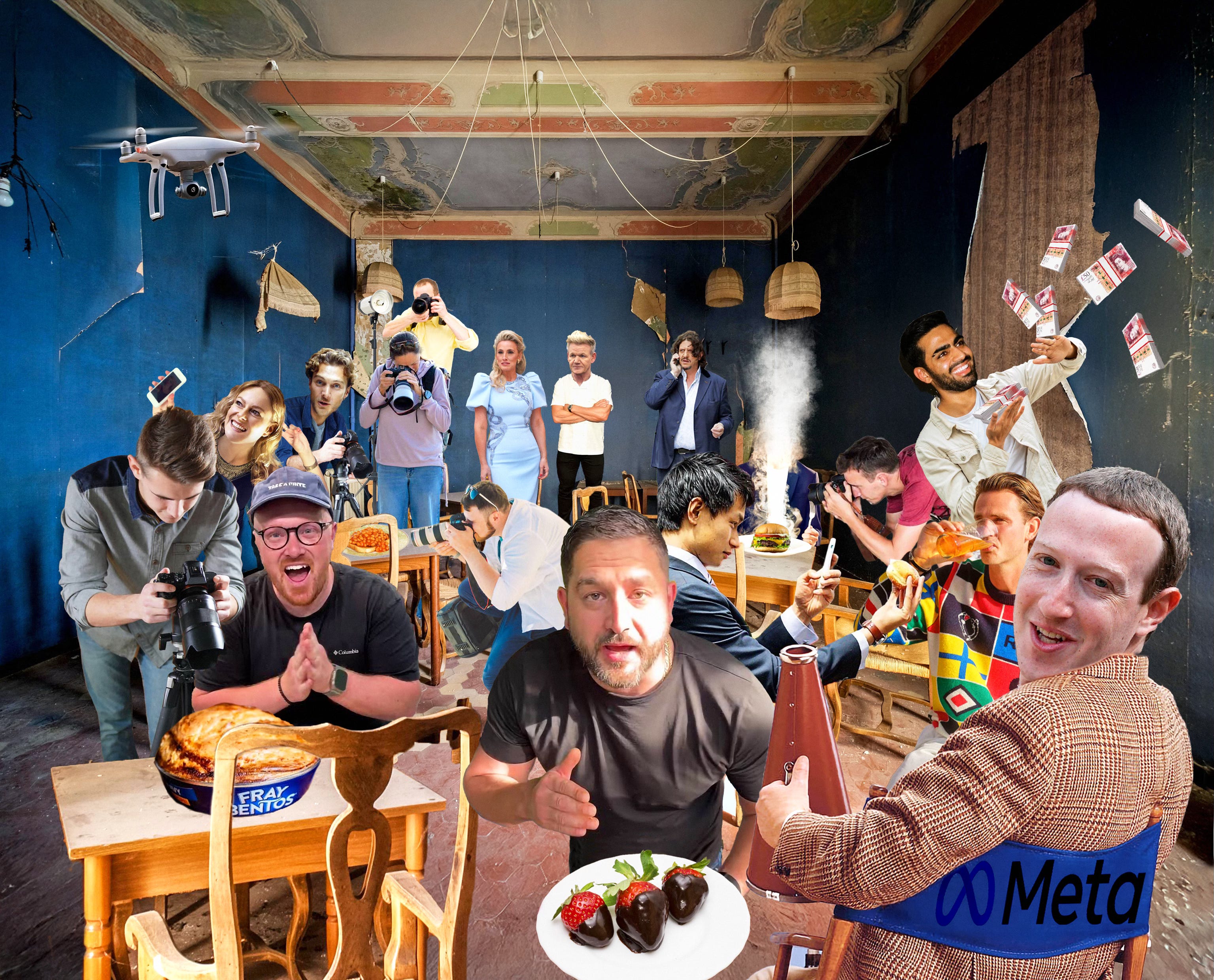
Restaurant influencers are the most powerful force in food media – but how are they actually making their money? By Stephen Buranyi. Collage by Cold War Steve
In 2017, two aspiring YouTubers going by the name Topjaw published ▶a video posing the London foodie’s most important question: what to eat in Chinatown? They enlisted the help of long-time instagrammer Kar-Shing Tong (better known by his username @ks_ate_here), who took the pair on a lovingly curated loop of the neighbourhood. Cantonese siu mei duck at Four Seasons, Chongqing-style handmade noodles at the now-defunct Little Wooden Hut, and a slightly upscale jag across Shaftesbury Avenue to Barshu, where they decadently cracked a whole crab for the camera. Any of the 100,000-odd viewers who watched it at the time would have been well served by its responsible (if unspectacular) recommendations. But in retrospect, the video may be of more interest to historians. In its unassuming and rapidly cut seven minutes, you can almost see the tectonic plates of the food world begin to shift.
Tong is the elder statesman: the @ks_ate_here account began in the social media dark ages, first on Twitter, through to static Instagram photography. He’s in his element in the video, dutifully explaining the history and technique behind the dishes. He is relaxed and amiable on camera, but in his own work he doesn’t show his face often – it just isn’t the style. Topjaw is something different. Nine years ago, it was still embryonic: host Jesse Burgess sweating profusely at any hint of chilli, cameraman Will Warr not able to use chopsticks. But the formula was there. The constant checking in to see if what they’re eating truly is ‘the best’. Even doubled over from the heat of a spicy fish soup, Burgess’s eyes always find the camera. He holds out food for inspection and addresses the imagined viewer. The audience is out there. ‘KS has 40,000 Instagram followers! 40,000!’ Burgess says, pointing at Tong with aspirational glee.
Now, Topjaw (@topjaw) – buoyed partly by their own charms and partly by the tech industry’s hard turn to shortform video – have some 1.7 million followers across the major platforms (in 2024, they gained 52,000 followers in one month alone). But they aren’t a singular phenomenon. The algorithm now serves up an influencer for every genre of restaurant, from halal spots to fine dining. The most popular account in the UK – with 2.5 million followers on Instagram and 1.3 million on TikTok – is Eating with Tod (@eatingwithtod), featuring the preternaturally excitable Toby Inskip, who rubs his hands together and hangs his mouth open in gluttonous ecstasy behind gargantuan mounds of roasted meats. Rollin Lee (@rollinjoint1) goes deep on Korean food and culture. The landscape skews depressingly male among the largest accounts, but Lylaa Shaikh of @saltandshaikh promises a guide to the ‘ethnic hot girl spots in London’, while Kate Ovens (@kate.ovens) mixes restaurant reviews with the occasional – stunningly impressive – competitive eating challenge.
The meteoric rise of these influencers in the half decade since the pandemic initially caught the restaurant world completely off-guard. Asma Khan told me that her restaurant, Soho’s Darjeeling Express, was busy for four months after appearing in a Topjaw video. Man Hon Luk, of Uncle Hon’s BBQ, said that, in one day, some 200 people came to his pop-up in Hackney Wick after he was featured on Inskip’s ‘Best BBQ’ series. Their rise has also disrupted the food media world. There is no doubt that influencers have equalled or supplanted traditional media critics as the dominant force in restaurant coverage – with a collective audience in the tens of millions, influencers are bigger than the traditional press ever was. As Hannah Twiggs, food editor of the Independent noted, one reel by Inskip alone can reach a larger audience than the circulation of the entire print media in the UK.
‘It’s never been the case that I say, if I invite someone, they have to give positive coverage – it’s not spelled out like that. But it is kind of how it works … There’s no such thing as a free lunch’
Over the past few months I’ve spoken to more than fifty influencers, chefs, restaurateurs, PR professionals and other industry players to find out where influencers came from, how they gained this position in the restaurant world and how the business of influencing works day to day. I’ve learned that while some restaurateurs and PRs claim influencers are a plague of locusts with ring lights, many more see them as a form of cheap advertising. The most striking thing I learned was that very few influencers have been able to translate their views into steady paydays. They battle to be invited to exclusive launches, while also trying to hawk their imprimatur to brands for potentially lucrative partnership deals. It is clear that there is a secretive trade involving some influencers taking under-the-table payments from restaurants in return for positive coverage, blurring the line between entertainment and advertising, and certainly violating the UK’s advertising standards rules. While influencers’ audiences are growing exponentially, their relentless positivity and seemingly total lack of critical faculty has led to a viewer backlash that one influencer described to me as a ‘crisis of authenticity’.
Through means both shady and legitimate, the influencer is the current kingmaker of the London food scene. This is the story of how it happened, how long it can last and who, at the end of the day, is paying for all this content.