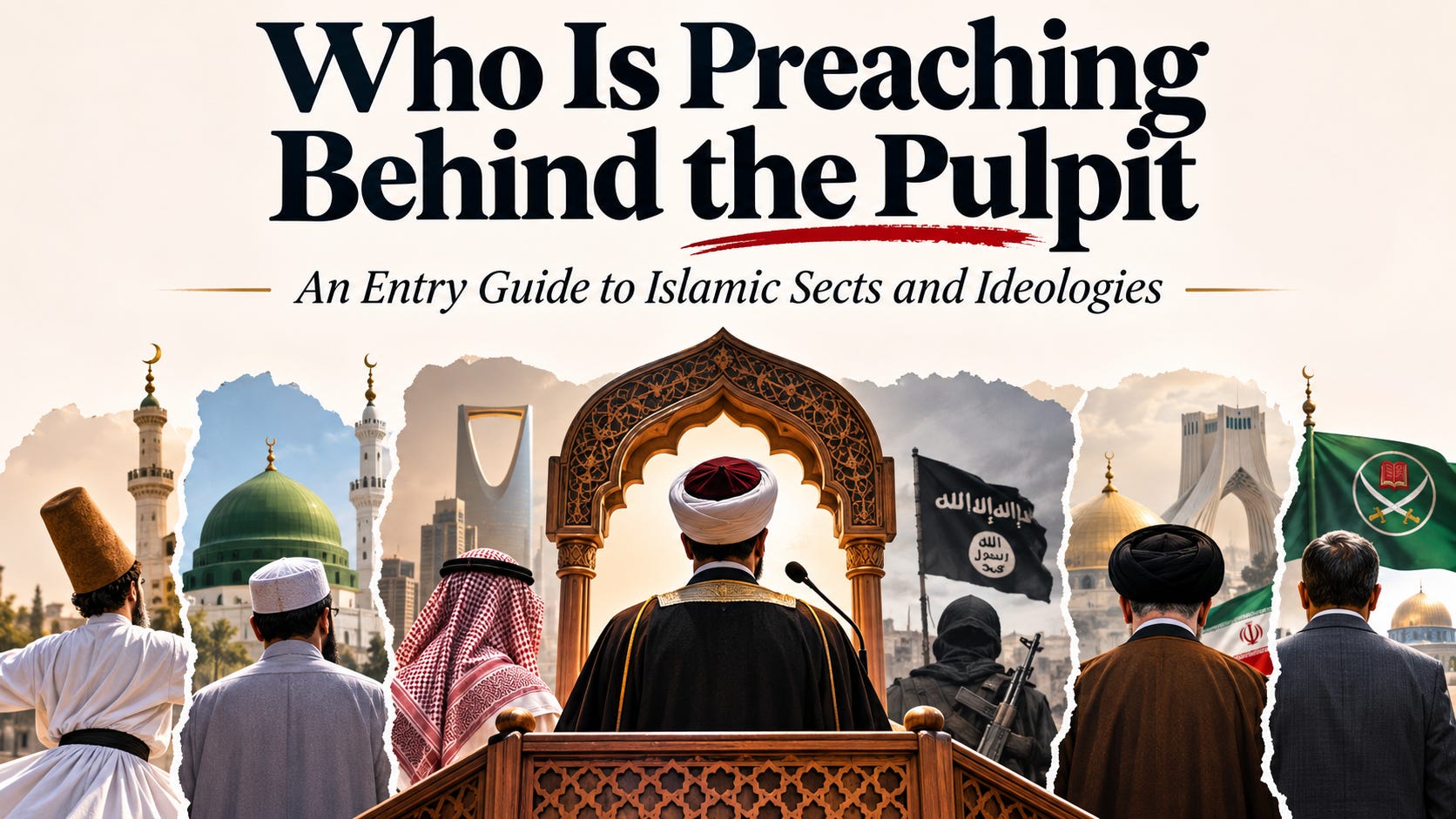
I started this research to support other work I was doing, and I wanted to understand the full range of Islam before going further. Who the groups are, what they believe, where they operate, why they formed, and how they work differ from one to the next. There are so many facets that I can’t say I’ve found them all. This is what I found, and I’m sharing it in the hope that it helps you understand Islam, too. Full disclosure: I had AI take all my notes and transcribe them into a legible (I hope) primer.
Islam is not one thing, and neither are the people who preach it. Over 2 billion people practice it, and they belong to branches, schools, and movements that disagree with each other, sometimes violently. A Sufi mystic in Senegal, an Ahmadi family in Ohio, and a Muslim Brotherhood organizer in Cairo share a religion and very little else. Treating them as one bloc is inaccurate. So is acting as though the differences don’t matter.
When a mosque opens, a charity forms, or a speaker is invited to a campus, the useful question is which tradition or movement is behind it.
Islam is a religion, and for nearly all who practice it, it means prayer, fasting, charity, family, and a moral code. Islamism is a political ideology that took shape in the 20th century. It treats Islam as a program for the state, with law, courts, schools, and public life run on one reading of Islamic rules and enforced by the government. The same line separates a sect from a movement. A sect is a religious community. A movement is an organized effort to shape law and politics, and some groups are both.
The difference shows up in who gets hurt or worse. Most victims of al-Qaeda and ISIS have been Muslim. Iran’s government, built on Islamist doctrine, has jailed and executed Muslim women over how they wear a headscarf. The Taliban have barred girls from secondary school since 2021. Islamism harms Muslims first and in the largest numbers.
People get this wrong in two directions. Islamists claim to speak for Islam and treat Muslims who disagree as weak or false, and accepting that claim does their work for them. Some critics go the other way and treat every Muslim as a possible Islamist and every mosque as a possible front. That’s wrong, and it makes the Islamist claim that the West is at war with Islam easier to believe.
Criticizing Islamism means criticizing a political ideology. Muslims are among its sharpest critics.
Related reading:
Most Muslims in the West are Sunni, and most don’t belong to any political movement. They work, raise their kids, and go to the mosque on Fridays to pray. The organizations that claim to speak for them are a different matter.
Many of the large Muslim institutions in the United States and Europe grew out of networks with ties to the Muslim Brotherhood, to South Asian movements like Jamaat-e-Islami and the Deobandis, or to Saudi-funded Salafi groups. The Muslim Students Association, founded in 1963, is one example. Some of its founders had connections to the Brotherhood, and the Islamic Society of North America (ISNA) grew out of it. In the 2008 Holy Land Foundation terrorism-financing trial, prosecutors introduced a 1991 Brotherhood memo describing a plan to build Islamic organizations in North America. The government also named ISNA and the Council on American-Islamic Relations as unindicted co-conspirators. Both groups dispute that label, and neither was charged.
Who sits on the board and where the money comes from are the questions to ask.