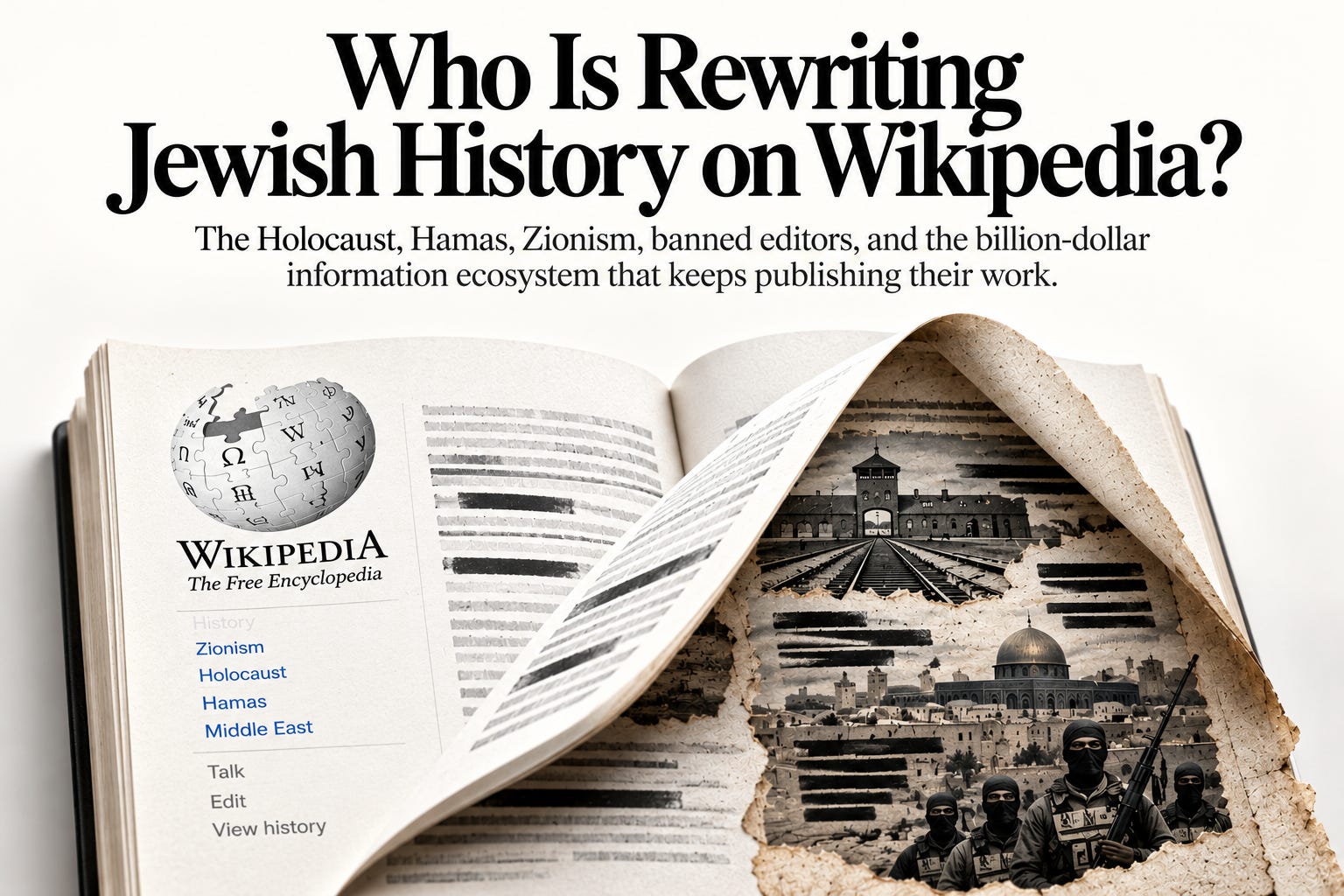
I’ve been sharing Wikipedia’s issues making it into the news for quite a while now, mostly through my Substack Notes. I report when an article about Zionism gets rewritten, or when information about Hamas disappears from the main page. An editor gets banned, but the changes remain. Because I have alert sets to follow any online conversations about Wikipedia, I’ve covered these stories as they’ve come along, one at a time. But…I think I’ve been making a mistake.
This morning I read an excellent Substack article by Nahum Meron titled "Wikipedia". 10/10 recommend reading it. He’d been researching how Bosnia became predominantly Muslim under Ottoman rule, and his research brought him to Wikipedia. The explanation he encountered described the conversions as largely voluntary, influenced by social, economic, and religious factors. Meron wanted to know why there was so little about what life was like for non-Muslims under Ottoman rule, including the jizya tax and the devshirme system…where Christian boys were taken from their families and forced to convert and recruited into imperial service.
He asked his AI assistant to dig further, and the response included historical details that had been missing from the earlier account. Bosnia’s conversion to Islam took place over generations, with religious, political, and economic pressures all playing a role. Meron’s frustration was with how much of that Ottoman experience had been left out of the explanation he’d received.
His article got me thinking about everything I’ve been publishing in my Notes. The bits and pieces aren’t as impactful separately. When you see everything documented in one place, it’s VERY eye-opening. And extremely alarming.
Wikipedia is one of THE MOST widely used sources of information in the world. In January 2026, Wikimedia reported that its projects contained more than 65 million articles in over 300 languages and received nearly 15 billion page views EVERY SINGLE MONTH. Those articles are read by people like us, indexed by search engines, and supplied to companies developing various AI platforms… including the ones we have a love-hate relationship with: ChatGPT, Claude, Gemini, and others.
Meron mentioned that he instructs his AI assistant to avoid Wikipedia and Reddit and favor primary sources. I’ve made those same requests to my AI Assistant (it's named Atlas, by the way) while researching my articles. But how many people think to do that? Most ask a question, get an answer, and move along thinking their question was met with a satisfying answer. They have no reason to suspect that the information might have been rewritten by someone with a political agenda.
Prompting or instructing an AI assistant not to use Wikipedia during a search doesn’t actually remove Wikipedia material from whatever the model learned during training. Once that information has been added to its training dataset, a simple command can’t reliably erase its influence. Just ask your AI assistant about that.
For example, here’s what ChatGPT has to say about it:
“You can instruct me not to search Wikipedia or cite it as a source, and I can follow that instruction. But I can’t identify and remove everything I may have learned from Wikipedia during training. That information may already influence how I understand a subject and generate an answer, even when I never visit or cite Wikipedia.”
For years, teachers and professors have warned students against relying on Wikipedia as a final academic source. Many discourage citing it in research papers, while others prohibit it completely. Students are taught to follow citations, find the original documents, and check the scholarship. Yet Wikipedia’s content is being incorporated into the AI systems those same students now use to find information.
On October 15, the Anti-Defamation League published another investigation into Wikipedia. Researchers examined the work of a banned editor and found that 91% of the changes they could assess were still reflected in six major articles, including Jews, Zionism, and Hamas. Wikipedia removed the editor, but most of the changes identified by researchers… well, those are still alive and well in the articles.
That finding raises a question or hundreds that Wikimedia should have to answer. How does an organization that operates one of the world’s most influential information platforms ban someone for misconduct, leave that person’s work in place, and continue distributing the material to millions of readers and to some of the world’s largest technology companies?