On December 6, 2023, teachers across the Oakland Unified School District held a Palestine teach-in during the school day. Superintendent Kyla Johnson-Trammell had already told employees that the event wasn’t authorized by the district, but somewhere between 70 and 100 educators reportedly participated anyway.
The material covered students from elementary school through high school. Younger students could be introduced to P Is for Palestine. Older students could read Life Under Blockade, essays written by young Palestinians in Gaza. The program included lesson plans, videos, readings, activities, and a virtual panel with teachers and community activists. Johnson-Trammell later told families that she was “deeply disappointed” by material she described as harmful and divisive and said some resources presented opinion as fact.
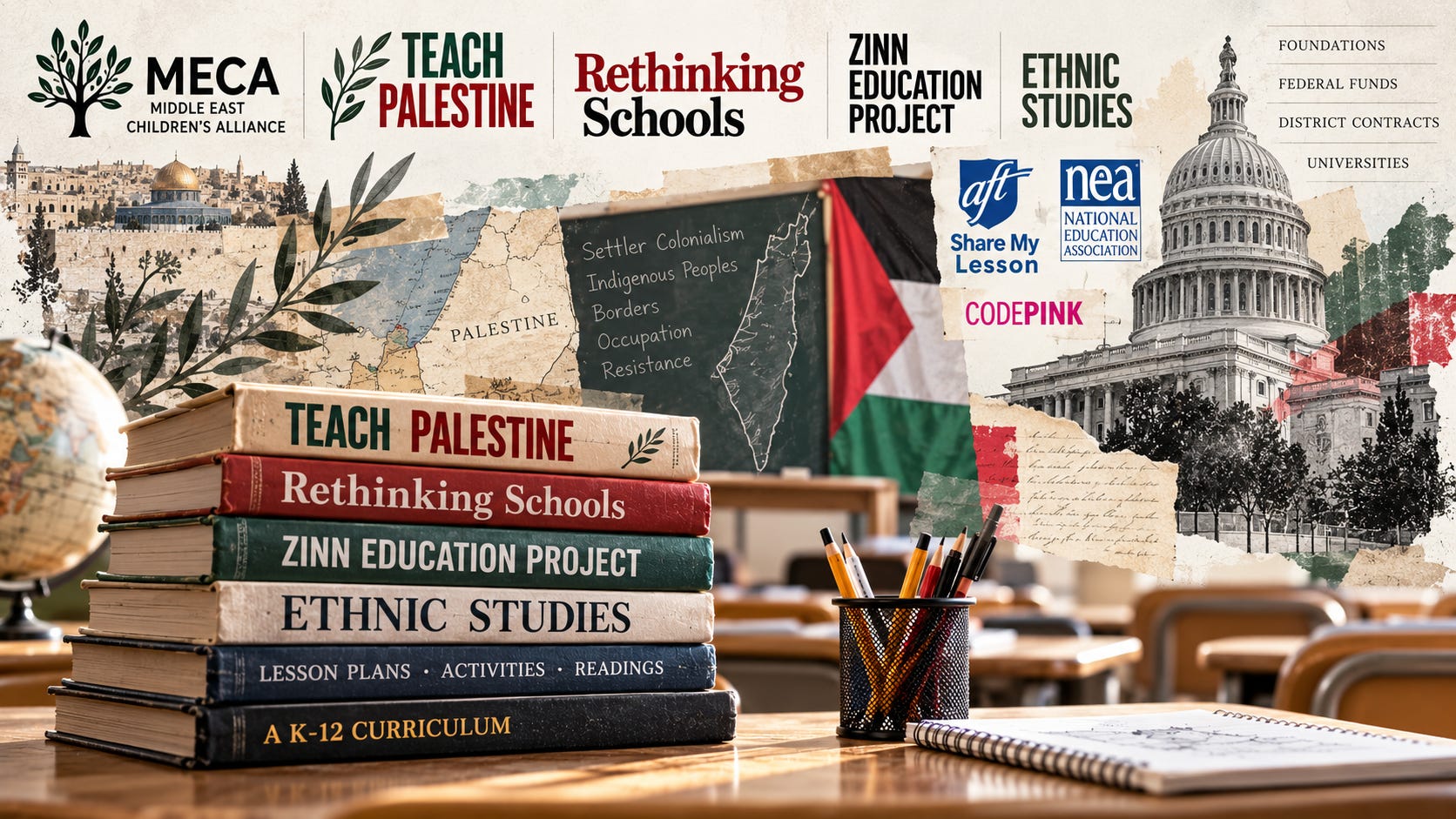
The teach-in had been organized only weeks after October 7, but teachers weren’t starting from an empty folder. Palestine lesson plans, reading lists, children’s books, videos, maps, teaching frameworks, and professional-development resources had been accumulating for years. Organizations were already training educators, publishing curriculum, holding workshops, and connecting Palestine to ethnic studies, Indigenous history, borders, race, colonialism, incarceration, and American social-justice movements.
Oakland was one place where that infrastructure reached the school day.
The classroom distribution system was already visible by the summer of 2026. Extremism in American Classrooms documented activist-created lessons appearing on Share My Lesson, the American Federation of Teachers’ open-source curriculum platform, where educators could find ready-made material on Israel, Zionism, Gaza, and the genocide case against Israel. Some assignments went beyond studying an issue and directed students to create social-media content around it.
Share My Lesson is near the end of the journey. By the time a lesson appears on a teacher platform, someone has already written it, packaged it, funded the organization behind it, trained educators around it, or built the network that distributes it.
Follow the material backward from the classroom and a much larger system appears.
One of the organizations behind that curriculum world is Teach Palestine, a project of the Berkeley-based Middle East Children’s Alliance, or MECA.
Teach Palestine provides materials for K–12 educators, beginning with elementary school. Its current curriculum library includes Sitti’s Bird: A Gaza Story for grades three through five, Youth Incarceration and Resistance in Palestine, Power and Perspective in Palestine, Borders & Walls, Determined to Stay, and a mathematics lesson called Bombs in Gaza. Suppose it was Chicago? Another resource asks children, Why Isn’t Palestine on Our Map?
The lessons move Palestine well beyond a conventional unit on Middle Eastern history. Students encounter it through immigration, borders, Indigenous history, environmental justice, incarceration, Manifest Destiny, racial politics, and settler colonialism. The math lesson uses proportional reasoning to translate the tonnage of explosives dropped on Gaza into an equivalent amount for Chicago.
Teach Palestine also hosts Samia Shoman’s Teaching Palestine/Israel: A Multiple Narratives Approach. The project’s description says Shoman developed it for situations in which “pushback from Zionist parents, administrators and/or organizations is likely.”
Shoman has spent years in California public education and appears repeatedly as this network expands. She has worked with Teach Palestine, helped edit Rethinking Schools’ Palestine material, and participated in the Liberated Ethnic Studies movement.
Teach Palestine does considerably more than post PDFs. It offers virtual and in-person professional learning for K–12 schools and universities, consults with teachers and school leaders, helps educators develop curriculum, conducts workshops, and offers support to families advocating for Palestine education in schools. MECA says the project has worked with schools and districts, supported teachers implementing lessons, conducted classroom visits, and presented at education conferences.
In 2018, Teach Palestine spent three days at the Santa Fe Indian School in New Mexico working with students and staff. Its program connected Pueblo and Navajo experiences with Palestinian history and presented American and Israeli history through a settler-colonial framework. The project has also worked with educators in Douglas, Arizona, connecting the U.S.-Mexico border with Palestine.
The network grew considerably after October 7.