When you’re finished reading today’s post, I hope you’ll check out the latest episode of “The Argument” podcast, where Jerusalem and I talk about how immigration is hurting the cause of liberalism in Europe. Paid subscribers can watch or listen ad free and read the transcript and show notes here. Free subscribers can watch the episode on YouTube here or listen wherever you get your podcasts.
Reading all of the 25th anniversary posts about September 11 last month, it seems that the modern consensus is that while the 9/11 attacks were bad and immoral, the American response was also bad.
I think this consensus is good.
But in the course of forging that consensus, I think many have been swept up in the notion that everything that was bad about the American response was “overreaction.” And I don’t think that’s right.
Part of the tragedy of the 9/11 response is that here we are, 25 years later, and the genuinely evil Taliban is once again in charge of Afghanistan. In a world full of problems and tragedy, Afghanistan (where girls over the age of 12 are officially banned from receiving education) is a pretty egregious outlier. The new Taliban regime is also harboring jihadi militants who are clashing with Pakistan’s military, and there are indications that al-Qaeda cells are regrouping in Afghanistan.
Obviously nobody wants the United States to invade again. But this is not a good situation!
The Taliban was, as of the fall of 2001, not the internationally recognized government of Afghanistan. They had terrible values. And their habit of harboring international terrorists who killed thousands of Americans was a perfectly legitimate casus belli under customary international law and the United Nations charter. It would be a lot better for the region and for the world if America had won the war in Afghanistan. And it’s driven me crazy for years that the media gave so much more scrutiny to the implementation details of the Biden administration’s withdrawal of forces at a point when the war was already unwinnable and had no public support than it gave to the prior 20 years of failed policy.
Because I think it’s clear that the United States messed up quite badly, but not by “overreacting” or relying too much on military force. Rather, the mistake was being way too complacent about the rapidly achieved win against the Taliban by the Northern Alliance (a coalition of anti-Taliban militias mostly composed of members of Afghanistan’s minority Tajik and Uzbek ethnic groups) and therefore not committing nearly enough resources to Afghanistan.
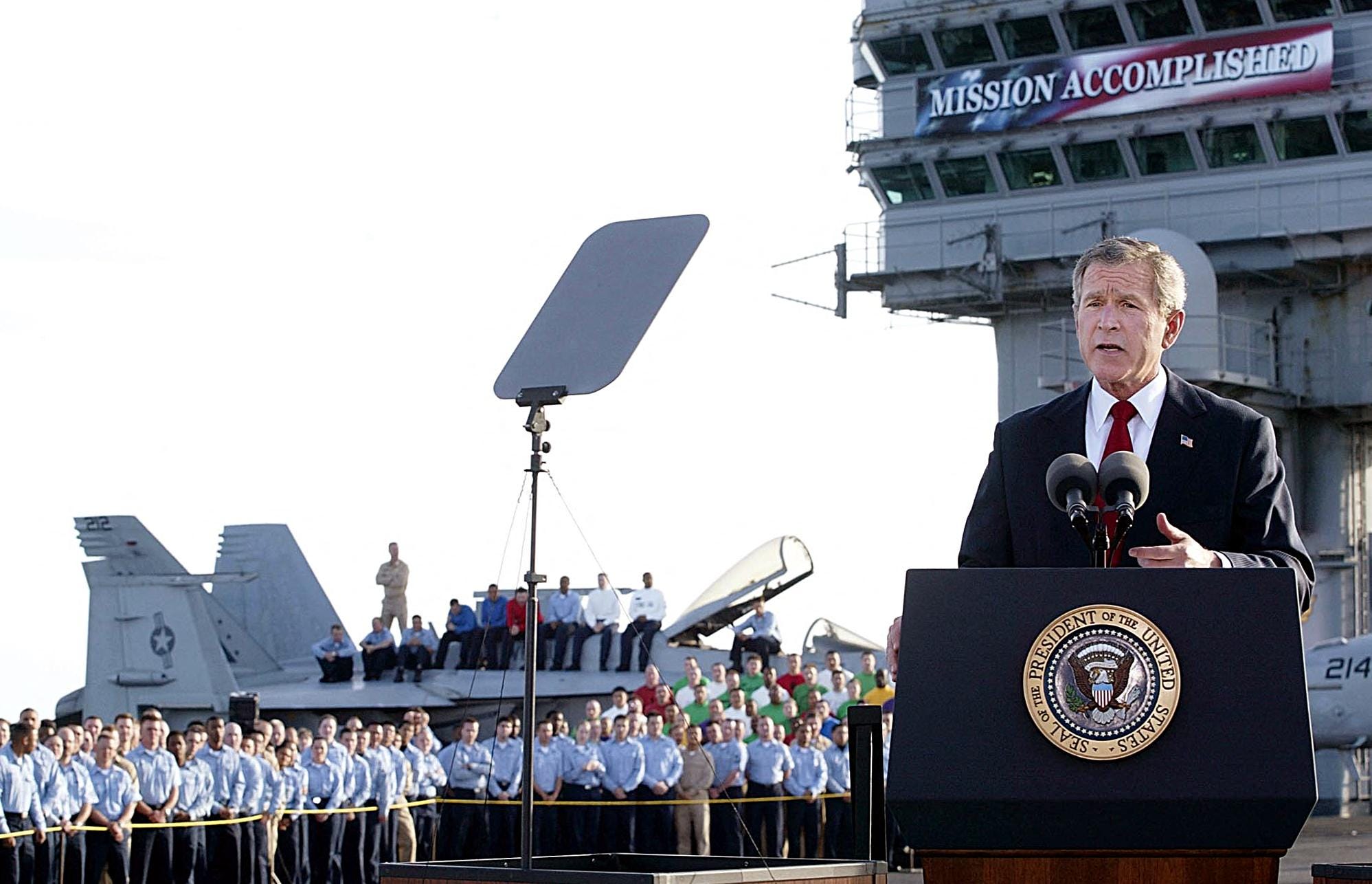
It was fashionable at one point to argue that the Bush administration’s passion for invading Iraq had fatally undermined the good war in Afghanistan. And while that view later became unfashionable because it inspired a bad policy choice of its own, I think it holds up reasonably well.
I recently read Carlotta Gall’s book “The Wrong Enemy: America in Afghanistan, 2001-2014,” which while excellent, suffers from the classic reporter’s aversion to clearly stating a thesis. She does, though, assemble the facts to tell a clear story, and if you want a much more detailed and vivid account of the war than I can possibly offer in one column, you should read it.
Though the Taliban ruled most of Afghanistan as of 9/11/2001, they were very much engaged in an active military conflict with the Northern Alliance. Right before 9/11, the Taliban had succeeded in assassinating the Northern Alliance’s main leader, Ahmad Shah Massoud, and perhaps would have won the war if not for the attack on the Twin Towers.
But the towers fell, and the United States became very interested in helping the Northern Alliance win the war.
The floodgates were open for supplies, and Northern Alliance fighters were the sudden beneficiaries of American close air support and special forces. Pakistan, which had been the Taliban’s best friend, panicked and cut it off.
This rapidly turned the tide and led to the fall of several major Taliban-ruled Afghan cities. By the time the Taliban tried to regroup in its southern heartland, the 10th Mountain Division, the 101st Airborne, and some NATO and Australian special forces had joined the fight. As a result, the Taliban collapsed rapidly and a lot of loose talk about “the graveyard of empires” looked silly.
But the Taliban’s leadership wasn’t dead, and they didn’t surrender.
Instead, they and many of their fighters retreated to Quetta across the border in Pakistan. After laying low for a brief span of time, they began to launch what was at first a low-level insurgency in the rural south of Afghanistan. And instead of really responding to this, the American government maintained low troop levels in the country and undertook a major invasion of Iraq.
The weak American presence on the ground from 2002 to 2006 had several consequences.
One is that it left the American troops who were there reliant on air power to protect themselves. This style of warfare performed well during the initial overthrow of the Taliban, but as a means of securing the countryside, it meant that the United States was killing innocent people.
Another is that allied troops were spread too thin to secure broad swaths of the country. People living in the insurgency-impacted region were in a worst-of-both-worlds situation: The Americans couldn’t necessarily protect them from the Taliban and also might accidentally destroy their homes in an anti-Taliban air raid.
Third, it meant few soldiers were available to train Afghan police and military forces.
As the insurgency gained steam starting in 2006, the United States started pouring more troops in. Then under Obama, there was another troop surge, which did temporarily reverse insurgent gains.
But through 2010, there were consistently more troops in Iraq than in Afghanistan, often many more. Even the Obama-era peak deployment in Afghanistan was much smaller than the peak deployment in Iraq had been.
Considering allied forces only makes this more striking. For a couple of years at the beginning of the insurgency there were more coalition (primarily British) troops in Iraq than there were Americans in Afghanistan. As unpopular as the Iraq War was globally, a lot of governments wanted to do the Bush administration a favor. If the favor Bush wanted had been more and earlier help in Afghanistan, he could have gotten that easily. And of course the United States could have sent dramatically more soldiers to Afghanistan and secured every southern town.
But that wasn’t his priority, and this mattered not just for the disposition of forces but for diplomacy.
Beyond troop levels, a huge consequence of the focus on Iraq is that the American government didn’t prioritize developing a coherent relationship with Pakistan. As George W. Bush eventually admitted in his memoirs, after the United States agreed to lift sanctions on Pakistan, make Pakistan a major non-NATO ally, and give Pakistan billions of dollars in aid, the country turned around and screwed him.
“Over time,” Bush writes, “it became clear that Musharraf either would not or could not fulfill all of his promises.” At another point he observes that “[s]ome in the Pakistani intelligence service, the I.S.I., retained close ties to Taliban officials. Others wanted an insurance policy in case America abandoned Afghanistan and India tried to gain influence there.”
Pakistan’s affection for the Taliban is a bit perplexing (as noted above, they are now at war, which seems like it should have been predictable) but also pretty longstanding.
One dimension of this is that Afghan nationalists have traditionally disputed the British-drawn border that separates the Pashto-speaking parts of Afghanistan from the Pashto-speaking parts of Pakistan, so Pakistan prefers Islamists to these secular nationalists. Another dimension is that Pakistan thinks Islamists are reliably anti-Indian. More broadly, Pakistani intelligence has long backed Islamist fighters in India and the Baluchistan corner of Iran.
Pakistan might prefer a world where Islamist groups in its neighboring countries were hermetically sealed off from al-Qaeda and from each other, such that it could turn support for any given group on or off like a switch, but the world doesn’t work that way.
Relatedly, the Pakistani government’s perception, at least early in the war, was that if it tried to root out Taliban safe havens inside Pakistan, it would have a domestic civil war on its hands. Alternatively, it could encourage the most fired-up jihadis in the country to go across the border and fight in Afghanistan. Rather than make tough choices, the Pakistanis preferred to defer as much as possible — fitfully cooperating with the United States against al-Qaeda but not moving against the Taliban’s refuges, while their intelligence services retained a lot of quasi-deniable channels to the Taliban.
Over time, this created a self-fulfilling prophecy whereby the Hamid Karzai government in Afghanistan was hostile to Pakistan and friendly with India, which became further reason for Pakistan to prefer the Taliban.
Steve Coll’s book, “Directorate S: The C.I.A. and America’s Secret Wars in Afghanistan and Pakistan,” is named after the branch of Pakistani intelligence charged with relations with the Taliban. Coll is somewhat more sympathetic than the aforementioned journalist Carlotta Gall is to American policy choices in this regard, arguing that turning a blind eye to Pakistan’s support for the Taliban paid real dividends in fighting al-Qaeda.
One point where Coll and Gall therefore end up disagreeing is on whether Pakistani intelligence was genuinely complicit in Osama bin Laden’s presence in their country. What’s agreed, though, is that by the time of the American raid on his compound, the relationship was strained and nobody in the American government regarded the Pakistani government as reliable or trustworthy. The decision was made to just muddle through as best we could, without a coherent take on the endgame for Afghanistan.
The basic “Bush lost Afghanistan by focusing on Iraq” narrative that I’m pushing is an argument that Barack Obama made on the campaign trail in 2008. It’s fallen out of favor in part because after winning the election, Obama sort of governed on the premise that you could throw this into reverse — drawing troop levels down in Iraq and surging forces into Afghanistan.
This surge meant that finally, by 2010 and 2011, we were properly investing in Afghanistan.
And according to Gall’s reporting, it worked in a limited sense. The insurgents were substantially beaten back. Civilian casualties didn’t end by any means (it’s still a war), but with more boots on the ground, there was a much higher ratio of “Americans providing useful security” to “Americans blowing stuff up from afar,” and people noticed. More engaged American commanders were able to facilitate some governance improvements in the south. The war effort still had its share of problems. Notably from the standpoint of my interests (though not Gall’s or Coll’s), Afghanistan not only adopted a presidential mode of democracy (always a mistake) but also had a weirdly centralized form of government with the president selecting regional governors.
But the fundamental issue, as Gall was able to forecast at the time, was Pakistan and America’s limited patience. The surge was designed from the beginning to be temporary. Everyone knew it was temporary, and the Taliban was foreseeably going to be able to wait the Americans out across the border and then come back. Which is exactly what happened.
I don’t want to say the war was categorically unwinnable by the time Obama took office, but there was just no way the United States was going to fully and durably commit to this level of effort starting in the eighth or ninth year of the war. The surge feels to me more like an effort to say that we tried than actually trying.
But that’s because the time to actually try was in 2002 and 2003.
Back then, the Taliban was defeated. Pakistan had its finger in the wind about the future of the region. If the United States had done an Iraq-scale troop deployment at the time, the insurgency never would have gained strength. If Afghanistan rather than Iraq had been the focus of American diplomacy, the Pakistanis might have been persuaded to drop their dumb hedging strategy with the Taliban that ended up backfiring on them anyway.
After 25 years and two big wars, plus smaller engagements in Syria and Yemen and Libya, it’s easy to mash the conflicts of the era together into one big blob of mistakes and failure.
But it’s genuinely quite relevant that for the critical early years in Afghanistan, we had more than 10x the troop levels over in Iraq on a mission with dubious legal and moral grounding while treating a much more legitimate effort as a backwater until it was too late.
America didn’t overreact in Afghanistan. We massively underreacted, and the embarrassing and tragic failure there should be seen as part of the cost of invading Iraq.
As a reminder, paid subscribers can watch or listen ad free to this week’s episode of “The Argument” or read the transcript and show notes here. Free subscribers can watch the episode on YouTube here or listen on your podcast app of choice.