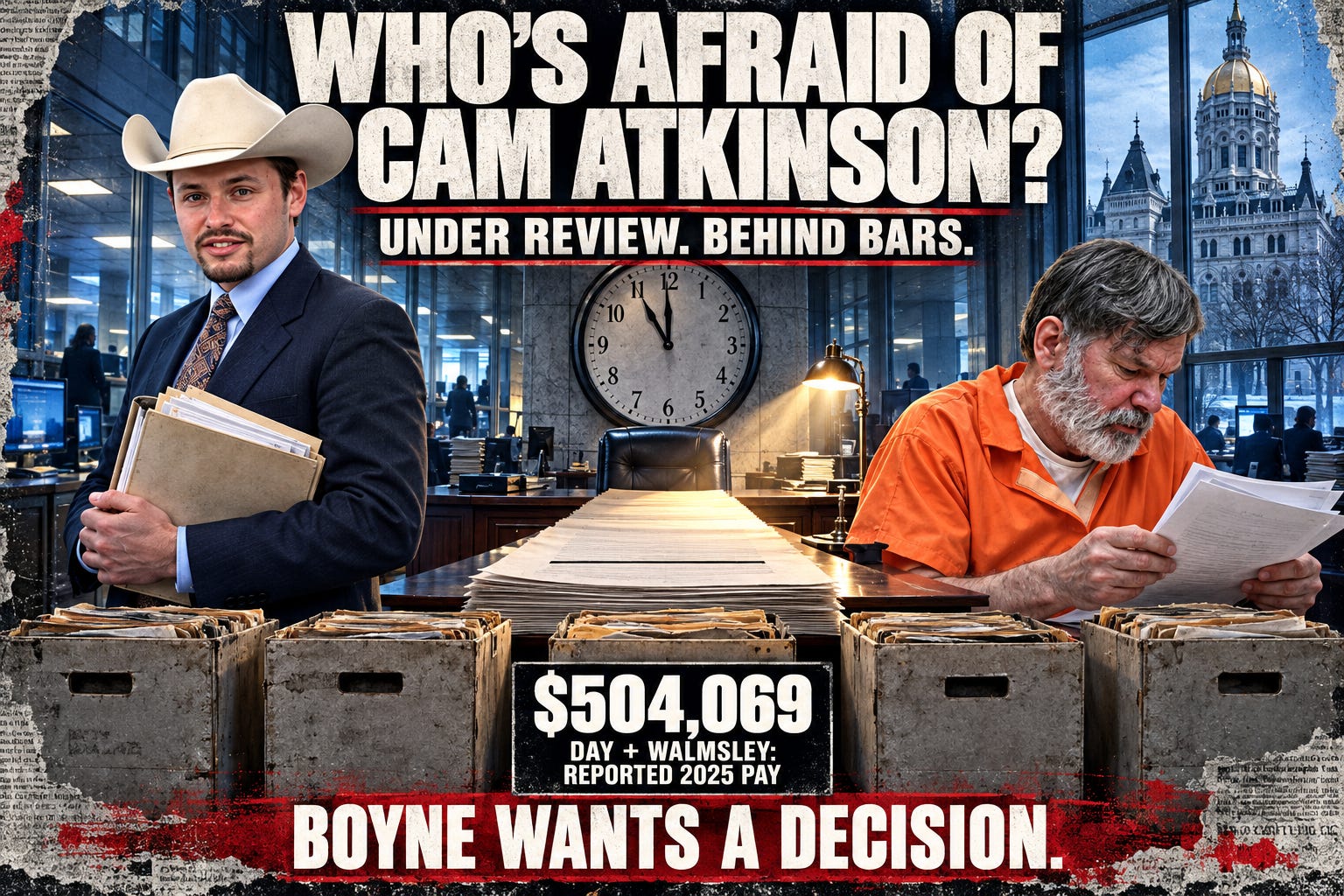
LUTHMANN NOTE: I asked PDS whether it fears Cam Atkinson will expose professional negligence in Boyne’s earlier representation. That question deserves an answer. An agency entrusted with defending prisoners must tolerate scrutiny of its own lawyers, especially when a former defense attorney now holds a senior position inside that agency. Boyne’s suspicions about outside influence require evidence. PDS controls records that could help establish what happened. Show us the appointment chronology. Explain who participated and how conflicts were handled. Then make a decision. Connecticut’s taxpayers have already financed the management salaries. Boyne shouldn’t have to finance bureaucratic indecision with more time lost behind bars. This piece is “Who’s Afraid of Cam Atkinson?,” first available on The Family Court Circus.
Paul Boyne has five boxes of discovery, a 20-year prison sentence, and a question for Connecticut’s well-paid public-defense bureaucracy: Where the hell is Cam Atkinson’s contract?
Boyne says nationally-renowned Constitutional lawyer Cameron Atkinson visited him at MacDougall-Walker in August and is willing to accept substantially reduced compensation, with some work donated as pro bono time.
Atkinson’s professional biography describes a practice devoted in substantial part to free speech, religious liberty, gun rights, and privacy. His actual proposed contract and financial terms remain to be confirmed.
Atkinson has already taken constitutional fights well beyond Connecticut’s courthouse steps. He has served as lead counsel in more than 30 federal and state appeals, and appeared as counsel of record in several U.S. Supreme Court matters. He earned both his law degree and MBA from Quinnipiac in 2020 and founded his own firm in 2022. That is substantial appellate experience packed into a short career.
His name also appears on the Supreme Court petition challenging Connecticut’s assault-weapons ban, alongside a team that secured Supreme Court review in * Grant v. Higgins* on June 30, 2026. Getting the justices to hear the challenge is a significant procedural accomplishment; the constitutional merits remain to be decided.
For Boyne, the attraction is obvious: Atkinson brings experience challenging government power, developing constitutional arguments and carrying them into appellate courts. Those qualifications deserve serious attention from the officials reviewing his proposed appointment. A prisoner asking for an independent examination of his prosecution has every reason to want a lawyer prepared to challenge the assumptions that put him behind bars.
“As of Friday, Cam still doesn’t have a contract,” Boyne said. Then came the question that should embarrass everyone drawing a management paycheck at Public Defender Services: “Where do I go from here?”
Chief Public Defender John Day and Assigned Counsel Director Alix C. Walmsley ought to be able to answer. OpenGovPay lists their combined 2025 pay at $504,069. Boyne’s account of their agency’s progress is considerably less impressive.
“Every time I ask where the contract is, it’s being reviewed.” By September 21, he was still reporting the same unfinished business.
Half a million dollars buys an awfully expensive waiting room.
The point of engaging Atkinson would be to put a fresh lawyer through the prosecution’s records and the defense’s performance, with enough independence to follow the evidence wherever it leads.
The waiting stretches back to August 14, when Boyne said PDS had identified Atkinson as its preferred candidate and was approaching him. Over forty days have elapsed between that account and Boyne’s latest phone call inquiry. The date of a completed application remains undisclosed. PDS can settle that question by producing the chronology. Until then, Boyne is describing more than five weeks of expectations followed by bureaucratic limbo.
Day knows what a shortage of defense lawyers looks like. In January, he told CT Mirror: “As the list of attorneys declined, we had to give more assignments to existing ones.”
Now Boyne describes a willing constitutional lawyer, willing to take reduced rates, waiting on the agency. If there’s a legitimate obstacle, Day should be able to explain it without another lap around the committee table.
The agency’s own rules put Walmsley in charge of assigned counsel and give Day final approval. A standing committee assists the process. The unit manages more than $40 million for approximately 22,000 cases annually. These people administer lawyers for a living. They should be capable of telling one prisoner which desk stands between him and a decision. portal.ct.gov
Here is what four senior PDS officials received in ** 2025 pay, reported by OpenGovPay**. The figures come from the individual payroll entries:
John R. Day—Chief Public Defender—$264,493Alix C. Walmsley—Director of Assigned Counsel—$239,576Jennifer Bourn—Chief of Legal Services—$233,056Todd Allen Bussert—Director of Complex Litigation—$203,335
That is nearly a million dollars across four officials, with Day and Walmsley accounting for more than half. These are annual payroll figures, not spending on Boyne’s case. They belong in this story because the public pays for competent administration, and Boyne’s account demands an explanation of what that administration has accomplished. A handsome salary doesn’t make a contract move. Somebody earning it has to do the work.
Boyne has a harsher explanation. He believes an independent lawyer threatens the professional comfort of people who handled his case. Richard Luthmann put that concern squarely to Day and Walmsley in a September 22 press inquiry: “Is PDS afraid Atkinson will expose professional negligence in Boyne’s prior representation?”
Date: On Tuesday, September 22nd, 2026 at 10:25 AM
Subject: PRESS INQUIRY: Why Is Paul Boyne Still Waiting for Cam Atkinson? Ten Questions for CT Public Defender Services
To: Alix.Walmsley@pds.ct.gov, john.day@pds.ct.gov
CC: catkinson@atkinsonlawfirm.com, Kelly.Billings@pds.ct.gov, Todd.Bussert@pds.ct.gov, Denis.OMalley@pds.ct.gov, Deborah.Sullivan@pds.ct.gov, Audrey.Gilzene@pds.ct.gov, deborah.d.sullivan@pds.ct.gov, RALafontaine@protonmail.com, RickLaRiviere@proton.me, mthomasnast@protonmail.com, frankiepressman@protonmail.com, mvolpe998@gmail.com, frankparlato@gmail.com, msully0916@gmail.com, charlotteobservernews1@gmail.com, larrylokshen@gmail.com
-
When did PDS receive Atkinson’s application or proposed engagement? Provide the submission date, when the materials became complete, and any outstanding requirements communicated to him.
-
What explains the delay? Identify the unresolved issues, the officials reviewing them, and how this processing time compares with similar appointments.
-
What representation and compensation are under consideration? Specify the proposed proceedings, payment terms, donated services, and whether any disagreement over scope or money is preventing approval.
-
Is PDS afraid Atkinson will expose professional negligence in Boyne’s prior representation? My concern is that an independent examination could embarrass the agency and its lawyers. Has fear of that scrutiny played any role in delaying, limiting, or opposing his appointment?
-
Has Todd Bussert participated in discussions or decisions about Atkinson’s appointment? Your directory lists Bussert as Director of Complex Litigation, and Boyne challenges his trial representation. Identify Bussert’s involvement and any measures taken to prevent conflicted review.
-
Mr. Day, did you call Boyne a “fucknut,” as Boyne alleges? Confirm or deny the statement. If you made it, explain the circumstances and whether personal hostility has affected your decisions concerning his representation.
-
Is anyone outside PDS directing or influencing the selection of Boyne’s counsel? Identify communications with prosecutors, judges, political officials, advocacy organizations, or other outside parties concerning whom Boyne should have as counsel or what that lawyer should be permitted to examine.
-
Have Joette Katz, Jonathan Greenblatt, the Anti-Defamation League, or anyone acting on their behalf sought to delay, restrict, or prevent Atkinson’s appointment? Boyne attributes the obstruction to their influence. Please address that accusation directly and identify any relevant communications or requests.
-
When will Boyne receive a decision, and who is protecting his interests while he waits? Identify current counsel, responsibility for approaching deadlines, and the date PDS expects to resolve the proposed appointment.
Tips or Story Ideas:
(239) 631-5957
Substack:
Editor-In-Chief:
Editor-In-Chief:
Editor-In-Chief:
Contributor:
Contributor:
Follow Me on
No response to the inquiry was received as of press time.
Bussert’s position gives the question particular weight. He represented Boyne, and PDS’s directory identifies him as Director of Complex Litigation. Boyne disputes the adequacy of his defense. Has Bussert participated in decisions about Atkinson? Has anybody whose work might be challenged helped determine the scope of the proposed assignment? Those questions go straight to whether the next lawyer can examine the previous lawyers without institutional interference.
Meanwhile, Boyne says he is digging through the evidence himself: “there’s no index to the shit.” That was his description of the discovery boxes in the September 21 call. A prisoner sorting records under those conditions needs someone equipped to turn potential issues into properly supported claims. Every week of administrative drift leaves him doing more of that work from a cell.
There is a document explaining why the constitutional review matters. In a January 13, 2023 email, Virginia Attorney General’s Office Chief Prosecutor Phillip O. Figura wrote that “Connecticut authorities suddenly have 1’st amendment concerns about a possible prosecution.” He wanted a meeting about bringing charges or returning Boyne’s property.
That email predates Boyne’s conviction. It records a constitutional problem officials were discussing during the investigation, without resolving whether the eventual prosecution overcame it. An independent lawyer should trace what happened next: what advice was given, how the charges developed, what the defense challenged, and what reached the jury. The state’s own correspondence supplies a reason to investigate. PDS should be helping a lawyer examine it.
Boyne’s outside-influence theory reaches further. He believes Joette Katz, Jonathan Greenblatt, and the Anti-Defamation League helped drive the prosecution and would resist independent scrutiny of it.
Boyne predicts that “the wheels will come off the crazy bus” if independent counsel gets involved. Boyne described what he says discovery reveals about Katz’s contacts with prosecutor John “Jack” Doyle: “Every fucking email she received, either from me or you, or Volpe, was forwarded to Doyle.”
That is Boyne’s account of discovery. His accusation should be tested against communications and decisions, with names, dates, and the actual requests attached. PDS has every reason to make that examination possible. A complainant forwarding correspondence to a prosecutor may have an ordinary explanation. An outside party trying to dictate a defendant’s lawyer, restrict the lawyer’s investigation, or protect former counsel from scrutiny would present a very different problem.
So ask the uncomfortable questions. Has anyone outside PDS discussed Atkinson’s appointment with Day, Walmsley, Bourn, or Bussert? Has anyone sought limits on the records he could review or the claims he could pursue? Has concern about embarrassing a judge, prosecutor, former defense lawyer, or advocacy organization entered the discussion? Publish the nonprivileged appointment records. Identify any conflicts and explain how they were handled. Institutional independence ought to survive contact with its own paper trail.
The same inquiry asks Day whether he called Boyne a “fucknut,” as Boyne claims. Day should answer directly. If he used the word, he should explain whether that contempt influenced decisions about Boyne’s representation. A chief public defender cannot make a client’s likability the entrance exam for competent advocacy. Difficult clients are part of the job. At $264,493 in reported annual pay, personal irritation is a poor excuse for failing to do it.
Boyne’s accusation of previous deliberate obstruction is corroborated by a smoking-gun email. The demand for a PDS decision needs no conspiracy theory. Day controls final approval. Walmsley runs the contracts. They should identify the outstanding requirement, resolve the proposed assignment, and tell Boyne who is protecting his interests in the meantime.
If Atkinson’s application is deficient, say exactly how. If PDS rejects him, explain the decision and the plan for independent representation. If fear of what he might uncover has entered the process, the scandal reaches beyond an unsigned contract. It reaches an agency using its power over a prisoner’s defense to protect itself.
Boyne is serving the sentence. The administrators collect the salaries. Day and Walmsley should earn theirs by putting a decision on paper and allowing the resulting representation to withstand scrutiny. Connecticut has already paid handsomely for their judgment. It should stop accepting “being reviewed” as the finished product.
“At this point, I have a shit-ton of discovery pointing to misconduct and malfeasance,” Boyne said. “Cam Atkinson would make short work of the constitutional violations, which is why the Connecticut tyrants will never allow him to be engaged.”