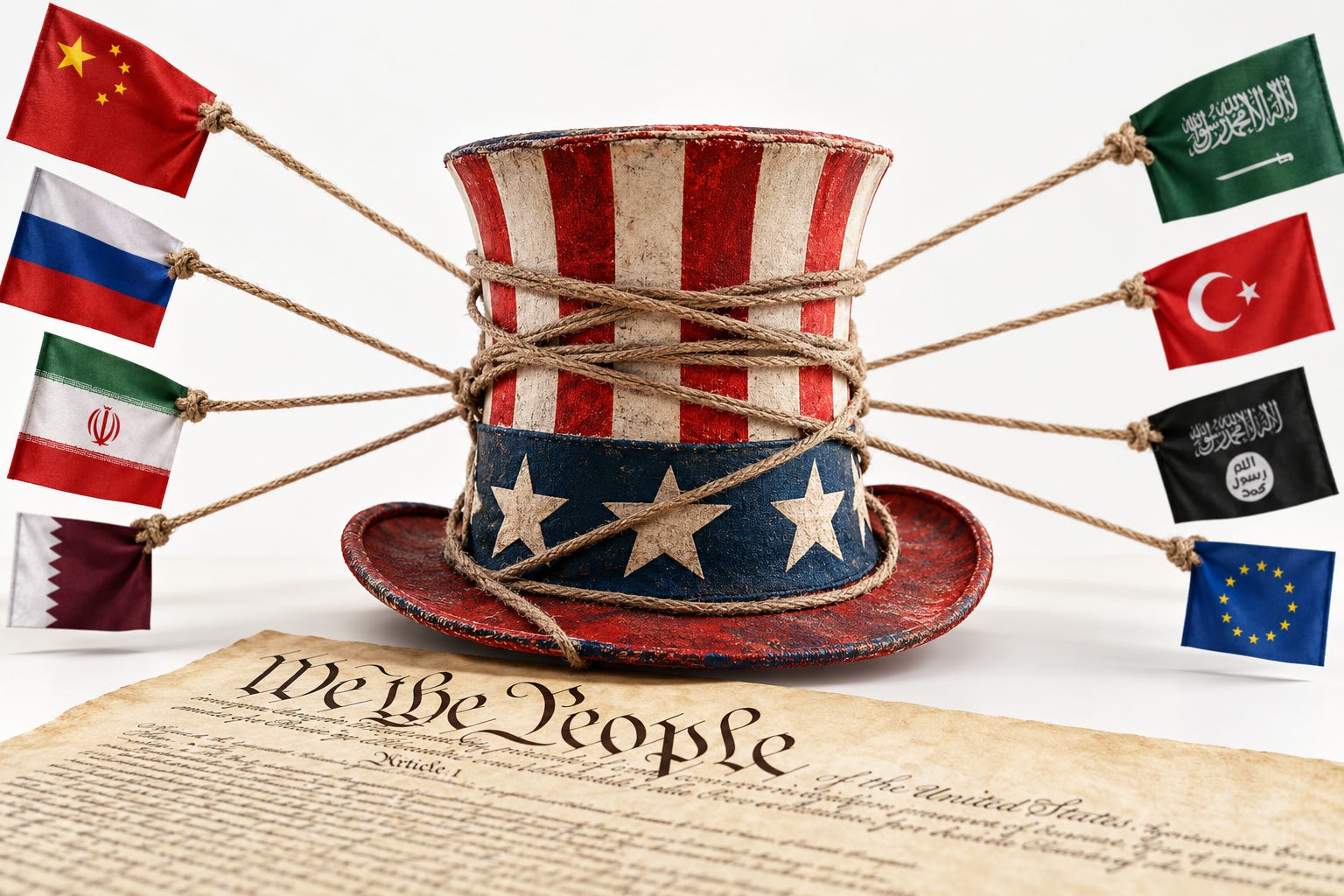
I knew about a few of these pieces individually. I’d researched and written about some before. You’ll find some of my articles linked throughout this piece. There’s something very different about putting more than two hundred years of them in one place and seeing what they look like together.
A few days ago I published “First the Nazis. Then Iran. Why Argentina?” and followed decades of foreign interests, political movements, money, ideology, and influence through one country.
A friend read it and suggested I turn the same lens on America.
This turned out to be quite a bit bigger. So, let’s get into it.
In 1793 a French diplomat decided George Washington was getting in his way.
Edmond-Charles Genêt arrived in Charleston that April representing revolutionary France, which was at war with Britain and much of Europe. France had helped Americans win their independence, the French Revolution had plenty of fans here, and Genêt got a hero’s welcome. Apparently, he took that as encouragement.
Washington wanted to keep the United States out of another European war. Genêt wanted American help and began behaving as though he already had it. Before he had even formally presented himself to Washington, he was commissioning privateers in American ports to attack British ships and encouraging Americans to join French military ventures.
The administration told him to stop. Genêt kept going, convinced enough Americans supported France that Washington could be worked around. If the president wouldn’t cooperate, Genêt was prepared to take his case directly to the American people and let public pressure do the work. A representative of a foreign government was trying to use Americans to push an American president into changing American foreign policy.
In 1793.
Washington demanded his recall, but he clearly didn’t forget the experience. Three years later his Farewell Address included a warning about Americans becoming too attached to foreign powers and too consumed by their fights with one another. Foreign influence, he wrote, was “one of the most baneful foes of Republican Government.”
Political factions made the country easier to manipulate because they gave outsiders Americans who were already angry at other Americans. Washington warned that foreign powers could “mislead public opinion” and work through “the channels of party passions.” He even warned that people working in another country’s interests could look like patriots while the people resisting them were painted as the enemy.
There was no television, social media, universities taking billions in foreign money, nonprofit foundations, fiscal sponsors, or influencers with millions of followers. There were Americans who disagreed with one another and foreign governments smart enough to notice.
Thomas Jefferson had already run into a different version of the problem. In 1786 he and John Adams met with the ambassador of Tripoli because the Barbary states were attacking American ships and taking their crews captive. The Americans hadn’t attacked them. Adams and Jefferson wanted to know why they were being targeted.
Their report to John Jay recorded the ambassador’s answer. He told them the justification came from “the Laws of their Prophet” and the Quran, which he said gave them the right to wage war against nations that did not acknowledge their authority and enslave prisoners they captured.
Adams and Jefferson agreed America had a problem, but they disagreed pretty sharply about what to do with it. Adams looked at the cost of a war, looked at what European countries were already doing, and favored paying tribute. Jefferson looked at the same arrangement and saw a pretty obvious problem: once threats get results, there’s a reason to keep making threats.
America paid tribute for years anyway, and the demands kept coming. Tripoli eventually wanted more. Jefferson refused, and Tripoli declared war in 1801, sending American warships to the Mediterranean.
There’s something noticeable that keeps turning up in this story. Intimidation gains power when intimidation works. Governments, political movements, and extremists don’t need everyone to agree with them if enough people decide resisting them is more trouble than giving them what they want. The people living closest to extremists can pay for that bargain too, including moderate Muslims who challenge Islamist movements while everyone else decides avoiding confrontation is safer.
Jefferson worried about quieter forms of influence too. In 1797 he wrote to Elbridge Gerry about British influence reaching into American commerce, banking, politics, and “our printing presses.” He wanted some way to protect the country against foreign influence “commercial, political, or in whatever other form it may be attempted.”
The problem was already sitting in the parlor, and the solution was harder. America protected speech, political disagreement, association, and a free press. Government wasn’t supposed to control what people believed or whom they supported. Give it enough power to root out foreign influence, though, and it could very quickly acquire enough power to go after Americans it didn’t like.
It didn’t take long to prove the point.
Fear of French influence helped produce the Alien and Sedition Acts in 1798. Newspaper editors were prosecuted, and political opponents were targeted. An attempt to protect the republic had handed the federal government powers that threatened the freedoms it was supposed to protect.
Americans pushed back, and the laws mostly disappeared. But... the problem didn’t. That push and pull would show up over and over again: a real threat, a government response that went too far, public outrage, new protections, and another opening nobody had considered yet.
America has been trying to get the balance right ever since.
More than a century later Europe went to war, and the United States wanted to stay out of it. Germany found plenty of ways to bring the war here anyway.
In the early hours of July 30, 1916 explosions ripped through the Black Tom munitions depot in Jersey City. The place was packed with ammunition waiting to be shipped to Britain and France. The blasts shattered windows across New York Harbor, hurled debris through the air, and damaged the Statue of Liberty. Her torch has been closed to visitors ever since.