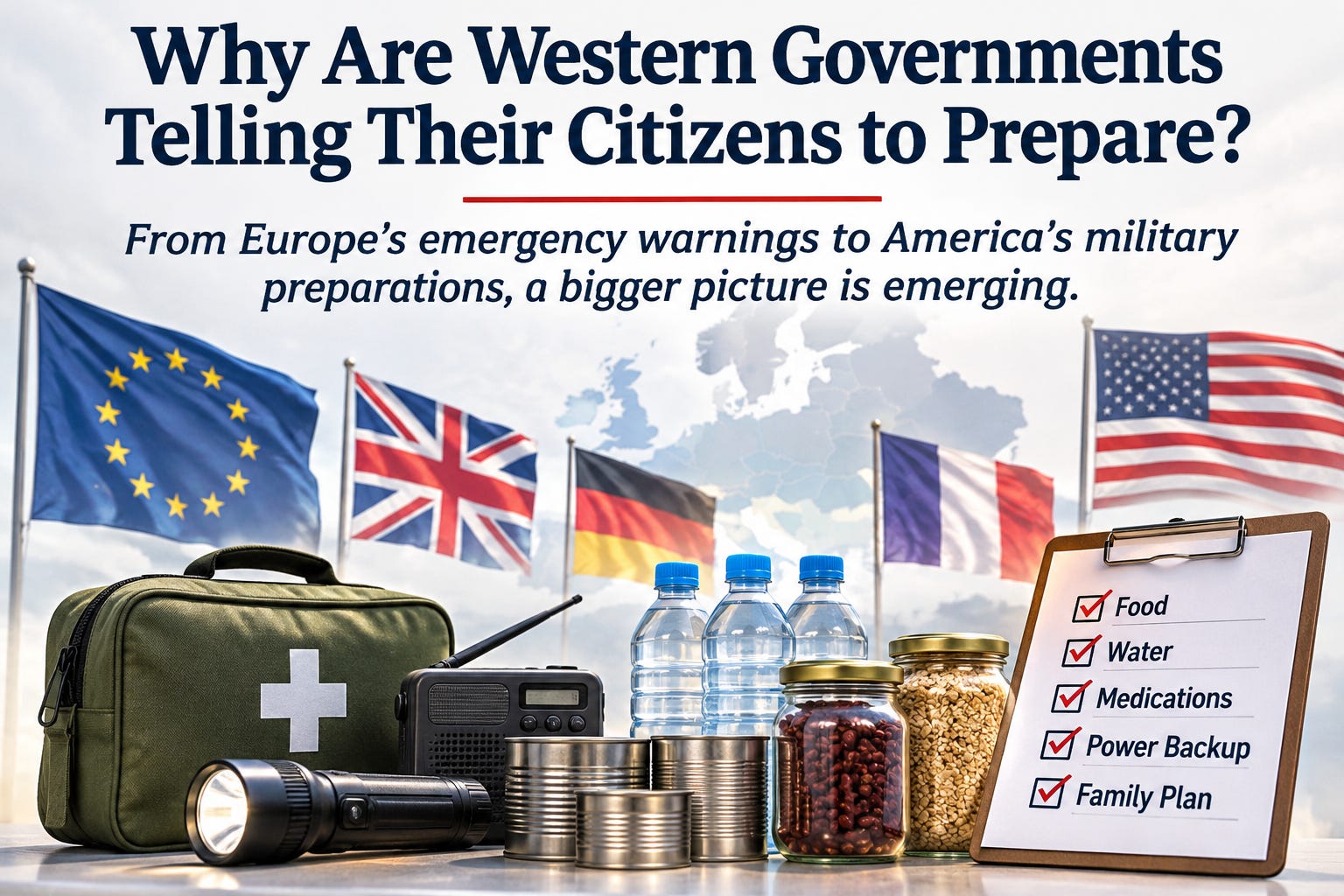
I feel like this is a weird, uncomfortable article to write. Especially the day after our nail-biting elections. But between everyone sending me videos and the stories I’ve been following from Europe and the United States, I’m a bit unsettled. When you read about Britain’s new emergency preparedness campaign, it’s one story. Germany telling its citizens to stock up on 10 days' worth of food and water is another. Sweden bringing back Cold War-style civil-defense instructions, the European Union asking 450 million people to prepare for emergencies, and the Pentagon working on making American military bases more self-sufficient are all separate stories that might not get much attention beyond their own headlines.
But…when you start stacking those stories on top of one another, a much bigger picture begins to emerge. And that’s what’s giving me reason to pause. I wanted to know what the full picture looks like, because each announcement in isolation doesn’t tell us nearly as much as checking out what governments across the Western world are doing almost simultaneously.
OK, I’m not about to start running around in circles screaming that the sky is falling; that would be premature. Because I have absolutely no clue about what’s coming, if anything at all. And I’m not necessarily an alarmist, anyway. But…I do like to be forewarned and prepared, just in case of a hopefully unlikely catastrophic or otherwise type of event.
The reality is, these governments could simply be getting better at preparing their populations for emergencies, which is something they should have been doing all along. But…I also have to wonder whether officials with access to classified intelligence and national-security assessments are receiving information about risks that the rest of us don’t have access to or even fully understand yet. Could these public preparedness campaigns encourage people to get ready without creating unnecessary panic? It’s a question I think is worth asking, although I couldn't find any evidence that the campaigns are intended as coded warnings.
I’ve also been hearing from others about people buying cases of bottled water, stores running low on canned goods, and certain supplies disappearing from shelves. I have no idea how widespread any of that is, or whether it’s connected to these government announcements. But it’s another reason I’ve been paying attention, particularly as so many countries are encouraging households to consider what they would do if ordinary supply chains were interrupted.
Maybe you’ll read this and think I’m connecting dots that don’t belong together. Maybe you’ll think there’s something here worth watching, or maybe you’ll decide it’s all a big nothing burger (don’t ask me why I’m using that expression, it just flew from my fingers and I’m going with it). I’m perfectly fine with any of those reactions, because I’m still trying to figure out what to make of it myself.
What I don’t want is for any of us to be caught completely by surprise if a serious emergency does occur. There’s nothing wrong with having a little extra food in the pantry, keeping water and medications on hand, or making sure your family has a plan if the electricity or internet goes down. We do those things for hurricanes, and I don’t see why preparing for other possible disruptions should be any different.
So I started going through government announcements, preparedness guides, military initiatives, and security warnings to see what each country is actually saying, what threats its officials are discussing, and how these developments look when all stacked together.
On October 22, 2026, the British government launched Be Ready, the first stage of a three-year public-information campaign encouraging households to prepare for emergencies. The government recommends keeping enough food and water for three days, along with flashlights, batteries, essential medications, a first-aid kit, and some cash in case electronic payment systems become unavailable.
Britain has issued household preparedness guidance before, but this campaign is intended to reach a much larger audience through advertising, businesses, and community organizations. More than 500 organizations have signed up to help distribute the information, which explains how people can prepare for interruptions to electricity, water, telephone service, and internet access.
The Cabinet Office says households capable of looking after themselves during the first few days of an emergency allow responders to concentrate on people who need immediate assistance. Severe weather remains an important concern, although Britain’s broader national-security planning also addresses cyberattacks, hostile states, and the vulnerability of essential infrastructure.
Canada is also encouraging households to keep enough food, water, medications, and other essentials to manage for at least 72 hours without outside assistance. Its emergency preparedness guidance covers severe weather, wildfires, cyberattacks, power outages, and disruptions to essential services.
On November 3, 2026, Public Safety Canada reiterated its recommendation that Canadians prepare to look after themselves for three days during an emergency. The guidance has been in place for years, although officials acknowledge that restoring services or reaching isolated communities can take longer.
The Canadian Red Cross also recommends keeping seven to ten days of supplies in Northern communities, where emergency assistance and deliveries may take longer to arrive.
Australia is also encouraging households to prepare for disruptions to electricity, water, communications, and supermarket access. Queensland recommends having at least 3 days' worth of emergency supplies, while New South Wales advises residents to plan for up to 14 days at home.
On October 12, 2026, the federal government announced that its new national emergency messaging system, AusAlert, was operational, along with a service that allows mobile phones to connect to another network during certain disasters. Officials are preparing for a higher-risk weather season involving bushfires, floods, cyclones, and severe storms.
The government has denied social media claims that it issued a new nationwide stockpiling warning. Australia’s current preparedness advice largely focuses on natural disasters, although many of the recommended supplies are the same ones that European governments are asking their citizens to keep at home.
Germany’s Federal Office of Civil Protection recommends maintaining enough food and drinking water for ten days, a longstanding policy that has received renewed attention as the country’s security environment has changed. Its guidance explains how households should manage when grocery deliveries stop, electricity becomes unavailable, or disruptions to transportation and communications make ordinary errands impossible.
The updated materials address cyberattacks, sabotage, disinformation, energy shortages, and the possibility of military conflict affecting Germany. Russia’s invasion of Ukraine has led German authorities to reconsider risks that received less public attention in earlier years, particularly the vulnerability of infrastructure that millions of people depend on every day.
A prolonged electrical failure can affect far more than lighting. Heating systems, water distribution, fuel stations, banking services, and telecommunications may all depend on electricity, leaving households with several problems at once. German officials want people to understand those connections and maintain enough supplies to manage while emergency services work to restore normal operations.
In November 2025, the Dutch government began distributing emergency preparedness booklets to more than eight million households as part of its Denk Vooruit, or Think Ahead, campaign. The booklet asks people to consider how they would manage for 72 hours without electricity, running water, or internet access, and provides practical instructions for creating an emergency kit, developing a household plan, and helping neighbors.
The Dutch government identifies cyberattacks, sabotage, geopolitical tensions, extreme weather, and failures of critical infrastructure among the risks facing the country. Its public guidance explains that a widespread emergency could leave millions of people needing assistance simultaneously, making it impossible for authorities to reach everyone immediately.
The campaign also encourages families to discuss what they would do if mobile networks stopped working or electronic payments became unavailable. These are ordinary services that most people use without thinking about them, which is exactly why Dutch authorities want households to consider alternatives before an emergency occurs.
Sweden has a long history of preparing its population for national emergencies, including the possibility of war. During the Cold War, the government distributed civil-defense instructions explaining how citizens should respond if their country came under threat, and that tradition has returned to prominence as the security situation in Europe has deteriorated.
In 2024, Sweden distributed an updated version of If Crisis or War Comes, covering military attacks, sabotage, cyberattacks, disrupted supplies, and the loss of essential services. Swedish authorities recommend that households prepare to manage for at least a week, including having access to food, drinking water, warmth, and reliable information when ordinary communications become unavailable.
Sweden also maintains a system known as total defense, which involves government agencies, businesses, communities, and ordinary citizens. Under Swedish law, residents between the ages of 16 and 70 can be required to contribute to the country’s defense during heightened alert or war, meaning preparedness extends beyond keeping emergency supplies at home.
The country began rebuilding its total-defense capabilities in 2015, and Russia’s full-scale invasion of Ukraine accelerated those efforts. Swedish officials have described the current security situation as the country’s most serious since the Second World War, which helps explain why the government places so much emphasis on both household preparedness and the responsibility of citizens to help keep society functioning.
France published Tous responsables, or Everyone Responsible, in November 2025, providing citizens with guidance for emergencies ranging from natural disasters and pandemics to terrorism, cyberattacks, energy shortages, and armed conflict. The document was prepared through the country’s national defense and security apparatus and recommends that households maintain enough essential supplies for 72 hours.
The guide also explains how citizens should respond to public warnings, develop family emergency plans, and assist their communities when emergency services are under pressure. France’s government points to wars in Europe and the Middle East, international tensions, and threats to essential infrastructure as reasons for strengthening national preparedness.
French authorities are particularly concerned about maintaining essential services when several problems occur at once. A major disruption to electricity, for example, could interfere with transportation, telecommunications, water supplies, and healthcare, creating difficulties that extend well beyond the original emergency.
Italy’s Io non rischio, or I Don’t Take Risks, campaign has traditionally concentrated on earthquakes, floods, volcanic activity, wildfires, and other emergencies the country has experienced firsthand. Its public education programs encourage people to understand the risks in their communities, recognize official warnings, and prepare their households before an emergency occurs.
Italy also participates in the European Union’s broader preparedness initiatives, although its established national campaign places greater emphasis on natural disasters than Sweden’s wartime civil-defense program. That difference is important because European governments are responding to a range of threats, even when their recommendations about household supplies overlap.
Ireland has long encouraged households to keep enough essential supplies for approximately three days, with guidance that also addresses family communication plans, alternative meeting places, and the possibility that telephone or transportation services could become unavailable. Irish officials ask families to consider how they would contact one another if an emergency occurred while parents were at work, children were at school, and relatives were scattered across different locations.
Both countries demonstrate that emergency preparedness is hardly a new idea. What has changed across Europe is the attention governments are giving to the possibility that modern infrastructure could be interrupted by cyberattacks, sabotage, international conflict, or several emergencies occurring together.
On March 26, 2025, the European Commission presented its Preparedness Union Strategy, calling for stronger civilian and military readiness across the bloc. The strategy recommends developing guidelines to help citizens remain self-sufficient for at least 72 hours, while also strengthening emergency stockpiles, warning systems, critical infrastructure, and cooperation between governments and private businesses.
The Commission identifies armed conflicts, geopolitical tensions, cyberattacks, disinformation, and natural disasters among the major risks facing Europe. Its proposals include preparedness education in schools, better protection for essential resources such as water, and closer coordination between civilian authorities and military organizations during major emergencies.
The strategy reflects a concern that governments may need to respond to several kinds of disruption at the same time. A cyberattack against infrastructure during an international crisis, for example, could create problems for transportation, communications, energy supplies, and emergency services simultaneously, leaving authorities with difficult decisions about where to send assistance first.
The EU’s recommendation is intended to give households enough time to manage the initial disruption while emergency responders concentrate on restoring services and helping vulnerable people. It doesn’t predict that every European household will lose access to electricity or water for three days, but it does acknowledge that such interruptions are serious enough to warrant continent-wide preparation.
On September 30, 2026, Defense Secretary Pete Hegseth announced FORTRESS America, a Pentagon initiative intended to make American military installations more capable of maintaining operations during major disruptions. The program focuses on energy independence, supply-chain resilience, strategic reserves, installation security, cybersecurity, and the protection of communications systems.
American military bases depend on many of the same civilian networks that serve surrounding communities, including electricity, water, fuel deliveries, and telecommunications. If those services become unavailable because of a cyberattack, sabotage, natural disaster, or military conflict, an installation could lose capabilities needed to carry out its mission.
Defense reporting has described a proposed objective of allowing major installations to sustain essential operations for at least 90 days without outside support, although the precise scope of that requirement still needs confirmation through a published Pentagon directive. The military is also pursuing small nuclear reactors as a possible source of reliable electricity at selected bases, with the Army’s Janus program identifying five installations for future development and targeting its first operational reactor for 2028.
Military installations have responsibilities that ordinary households don’t, so a…