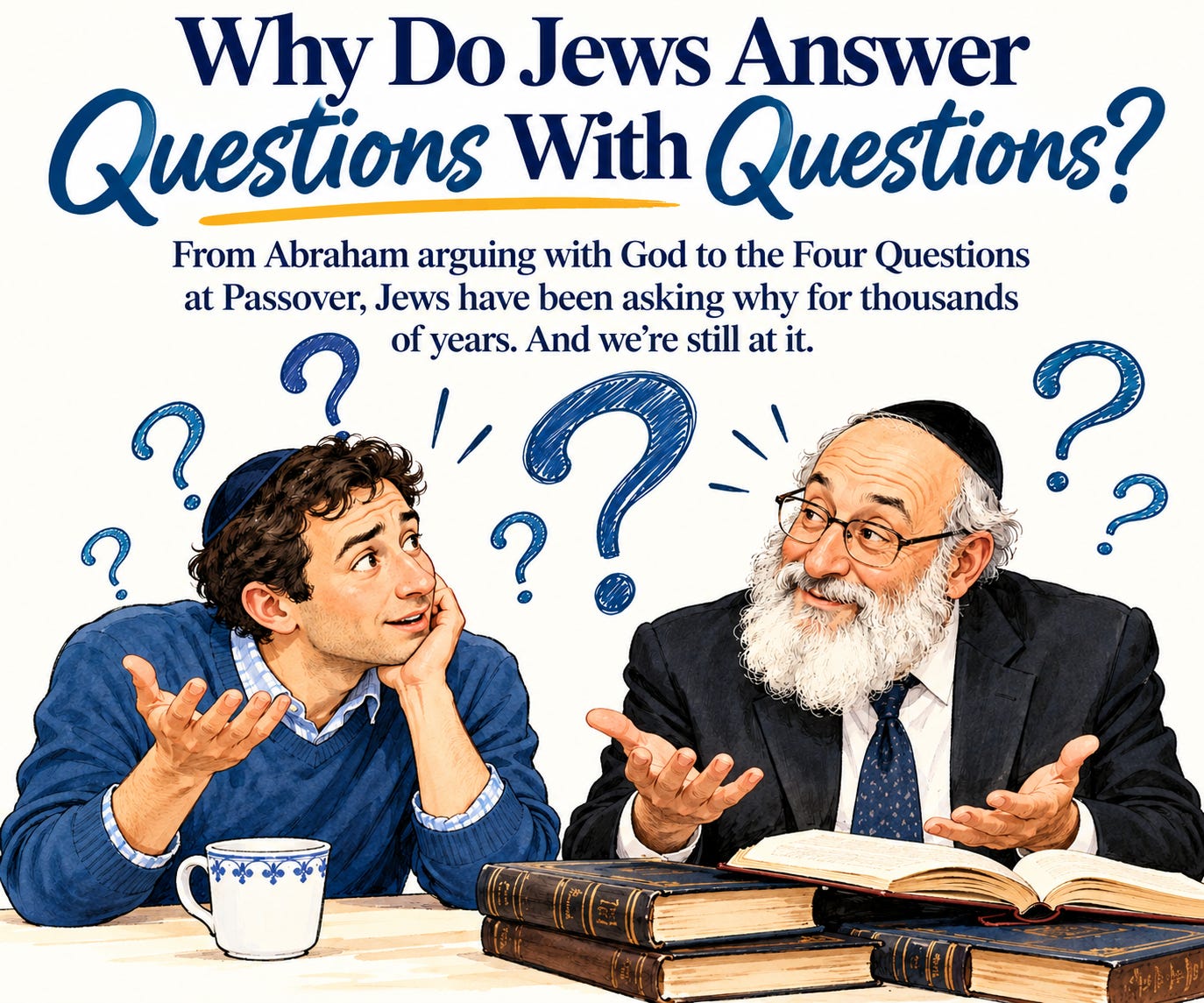
A man walks up to a rabbi and asks, “Rabbi, why do Jews always answer a question with another question?”
The rabbi looks at him and says, “Why shouldn’t we?”
It’s an old Jewish joke, and if you’ve ever spent an afternoon with a Jewish family, you probably understand why it’s lasted this long. Ask one…just ONE innocent question, and you might get an answer, three follow-up questions, two competing opinions, and a completely unrelated story about somebody’s cousin in Boca. And a follow-up phone call a week later to bring up the topic again.
Someone asks whether it’s going to rain today, tomorrow, or whenever. Within minutes, the conversation goes from “I can feel it coming, my bum hip hurts” to whether the weatherman can even be trusted, what happened the last time it rained, why anyone would plan an outdoor event in October, and whether somebody remembered to bring a sweater. And did anyone catch the Lions game? By the time anyone answers the original question and navigates the conversational spider web, nobody remembers exactly what the question was or who asked it. And heaven help the person who suggests everyone just agree on something, because now there’s an entirely new argument.
There’s a reason questioning has become such a familiar part of Jewish humor. For thousands of years, Jewish communities have valued discussion, interpretation, education, and the ability to challenge an idea. You can see it in ancient Jewish writings, in the debates that shaped Jewish history, in immigrant family life, and eventually in the comedians who made the whole world laugh at our tendency to turn a simple conversation into a committee meeting. You certainly don’t have to be religious to participate. Jewish questioning has traveled well beyond synagogues and religious schools.
Even the Torah is full of people asking difficult questions. In Genesis 18, Abraham questions God’s decision to destroy Sodom. He wants to know whether innocent people will be punished alongside the guilty, and then he begins negotiating. What if there are fifty righteous people in the city? Forty-five? Forty? Thirty? Twenty? Ten? He keeps lowering the number, and God keeps answering.
Moses had plenty of questions, too. When God called him to lead the Israelites out of Egypt, Moses wanted to know why he had been chosen, what he was supposed to say, and what would happen if the people didn’t believe him. He raised objection after objection before accepting the assignment. Then there’s Job, who spends much of the biblical book named for him demanding an explanation for his suffering. His friends are convinced they understand what’s happening, but Job keeps challenging their answers.
These stories have been part of Jewish culture for generations, including among Jews who don’t consider themselves particularly religious. The characters question authority, challenge explanations, and insist on understanding what’s happening around them.
The rabbis carried that tradition into their own debates. The Mishnah and Talmud preserve centuries of discussions about Jewish law, ethics, customs, and everyday life. One rabbi presents an opinion, another challenges it, and somebody else introduces a completely different interpretation. Sometimes they reach a decision, sometimes they preserve competing opinions, and sometimes the argument goes on for pages.
Imagine a family disagreement in which every objection is written down, everybody is identified by name, and future generations are expected to study the entire conversation. That’s a reasonable introduction to the Talmud.
One of the funniest examples appears in the Babylonian Talmud, Bava Metzia 59b, in a story known as the Oven of Akhnai. The rabbis are arguing about whether a particular oven can become ritually impure. Rabbi Eliezer believes one thing, while the other sages disagree.
After failing to convince them with his arguments, Eliezer calls on a nearby carob tree to prove he’s right. According to the story, the tree uproots itself and moves. The other rabbis aren’t impressed, so he tries again, this time calling on a stream. The water begins flowing backward, and there’s still no agreement.
Then the walls of the study hall begin leaning inward. Eventually, a heavenly voice announces that Rabbi Eliezer is absolutely correct. You’d think that would settle the argument, but nope. Rabbi Joshua responds by quoting the Torah: “It is not in heaven.”
The rabbis reason that once the Torah was given to the Jewish people, interpreting its laws became a human responsibility governed by study and majority decision. Even a heavenly voice couldn’t settle the debate for them. Later in the story, God is described as laughing and saying, “My children have defeated Me.”
The full account also describes painful consequences for Rabbi Eliezer and his colleagues, but the debate itself has become one of the best-known examples of Jewish intellectual independence. A tree moves, a river flows backward, the walls begin to lean, and a voice from Heaven announces the answer. And the rabbis are still arguing.
One of the most familiar Jewish traditions is built around questions. Every Passover, families gather for the Seder and retell the Exodus from Egypt. The youngest participant traditionally recites the Four Questions, beginning with the familiar question about why this night is different from all other nights.
The practice comes from an ancient tradition of encouraging children to notice unusual things and ask about them. The Mishnah even instructs parents to teach children what to ask if they can’t come up with questions themselves.
The wording of the questions has changed over time. An early version included a question about roasted meat, reflecting the Passover sacrifice associated with the Temple, while the familiar modern version includes a question about reclining.
The Haggadah also introduces the Four Children: the wise child, the wicked child, the simple child, and the child who doesn’t know how to ask. Each receives a different response based on how the child approaches the Exodus story. The fourth child may be my favorite, because the parent is instructed to begin explaining without waiting for a question. So even the child who hasn’t asked anything is getting a lesson.
There’s also a story in the Talmud about a young Abbaye, who noticed that his teacher Rabbah had the table removed before the Seder meal. Abbaye immediately asked why they were taking it away when nobody had eaten. Rabbah was pleased because the boy had asked exactly the kind of spontaneous question the evening was meant to encourage.
Of course, Jewish families have since turned the Four Questions into an annual production involving nervous children, proud grandparents, competing melodies, and at least one adult whispering the words because somebody forgot them. And that’s before anybody starts debating how the Seder should be conducted.
There’s an old saying that if you put two Jews in a room, you’ll get three opinions. Sometimes four, depending on whether somebody’s mother is listening.
Jewish communities have argued about religious law, philosophy, politics, education, leadership, and just about everything else for centuries. Some disagreements were intellectual exercises, while others became serious enough to divide entire communities.
Maimonides, the medieval Jewish philosopher and physician who died in 1204, faced criticism from other Jewish thinkers over his philosophical writings and interpretations of Jewish law. His work inspired debates that continued for generations.
In eighteenth-century Eastern Europe, the rise of Hasidism led to fierce disputes between Hasidic Jews and their opponents, known as Mitnagdim. They argued over religious authority, prayer, mysticism, and the direction of Jewish communal life.
But the tradition of arguing didn’t stay inside religious institutions. As Jewish communities spread across Europe, North Africa, the Middle East, and eventually the Americas, disagreements became part of communal politics, education, literature, and everyday conversation.
Jewish newspapers published competing opinions. Political movements argued about the future of Jewish life. Zionists disagreed with other Zionists, socialists argued with religious leaders, and Jewish organizations frequently found themselves debating how best to respond to the same problem.
Even the modern State of Israel has a political culture famous for fierce arguments, competing parties, and citizens who are perfectly willing to tell their elected leaders exactly what they think. The Jewish world has never been short of opinions. Getting everyone to agree on one is another matter.
One classic joke tells of a Jewish man stranded alone on a desert island. Years later, rescuers arrive and discover that he’s built two synagogues.
“Why two?” they ask. “You’re the only person here.”
He points to one and says, “That’s the synagogue I attend.”
Then he points to the other.
“And that’s the one I wouldn’t set foot in!”
Even on a deserted island, the poor man has managed to find a congregation he can’t stand.
Jewish education has traditionally placed a high value on learning, and that emphasis has continued in many families even as they have become less religious.
In immigrant households, parents often worked long hours to make sure their children could attend school, learn English, and pursue opportunities they hadn’t enjoyed themselves. Education became a major source of pride, and children were frequently encouraged to study, read, and develop opinions. Of course, encouraging a child to think independently comes with a few complications.
You tell your child to ask questions, and much to the parents’ dismay…that child begins questioning you.
“Why do I have to be home by ten?”
“Because I said so.”
“But why?”
“Because I’m your mother.”
“But whhhhyyyyy?”
And now the child is conducting a cross-examination outside the bathroom door while the mother locked herself inside.
There’s a wonderful contradiction in the way Jewish family humor treats education. Parents want their children to become doctors, lawyers, professors, and other accomplished professionals, but they don’t necessarily want those same children using their newly developed debating skills at the dinner table. Especially when the subject is whether they should wear a jacket.
Jewish humor developed across many communities and languages, but Yiddish-speaking Eastern European Jews left a particularly large mark on American comedy. Yiddish storytelling was filled with clever exchanges, reversals, arguments, and jokes about rabbis, merchants, matchmakers, husbands, wives, and neighbors. Characters often talked themselves into trouble and then tried to talk their way out of it.
The schlemiel, the person who continually makes mistakes, and the schlimazel, the person who suffers the consequences of somebody else’s mistakes, became familiar comic figures. A classic explanation goes something like this: the schlemiel spills the soup, and the schlimazel is the one it lands on.
Yiddish humor also made room for the person who always had a clever answer, even when the answer didn’t solve anything. The famous town of Chelm, celebrated in Jewish folklore as a community of fools who believed themselves to be wise, became the setting for countless stories about people applying elaborate reasoning to simple problems.
In one traditional Chelm tale, the townspeople decide to capture the moon’s reflection in a barrel of water so they’ll have light whenever they need it. They cover the barrel, and when they later discover the moon has disappeared, they must figure out what happened. It’s the kind of reasoning that makes perfect sense right up until somebody asks one more question.
These stories were told and retold through generations, and they eventually became part of the wider world of Jewish comedy.
When millions of Jews emigrated from Eastern Europe to the United States during the late nineteenth and early twentieth centuries, they brought their languages, customs, stories, and humor with them. Yiddish theater flourished on New York’s Lower East Side, where immigrant audiences watched plays and comedies about family relationships, marriage, money, social expectations, and the challenges of American life.
Jewish entertainers later became central figures in vaudeville, radio, film, television, and stand-up comedy. George Burns, Jack Benny, Milton Berle, Henny Youngman, Mel Brooks, Carl Reiner, Joan Rivers, and Jackie Mason all helped shape American comedy, although their styles were very different.
Jack Benny could get a laugh by hesitating before answering a question. Henny Youngman delivered rapid-fire one-liners. Mel Brooks created characters whose confidence greatly exceeded their intelligence, and Jackie Mason drew heavily on Jewish speech patterns, family expectations, and the ridiculous things people say when they’re trying to sound important.
Much of the humor relied on timing, wordplay, arguments, misunderstandings, and the ability to turn an ordinary conversation into something absurd. The old rabbi joke fit right in. Its exact origin is difficult to trace because jokes traveled through families, performances, and oral storytelling long before anyone thought to document them.
By the twentieth century, the punchline was familiar enough that audiences could see it coming and still laugh.
The Jewish mother has been a favorite character in American comedy for generations, and nobody has made better use of the follow-up question.
“Are you cold?”
“No.”
“Then why aren’t you wearing a sweater?”
Or the telephone call:
“Why haven’t you called?”
“I called you yesterday.”
“So you couldn’t call today?”
The Jewish mother became a familiar comic figure during the twentieth century, particularly as entertainers explored the relationships between immigrant parents and American-born children. The stereotype was built around worry, guilt, family expectations, and a mother’s ability to make her children feel as though every decision required a committee hearing.
She didn’t necessarily have to tell you that you were making a mistake. She could simply ask whether you were sure.
“Are you really going out dressed like that?”
“Yes.”
“And you’re comfortable?”
“Yes.”
“Okay. If you’re happy.”
Any Jewish daughter who has heard that last sentence knows the conversation is nowhere near finished.
Real Jewish families are as different from one another as any other families, but the comedy character became famous because audiences recognized the exchanges, the timing, and the endless questions that could turn a five-minute phone call into an afternoon.
And then there are the Jewish grandparents, who have perfected an entirely different line of questioning.
“When are you coming to visit?”
“Next weekend.”
“Why not this weekend?”
“Because we’re busy.”
“Too busy for your grandparents?”
Somehow, a perfectly ordinary scheduling conversation has become a moral inquiry.
Questioning has also played a role in Jewish intellectual and cultural life well beyond religious study. Jewish writers, philosophers, scientists, political activists, and comedians have approached the world from different perspectives, often challenging accepted ideas and established institutions.
Baruch Spinoza, born into Amsterdam’s Portuguese Jewish community in 1632, questioned traditional religious authority and developed philosophical ideas that led to his expulsion from the Jewish community in 1656.
Theodor Herzl, born in Budapest in 1860, questioned whether European Jews could ever depend on assimilation and acceptance to secure their future. His political Zionism challenged existing assumptions about Jewish life and helped launch a movement that would change Jewish history.
Hannah Arendt, born in Germany in 1906, became known for examining political authority, totalitarianism, and the responsi…