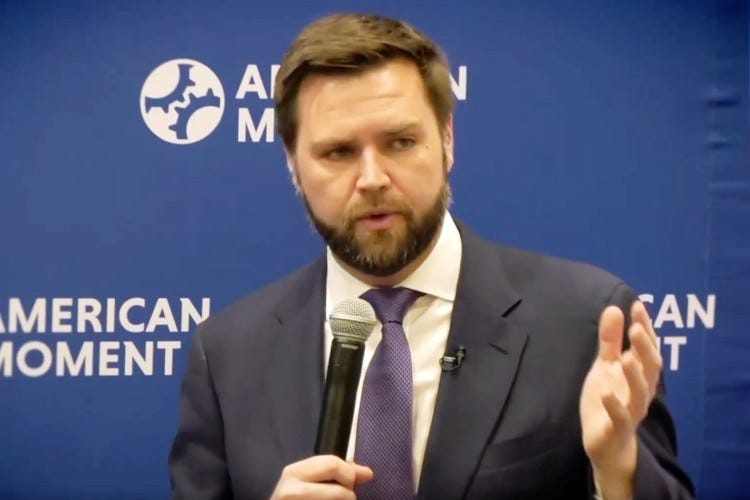
J.D. Vance recently made a comment that made entire economics departments want to Jonestown themselves. This was the comment:
Many things about that clip are incredible, starting with the fact that Vance opened with “by the way”. Statements that big typically don’t start with “by the way” — it would be odd to say “By the way, dinosaurs are back,” or “By the way, God’s in my Pilates class.” It’s also incredible that after running a campaign about the existential threat to American life posed by high egg prices, Vance is musing that it might be good for practically everything to cost more. And perhaps most troublingly, the Vice President — and possible next Republican nominee — is publicly dishing galaxy-brained economic hot takes like he’s a stoned college freshman in a beanbag chair. That was on tape, J.D. — the Vice President’s words matter! And his statement caused people to dig around and realize that — holy shit! — Vance is truly 𝕏not 𝕏sold on the dollar being the world’s reserve currency.
Just about everything in economics has pros and cons. The fact that the dollar is the world’s go-to store of value makes it a stronger currency than it otherwise would be. And though “strong” sounds *ipso facto *good — we don’t want some low-T, limp-dick currency, do we??? — there are actually upsides and downsides to a strong currency. To boil it down: A strong currency makes stuff we buy from other countries cheaper, but stuff we sell is more expensive, and therefore harder to sell. 𝕏Defenders of Vance’s view argue that it’s not crazy to look at the “good for consumers, bad for producers” tradeoff and wonder if we’re getting the short end of the stick.
And if that was the whole story, economists would not be reacting like Vance just defiled Adam Smith’s corpse. But reserve currency status actually makes the US something of a Privileged Fancy Boy in the world’s economy — picture America as a golden-haired prince in silk breeches peering out the window of a jewel-encrusted carriage at filth and squalor that he cannot comprehend. The first and biggest benefit of reserve currency status is that the US can borrow more money and at cheaper rates than any other country; even if you think our debt level is a problem — and I do! — it’s still obviously better to service that debt at low rates than high ones. Other benefits include banking dominance, fiscal flexibility, fewer downsides to currency fluctuations, more demand for our securities, and the fact that the world has a vested interest in not seeing our economy go tits-up. The US gets to play by special rules and is the envy of every other country, especially Britain, because they used to be the Fancy Boy in the carriage.
So why in the world would Vance think that it might be good to give that up? I think the answer is simple: myopia. Reserve currency status puts dozens of things on the “pros” side of the leger for the US and one thing on the “cons” side, but that one thing is the only thing Vance cares about: manufacturing jobs. Vance is from Ohio — in the Rust Belt, the loss of manufacturing jobs is a big political narrative. Vance is also a Republican, and Republicans tend to fetishize tough-guy jobs for capital-”d” Dudes. If your one and only priority is to boost manufacturing, then the dollar’s reserve currency status might, indeed, be bad. To put things in a slightly-dickish-but-fundamentally-accurate way: Vance thinks it might be good to trade America’s purchasing power, economic stability, social safety net, booming stock market, strategic dominance, and resistance to fiscal shocks for some jobs making toaster ovens and gloves.
Which makes Vance’s reserve currency skepticism merely the latest manifestation of this administration’s push to boost manufacturing no matter how much American consumers have to suffer. This effort — which consists of tariffs, subsidies, and jawboning — has been a 𝕏resounding failure. And of course it failed — it’s a strategy designed to counter the false narrative that the American economy has been “hollowed out” by international trade. The fact of the matter is that trade helped America swap 20th century jobs for 21st century jobs, and that’s part of the reason why we enjoy Fancy Boy status. Some people want to go backwards; Vance is merely taking that view to its logical — if unbelievably misguided — conclusion. I’d call his view “Ohio über alles”, which is darker than anything I care to comprehend.