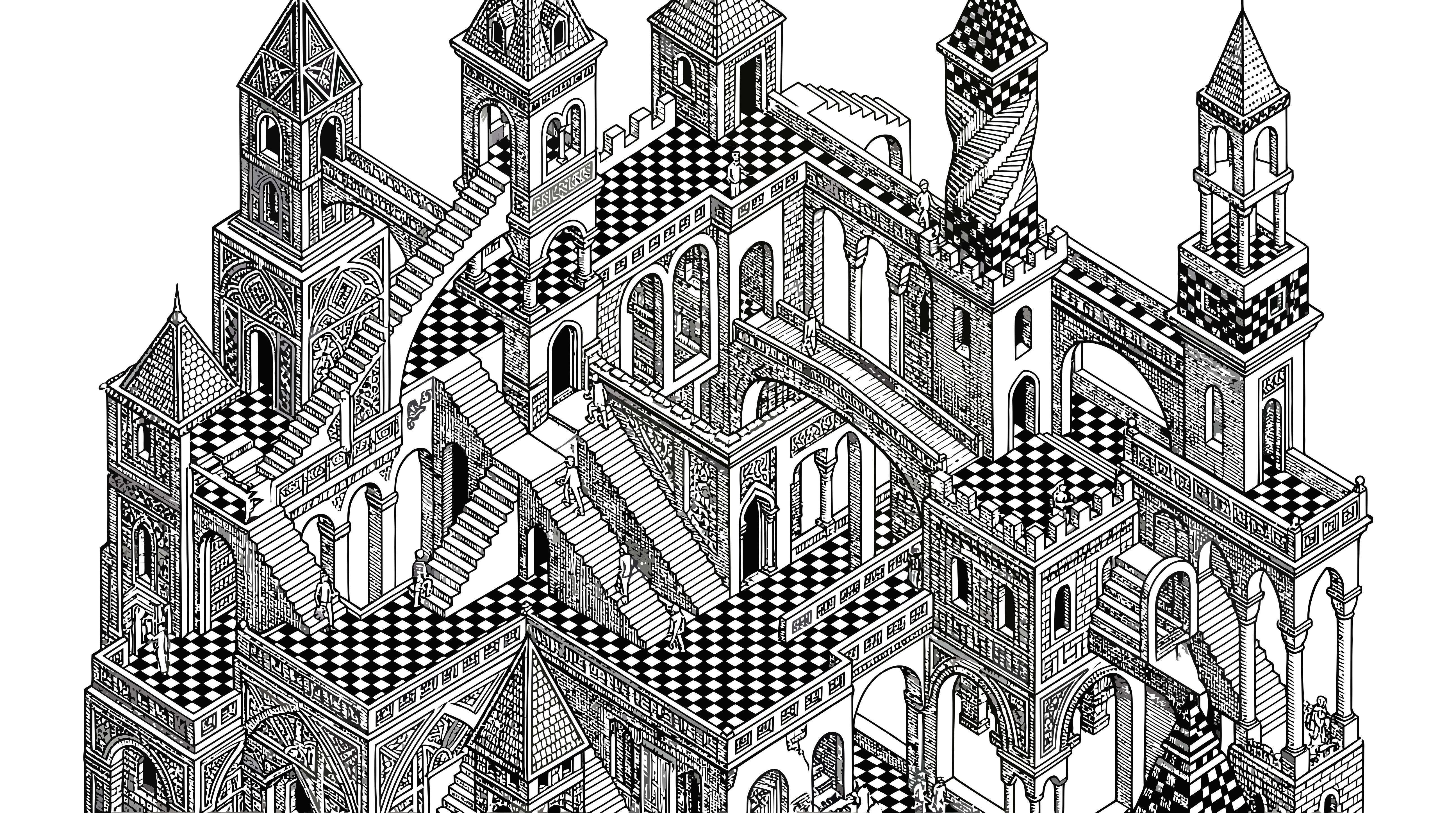
As someone who enjoys science and philosophy and the application of words and math to describe reality, I can write from both sides of an argument. But the person my words cannot fool is myself. Every writing experience another opportunity to examine what the meaning is. Understanding why this might be the meaning for anyone else.
This method is far from perfect, causes me some fair amount of pain. On some days my point of view takes on the opposite of what I wrote about just the day before. What this brings me back to is that there are always paradoxes, always two oppositional points of view.
What this does is create a forcing house of being completely honest with myself. It invokes a mandate to find the meaning & then to examine it from both sides. Meaning that I am perpetually in an evolving position, increasingly able to argue with brutal honesty about what meaning I have found.
Recognizing that having arrived at and argued for a particular meaning does not mean I have some lock on meaning. Being able to argue from two oppositional points of view underscores my credo that I have no right to decide for the reader.
This strategy is Socratic, perpetually in a state of asking new questions, and then arguing for a particular answer. Both attempting always to defend an answer as simply as possible and to encourage myself to continue to question. For me learning means never being 100% convinced of a particular theory, but means always being able to question.
Having a lock and key on a particular point of view or theory would mean I have stopped questioning and have stopped doing science altogether. Science becomes a living breathing process of asking questions, of using what is found to leap ahead to a fresh plateau. Having found a new perch, recognizing that each time it is simply a plateau, not a dead end.
The sentence which Dirac had written contained one word which Richard Feynman questioned. Feynman’s question, Dirac’s answer, and Feynman’s quest to answer the question would change modern physics.
Analogy. Analogue. Corresponds to. These are Dirac’s words for the relation between the classical quantity and the quantum one — a likeness held loosely, not an equation.
Feynman’s word was proportional. At Princeton’s bicentennial celebration in the fall of 1946 he found Dirac lying on the grass outside the conference, and asked him:
“Did you know they were proportional?”
“Are they?”
“Yes, they are.”
“Oh. That’s interesting”
Dirac had written the word and walked right past it.
One word, questioned.
We have asked — and only partially answered — that one word may be the hinge upon which a whole science, a whole life, a whole play, a whole government, a whole civilization depends.
Not: “No matter, never mind”, the title of a poem by California poet Gary Snyder.
Because if there is matter, there will be found a mind. If there is no matter, there is no mind, and therefore no thing.
Why worry over which mind said what? Asking instead, what questions was a mind capable of asking?
A Socratic question is not Hamlet’s: “To be or not to be?”
The Socratic turn is to notice that Hamlet already is. He may never, ever, erase that he has lived and has, through living, had a choice.
Epistemological reason leads us to ask the following.
What slings and arrows led Hamlet to ask this question about being or nonbeing?
The Socratic question has undergone a great transformation.
The heated, emotionally turbulent, Socratic, question, is the point. The whole point.
Transformation reveals: a set of words, a set of mathematics, a dependable direction, a definable shape, a set of thermodynamics.
Inside the museums, infinity may go up on trial, but it is within us, where the real work gets done, and where any meaning will be lost or found.
Socratic questions become the exoskeleton on which we drape our philosophy.
Here we have observed how one of the greatest of questions transformed itself into a great play for the ages.
Right in front of us: the system reveals an architecture we did not ask for, and did not expect.
The system does have an architecture, we simply needed to understand where to look for it and to recognize the shape, direction and thermodynamics.
Afterward:
Learning to argue from two oppositional points of view sharpens both learning and intelligence. It is not always comfortable but it covers all the bases.
A sharp mind with a dull pencil, is preferable to a dull mind with a sharp pencil.
From my latest book: Systems Architecture: Direction, Shape, Thermodynamics.