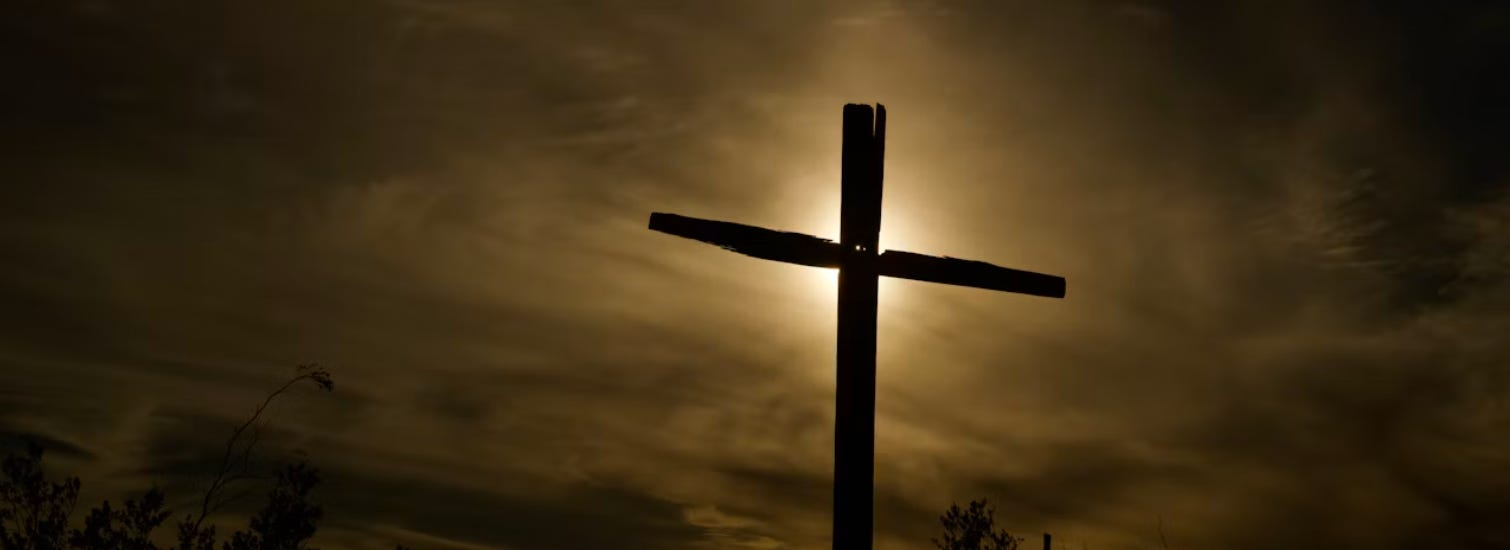
And at the ninth hour Jesus cried with a loud voice, ‘Eloi, Eloi, lema sabachthani?’ which means, ‘My God, my God, why have you forsaken me?’— Mark 15:34
There is a question that has troubled believers for two thousand years. Theologians have debated it. But it is not only a question for theologians. It is our question too. The question we ask when we are handed suffering we cannot explain, when the darkness does not lift, when God feels absent in the very moment we need Him most. What happened on that cross when the sky went dark over Jerusalem and the Son of God cried out is not just ancient history. It is the deepest question any of us faces.
Was He abandoned?
Because that question is never only about Him. It is about us. If He was left alone in that darkness, then we might be too. And if He was not, then neither are we. The answer is not a footnote. It is the ground we either stand on or collapse under.
The words are there, in both Matthew and Mark, in Aramaic so raw and unmediated that the Gospel writers did not translate them immediately. Eloi, Eloi, lema sabachthani. My God, my God, why have you forsaken me.
They left it in the original language. As if no translation could carry what those words held.
A cry so human, so exposed, so unlike anything we might have expected from the one who had just hours before prayed not my will, but yours (Luke 22:42). And yet it is there, in the text, unmistakable and unfiltered.
The answer does not stay on the cross. It follows us into our own dark hours.
My God, my God, why have you forsaken me is the opening line of Psalm 22. Jesus was not improvising on the cross. He was praying Scripture, reaching for the words that the Spirit had given David centuries earlier, words that described exactly what He was living through: the mocking crowds (all who see me mock me, Ps. 22:7), the pierced hands and feet (Ps. 22:16), the garments divided by lot (Ps. 22:18).
But Psalm 22 does not end in abandonment. It ends in vindication: he has not hidden his face from him but has listened to his cry for help (Ps. 22:24). And it ends with a declaration spanning every generation: declaring to a people yet unborn: He has done it (Ps. 22:31).
This is the arc of the gospel itself. Darkness, then dawn. The cross, then the resurrection. When Jesus cried out the first line of Psalm 22 on the cross, He was praying the whole psalm. The lament and the trust in the same breath. The desolation and the vindication, held together in the same psalm.
The abandonment was real. The darkness was real. But real is not the same as final.
Paul uses a specific word for what happened at the cross. God delivered up Jesus, gave him over, for us all (Romans 4:25; 8:32). This is the language of sorrow. And of hope. And of purpose. God did not look away. He never left. He was present in every cry, every breath, working through the darkness, not around it, and always toward the dawn. Winter does not become spring despite the cold. It becomes spring through it. The giving over was the means of salvation, not a failure of love.
Jesus had been moving toward this moment His entire life. He had walked among sinners, touched the untouchable, carried the weight of human brokenness throughout His ministry. Every healing, every forgiveness, every step into places others avoided. It was all leading here. And on the cross, at the furthest point of that journey, He did not merely draw near to our sin. God made him who had no sin to be sin for us (2 Cor. 5:21). He became it. He bore its full penalty, its final consequence, its entire weight, alone. He was not performing abandonment. He was entering it, on our behalf, so that we would never have to face it alone.
There is something in those words we must not miss.
He still calls Him My God.
Not “God who has abandoned me.” Not “God who is no longer mine.” My God. Even in the cry of desolation, the union between the Father and the Son. Unbroken. The lament is addressed to the one He trusts. The darkness cannot sever what was never divided.
And the cross did not end in the cry. It ended in tetelestai (τετέλεσται), it is finished (John 19:30). Not a gasp. Not a defeat. A declaration. The word of a craftsman whose work is complete, a priest whose offering is accepted, a king whose battle is won. Every last thing that needed to be done had been done. Nothing left undone. Nothing left unpaid.
History did not leave that claim untested. Three days later, the Father answered. The empty tomb was not a footnote. It was God’s verdict on everything that had happened on that cross: proof that He had been present in the darkness all along, working through it, and that the cry had been heard.
He had not hidden His face. He had been there from the beginning.
“My God, my God, why have you forsaken me?” was not a cry of despair without trust. It was trust beneath agony. The most honest prayer ever prayed, addressed to the one who loves and answers.
The Father’s response was an empty tomb.
If that is true of His darkness and suffering, it may also be true of ours.
We will come back to that tomorrow.
© 2026 Bible Portal. Free to share with attribution. Please keep the source and a link to Bible Portal intact. For other uses, contact us.