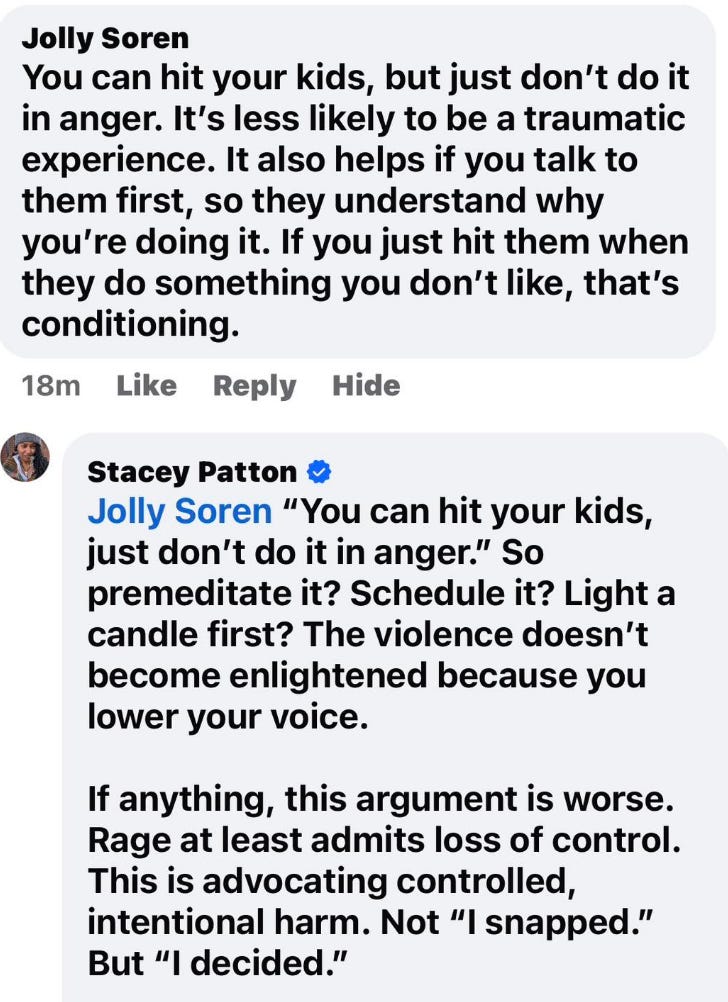
It’s the end of National Child Abuse Prevention Month, and every year around this time, people start getting uncomfortable with my tone when I talk about how children should never be hit under any circumstance.
“Stacey, you’re shaming parents!”
Good.
Now, let’s talk about that. Because what we’ve been doing in child abuse prevention and public health messaging around it for decades is something very different. We’ve been cushioning, softening, and translating violence into language that feels more comfortable for adults.
Meanwhile, children are being hit, injured, and dying by the thousands. The data on substantiated cases of abuse and fatalities keeps getting worse in Black communities. And somewhere along the way, folks decided that the real problem isn’t the violence. Nope. It’s how directly we talked about it. Somehow, being clear and unapologetic might make adults feel uncomfortable. But I am not here to coddle adults who harm children. I don’t give a shit about adult fragility.
I am a child abuse survivor. I know what it feels like in the body when somebody bigger than you decides pain is a lesson. I know what it means to be told that harm is protection, godly, or love. So when people ask me to be softer, more careful, more “non-judgmental,” what they are really asking is: Can you make this easier for adults to hear, even if it blurs what children are actually experiencing?
No.
Because we don’t do that anywhere else. We do not tell advocates working on domestic violence to be gentle about people who beat their partners. We do not say, “Let’s use less triggering language so abusers feel more comfortable engaging.” So why, when it comes to children, do we suddenly need to protect the feelings of the person doing the harm?
That is childism. That is the systematic centering of adult comfort over child safety. And I’m not participating in it because children are not afforded the same moral status as adults, even in spaces that claim to protect them. We still treat children as extensions of their parents rather than as people with their own rights, bodies, and boundaries. That means when harm happens, our first instinct is not to center the child’s experience but to manage the adult’s reaction. We worry about whether parents will feel judged, whether they’ll disengage, whether the message will land “the right way.” In doing that, we shift the focus away from the person being harmed and onto the comfort of the person causing it.
It also comes from how deeply normalized physical punishment still is. Unlike domestic violence, which has been publicly named, criminalized, and stigmatized over time, hitting children still sits in a gray zone where people can call it “discipline,” culture, or love. Because it’s normalized, people feel entitled to defend it. And because they feel entitled to defend it, institutions feel pressure to approach it gently, as if it’s a difference of opinion rather than a question of harm.
There’s also a persistent fear that if we are too direct or forceful, then we will lose people. That parents will shut down, disengage, or reject the message entirely. That fear shapes the language, tone, and the entire prevention strategy. All of that is why the standard shifts when the person being harmed is a child. It’s why we bend, soften, and cushion in ways we wouldn’t tolerate in other forms of violence. And that is exactly what childism looks like in practice where adult comfort, authority, and emotional protection are prioritized, even when children are the ones being hurt.
Now let’s deal with this word “shame,” because it gets thrown around every time someone refuses to sanitize this issue. Shame has become a catch-all accusation for any message that is direct and unwilling to euphemize harm. You say, “Hitting a child causes harm,” and suddenly you’re “shaming parents.”
No!
What’s happening is that the cover is being removed. When you can no longer comfortably say, “This is just discipline,” without somebody responding, “No, this is harm,” it feels like shame. But it’s actually exposure. And exposure is necessary for norm change.
On one side, we have traditional public health messaging that’s careful, measured, low-arousal, and designed not to offend. On the other, we have a digital culture that is loud as hell, visceral, repetitive, and unapologetically normalizing violence against children. People are watching viral videos of parents hitting kids and laughing and testifying and using degrading language to describe “these kids today.” They’re sharing skits reenacting childhood beatings for entertainment. They’re dancing to rap songs that frame violence as protection.
And we think we’re going to counter all that with a pamphlet with a pouting child holding a teddy bear that says “try positive discipline?’
Be serious.
The nervous system doesn’t respond to gentle suggestions in a high-intensity environment. It responds to clarity, repetition, and emotional impact. So when prevention messaging becomes so softened that it no longer registers in the body, it doesn’t fails and gets ignored. And in that silence, the louder narrative wins.
This is why I drag.
When somebody says, “I got whooped and I turned out fine,” I don’t nod politely and offer a resource link.
I say: “No you didn’t. You didn’t turn out fine. You adapted to violence and are calling it normal.”
I’m not trying to humiliate them. I’m challenging a popular script. That sentence, left unchallenged, teaches everyone watching that harm is acceptable. These conversations that go down online are not private. They are public performances of what is considered normal. And silence, in those moments, is endorsement.
So when I respond, I’m not just talking to the person who said it. I’m talking to the thousands of people reading. This includes the people who feel something is off but don’t have the language yet. The ones who are trying to unlearn and heal from what was done to them. And the ones deciding what kind of parent they’re going to be. That’s who the message is for.
Here’s the thing, Y’all, discomfort is part of behavior change. If nothing in your body reacts when you hear that hitting children causes harm, then the message hasn’t landed. We have confused “non-shaming” with “non-impactful.” We have decided that if a message makes someone feel bad, it must be wrong. But feeling bad about causing harm is not abuse. It’s accountability and accountability is how social norms shift.
So no, I’m not interested in cruelty or dehumanizing parents. But I am deeply uninterested in protecting adults from the emotional consequences of confronting what they’re doing to children. I believe that we can be compassionate about stress, history, and survival, and still be unequivocal that hitting children causes harm.
If that clarity feels like shame, then maybe what you’re feeling is the gap between what you were taught and what is actually true. And it’s in that gap where change starts. And if you’re reading this and feeling something, defensive, uncomfortable, reflective, curious, that’s exactly where this conversation needs to start. In honest, direct engagement with what we’ve normalized and what it’s doing to children.
So tonight, we’re not just leaving this on the page. From 6 to 8 p.m., I’m hosting a live community conversation on Zoom, sponsored by Tulane University, where we’re going to unpack all of this together. All of it. The science. The data. The culture. The religion. The digital normalization. The myths people cling to. And most importantly, what it actually looks like to move away from harm without hiding behind euphemisms.
If you’ve ever said, “I turned out fine,” come.
If you’ve been questioning how you were raised, come.
If you’re trying to parent differently but don’t have the language or tools yet, come.
If you’re uncomfortable after reading this, please come.
Because discomfort is not the end of the conversation. It’s actually the beginning of it. And our children deserve more than our silence.
Register here for free access to the community conversation: https://us02web.zoom.us/meeting/register/G3JJTz8ZTjahavRXv_sUYg?fbclid=IwY2xjawRe45pleHRuA2FlbQIxMQBzcnRjBmFwcF9pZBAyMjIwMzkxNzg4MjAwODkyAAEeQ24x6d_WQOmBKbC5RIVX-WLUUl3NMGFuuhltvnZSKIYGfJi7d54Xwnnp9cs_aem_DcXf5jTU7ajlfBFl-ecf2g#/registration
See Y’all tonight!
Thanks for reading. If this piece moved you or made you think, please consider becoming a paid subscriber. Your subscription keeps my Substack fueled and unfiltered. Paid subscriptions also help me support HBCU journalism students who need laptops, DSLR cameras, tripods, mics, lights, software, conference travel, reporting trips, and even food from our pantry. We appreciate your support!