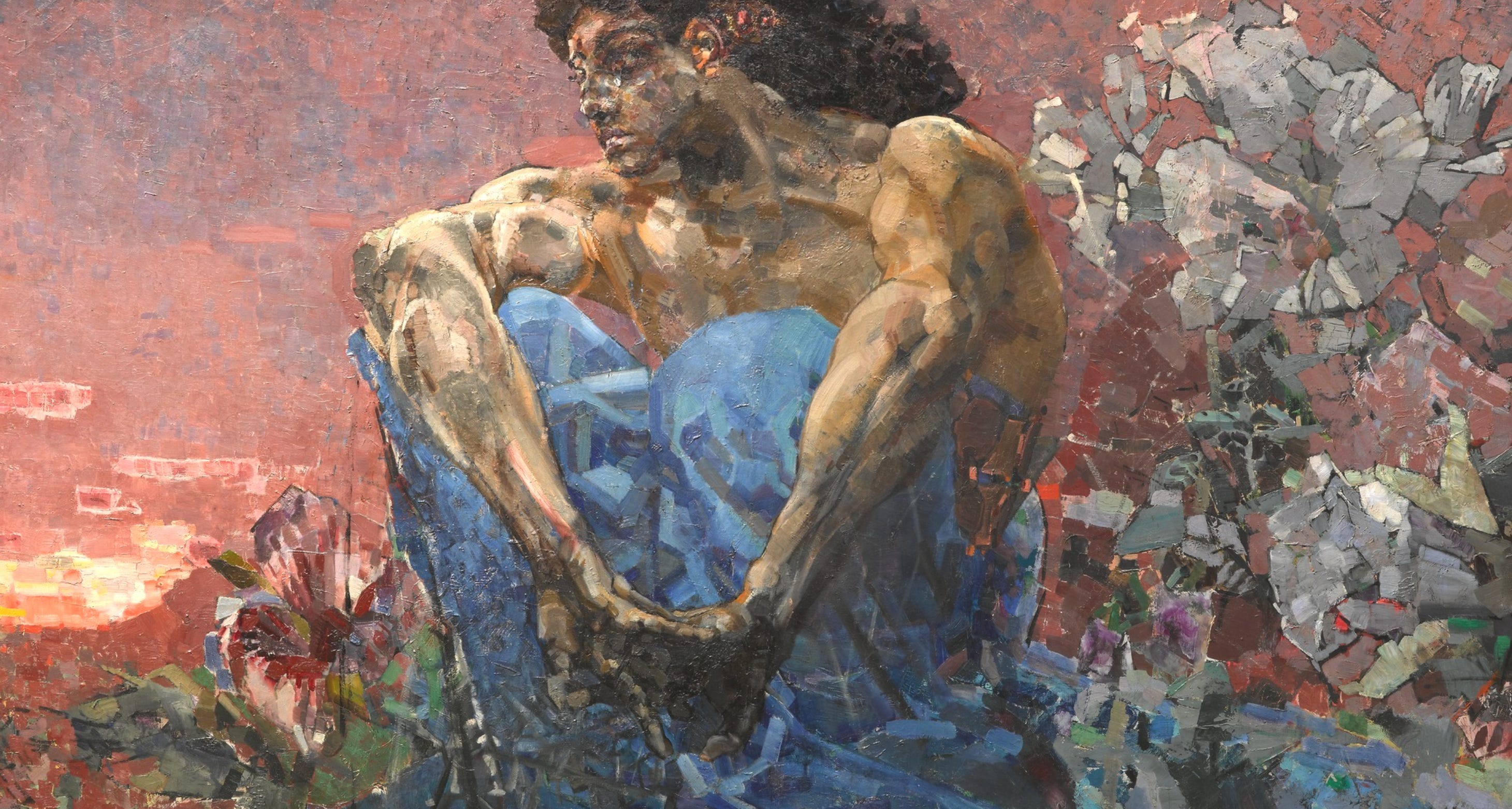
I added “BBC Select” to my Amazon Prime subscription, and boy, was it ever worth it. As a lover of documentaries, I can say without fear of contradiction that nobody does them better than the British. The other night I stumbled upon one called “Art In Russia,” a three-part history of, well, Russian art. The first episode is about the icon; the second is about art in Russia from Peter the Great’s opening to the West until the Communist era; the third is about Soviet art to the present.
I loved the first episode because it showed me some Andrei Rublev icons, in the St. Sergius Monastery, that I had never seen. The second, though, was my favorite. Back in 2019, I went to Russia to report * Live Not By Lies*, and while in St. Petersburg, went to the Hermitage (which was as good as they say), but also the Russian State Museum, which is dedicated to Russian paintings alone. Now
The BBC presenter discusses how you can see in Russian painting of the time, just as in Russian literature, the mounting crisis in Russia’s social and political life. This sense of a vast change coming, of the people growing weary of Tsarist autocracy, and preparing themselves for … Something, for the center was not holding. He cites “Barge Haulers On The Volga” (1873) by Ilya Repin, the most famous painting of this period, as an example:
I’ve seen the original in Russia, and no reproduction can do it justice. It was inspired by Repin seeing scenes like this on a visit to the river. Look at these faces:
The eternal peasant! The presenter points to the lower right of the canvas, which shows a steam-powered tugboat pootling down the river. It tells us, he says, that Repin is pointing out that Russia had the technology to use steam, not men, to do the work of barge hauling, but human labor (and human life) was so cheap back then that the wealthy did not want to spend the money to do it. Easier to treat the peasants like beasts of burden. The canvas was a smash hit in Russia at the time. Repin was onto something.
I had not seen the painting at the very top, titled “Demon Seated” (1890) by the Symbolist painter Mikhail Vrubel. Turns out Vrubel was obsessed with the Demon figure, and went back to it repeatedly in his work. It is not meant to be an evil spirit, but rather the embodiment of brooding passion, isolation, and frustration with the world. The muscular, androgynous youth looks like a coiled serpent preparing to strike. Vrubel’s Demon really does symbolize the restless spirit of the age, in which rebellion was gathering just below the surface. Vrubel said that he did not mean for it to stand for a demon in the strict Christian sense, but that he did believe that Christianity suppressed vital passions within people; in this sense was his demon anti-Christian.
In my research on Live Not By Lies, I read that in these pre-revolutionary years, Russian artists and cultural elites were fascinated by the figure of Lucifer as a Romantic hero. Knowing what came a generation after Vrubel painted “Demon Seated,” it’s not hard to see it as a prophecy. Knowing that Vrubel died in an insane asylum in 1910, and did not live to see the Revolution, it’s not hard for me, anyway, to speculate that his fascination with the demonic was not merely symbolic, whatever his intent.
I went to bed last night thinking about what works of art symbolize our own era and its passions. Nobody cares about painting anymore, I guess. Novels? The last popular novel I can think of that can be considered as representative of society in an era is Tom Wolfe’s “Bonfire Of The Vanities,” which satirized 1980s New York (and beyond). Movies? The Seventies were full of them, and even the Eighties. But I’m hard-pressed to think of any from the Nineties on. (Of course I invite you to correct me here, if you can.) The Sixties were full of music symbolic of that time’s social conflicts and passions, obviously, but it tapers off in the ensuing decades.
I wonder if it’s even possible anymore — and if not, why not?
Falling asleep, I came up with three ideas for paintings that, for me, would symbolize our time, in the way of which I speak. OK, shoot me for using Grok to illustrate them, but I can’t paint or draw. I’m just using these as concepts. I’m not an artist, but I came up with these to show that it is possible to make art that says something about a time and place.
Here’s the first one I came up with. It’s not exactly as I envisioned it in my mind, but it’s the closest I could get.
I call it “Purgatorio XXIII Reversed” — a reference to Canto 23 in the Divine Comedy, in which Dante meets the penitent gluttons. They are skeletal, and are drawn to a heavy-laden fruit tree in their midst. But they know that they cannot eat the fruit until they have God’s permission — that is, until they have been purged of their disordered desire for food. In this image, the starving, faceless people can’t even see the fruit tree, glowing with golden light, because their faces are transfixed by their phones, which give off dead electric light.
Here’s the second one, “The Pilgrims”. Again, this is not exactly how it exists in my mind — AI-generated images are so dead — but still, it shows a medieval Gothic cathedral as a tourist attraction, bathed in dead electronic light. The actual pilgrims, bearing warm candles, can’t get through the tourist crowds to enter the church.
Last one. I call it “The Decadent Marsh”. It depicts the distress of people on a boat. They have been traveling down a flowing river, which has played out into a stagnant, marshy delta. They can’t move through the reeds, and don’t understand what they are supposed to do. I mean this to symbolize what it is like to live in a time in which time has lost direction and force. The only act in the image is the girl holding out her phone to take an Instagrammable selfie of their anxiety and confusion.
You get the idea. I thought of these three ideas as I was falling asleep. They’re all probably way too obvious to constitute great art, even if a talented artist were to paint them. Still, these are big themes that inform much of my writing, and I think that it wouldn’t be all that difficult for a gifted artist (painter, filmmaker, novelist) to do something with those ideas. In fact, this novel that I’ve started is trying to do just that, though after a fast start, I’ve hit the wall, and am trying to read up on how to structure a novel, so I don’t simply meander.
What do you think? Can you point to contemporary works of art that in some concrete sense say something serious about our own time? I thought that maybe that Korean film “Parasite” would fill the bill — it’s certainly a powerful social commentary, though I don’t quite agree with its politics — but I’m at a loss for something else. The minor film from a couple of years ago, “Eddington,” is also a good candidate. But what else? Isn’t it more than a little strange that the world suffered the incredible Covid phenomenon, but we had no good movies (minus “Eddington”) about it? For that matter, 9/11 was a world-historical phenomenon, but as far as I can recall, there were only a handful of movies about it, and they were all forgettable.
We are living in a vivid historical time, but our artists, in all media, seem to have nothing to say. Why is this? Why were the painters and novelists of late 19th century Russia so in tune with the deep shifts in their own society, but ours today just … aren’t. I’m certainly not a close attendant of the art world, but whenever I see celebrated paintings, they seem to be either leftist agitprop, or meaningless. In fact, at the end of Part III of that “Art In Russia” documentary, the presenter visits an influential Moscow artist who makes pro-regime kitsch, and also an outsider artist whose work can at best be described as “clever,” but even then, just barely.
Are we so oversaturated by sound and image that it’s hard to penetrate the din? Or is it that you can’t make art that says something profound about one’s society without holding on to some real ideals — and we’ve lost that? Or maybe there really are talented artists working today, men and women with something substantial and important to say, but they have no way to get their work before the general public. Tell me what you think — I really want to know.
Yesterday on Twitter, I saw a clip of some hairy 1970s band playing a hit song of the era, one that people still listen to today. The person who tweeted it said that nobody in the 1970s was listening to music from 1918, but people today still listen to this stuff from the Seventies. The point he was trying to make was that popular music of the Seventies was just that great. I disagree. I’m not criticizing music of that era — I still listen to some of it — but rather the music of our own. Around the turn of the century, everything started to sound the same.
You can listen to any popular music of the 20th century, and place it by decade. There is a sense of progress, of contemporary musicians building on what came before, but innovating. That played out at some point in the 1990s, it seems to me. Now what you hear on the radio might be from 2002, or 2017, or new. True, there’s probably a sense of “your ears are old, pop” to this, but even when I was young, though I didn’t care about older popular music, I could still recognize it as coming from a particular time and place. No more. It’s like that swampy, stagnant marsh in the image Grok and I created. It has energy, but no life.
You know the answer from me will always be YES! But here’s a really interesting op-ed piece in the NYT today by Michal Leibowitz, who argues that religious belief and practice really does have something to offer to boaters stranded in the stagnant cultural marsh. Excerpts:
Religion is oddly suited to today’s technological and social landscape. It makes sense in it, in a way that wasn’t true even a couple of decades ago.
I write this all, admittedly, as a religious person myself. But what I’m suggesting doesn’t rely on metaphysical claims or personal encounters with the divine. Rather, I’m arguing that the technological environments we live in have become such sources of distraction, demoralization and tumult that religious offerings — including the Sabbath, textual learning, spiritual responsibility and divine law — are increasingly useful from a purely practical perspective.
She says that the standard secular critique of religion is that is stifles creativity by subjecting individuals to arbitrary rules. Leibowitz doesn’t buy it:
Spend time online, and it quickly becomes impossible to think of yourself as having an inviolate inner world from which emerge your authentic desires, your true values, your best self. It’s surely not a coincidence that the philosopher René Girard, who argued that desire is imitative — that what we want is formed by seeing what others want — has had a resurgence in recent years. We are shaped by what we consume, the images, ideas, memes. They become the
[furnishings of our minds], the building blocks we use for our own thoughts, narratives and stories.For too many people, those furnishings are composed of videos of A.I.-generated talking fruit and dramatic trick shots. Even those who think of themselves as intellectuals are at risk here of a certain kind of rootlessness, of losing themselves in the ever-flowing current of discourse and interpretive trends. Against the background of the algorithmically shaped life, being religious may look less like slavishly following an antiquated set of principles imposed from on high and more like actively choosing your values and influences.
Maybe Michal Leibowitz offers an answer, or a partial answer, to the questions I raised in the last item. The Russian artists wrote from within a culture marked by strong beliefs and practices, both religious and social (e.g., the rigidly stratified social structure of late Imperial Russia). But today? With us? Walker Percy wrote over three decades ago that you could write a scandalous play today, and nobody would care. He cited the 1967 play MacBird!, which featured LBJ as a MacBeth figure, and features scandalous sexual scenes. Nobody really cared. You can say anything you want today, but nobody cares.
Percy’s point is deep: that the Self has been emptied out in our time, and we turn to sex, violence, and taboo-busting simply to feel *something. *I think of the stories that members of Hugh Hefner’s former harem told about the old goat’s last days: there he would be, in bed with naked young women, jacked up on Viagra, with porn playing on TV screens on the wall, desperate to get himself ready for priapic action. These women all describe the scene as it was: grotesque and pathetic. Sex, in Hefner’s world, had been emptied out of all meaning. The only way to restore it to a simulacrum of potency is through chemistry and extreme images — and even then, it sometimes didn’t work for Hef. The women who serviced him were disgusted by it all.
In* Lost In The Cosmos: The Last Self-Help Book*, Percy wrote that “the self in the twentieth century is a voracious nought which expands like the feeding vacuole of an amoeba seeking to nourish and inform its own nothingness by ingesting new objects in the world but, like a vacuole, only succeeds in emptying them out.” He traces this descent to Descartes, who severed the natural connection between the Self and the world outside of the Self’s head. We have reached the end of this process, it appears. Maybe that’s why our art is so empty: because we are.
If you saw the documentary version of * Live Not By Lies*, you will know about the case of Isabel Vaughan-Spruce, a Catholic pro-life activist in Britain. She is constantly being dragged into court for standing on the street, silently praying, in the vicinity of abortion clinics. That’s right: it’s illegal for her to stand quietly on the street, praying inside her head. The state is
Above all things, pray for Isabel. Also, please consider donating to ADF International, the foreign arm of the US-based Alliance Defending Freedom. ADF International’s lawyers are representing Isabel for free, as they do for all their clients. I’ve had a lot of contact with ADF over the past few years, and I tell you, they are absolutely vital to defending religious liberty for Christians. Give to ADF today; you never know if you will need their help tomorrow.
The 1980s Woody Allen film “Hannah And Her Sisters” is one of my favorite movies, and indeed is a Thanksgiving movie. I’ve seen it six or seven times, and watched it again on Wednesday night. The poem below by e.e. cummings features in the screenplay, when one of the characters recommends it to a woman he fancies. You only hear a few of the lines, so I looked up the entire poem after the movie. Wow:
somewhere i have never
travelled, gladly beyond
somewhere i have never travelled, gladly beyondany experience, your eyes have their silence:in your most frail gesture are things which enclose me,or which i cannot touch because they are too near
your slightest look easily will unclose methough i have closed myself as fingers,you open always petal by petal myself as Spring opens(touching skillfully, mysteriously) her first rose
or if your wish be to close me, i andmy life will shut very beautifully, suddenly,as when the heart of this flower imaginesthe snow carefully everywhere descending;
nothing which we are to perceive in this world equalsthe power of your intense fragility: whose texturecompels me with the colour of its countries,rendering death and forever with each breathing
*(i do not know what it is about you that closesand opens; only something in me understandsthe voice of…