And the soldiers twisted together a crown of thorns and put it on his head and arrayed him in a purple robe. They came up to him, saying, “Hail, King of the Jews!” and struck him with their hands.— John 19:2–3
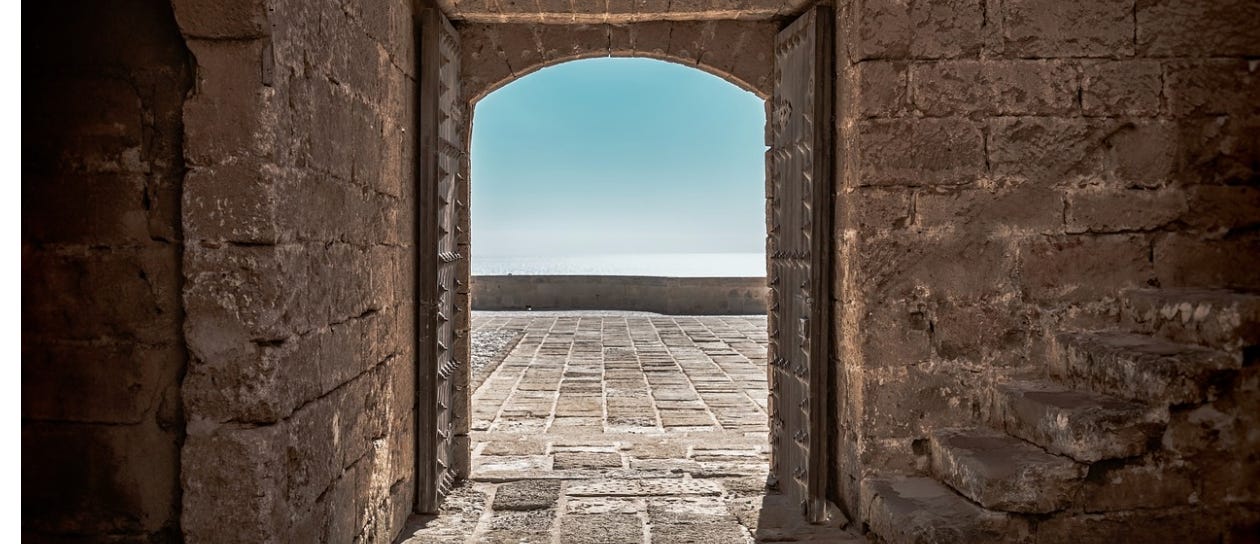
The main gate of Beijing’s Forbidden City has five doorways. For almost five hundred years, the one in the middle opened for a single man. Everyone else used the side openings, sorted by rank. The empress could pass through the center once, on her wedding day. The top three scholars of the imperial examination could walk out through it once, and that was the honor of their lives. The whole palace is laid out along a single north-south line, and the emperor’s throne sits on that line.
About an hour’s drive north, the Great Wall climbs along the mountain ridges. Soldiers, farmers, and convicts hauled its stones up those slopes over generations, and no one kept count of how many died doing it. The wall existed to keep the throne safe, and ordinary lives without number were spent to protect the one life at the center.
A tour guide once summed it up with a shrug: the emperors were cruel, but now their palaces and walls bring in tourist money, so their descendants are doing fine. He meant it as a joke. It also describes how most power has worked: the people pay, and the king is kept safe.
John’s Gospel shows us a different king. Roman soldiers made His crown out of thorns as a joke. They threw a purple robe over Him, called out “Hail, King of the Jews!” and struck Him with their hands (John 19:3). Then Pilate fixed a sign to the cross stating the charge: “Jesus of Nazareth, the King of the Jews” (John 19:19).
The crowd read that sign as mockery, but John wants us to read it as true. Jesus really was the King, though He refused to rule the way kings usually rule.
He had already told His disciples so. When James and John asked for the seats of honor beside Him, Jesus said that “those who are considered rulers of the Gentiles lord it over them” (Mark 10:42). Then He described Himself: “For even the Son of Man came not to be served but to serve, and to give his life as a ransom for many” (Mark 10:45).
The emperors’ wall was built with other people’s lives. At His last meal, Jesus lifted the cup and said, “This is my blood of the covenant, which is poured out for many” (Mark 14:24). The emperors drew strength from their people’s blood. Jesus gave His own blood to feed His people.
In 1707, Isaac Watts put the shock of that exchange into four lines:
Alas! and did my Savior bleed,And did my Sovereign die?Would He devote that sacred headFor such a worm as I?
— Isaac Watts
Watts calls Jesus his Sovereign. A king is the last person we expect to die for one of his subjects, much less for one who calls himself a worm.
We can see the same thing in where He went. Many of the religious leaders of His day knew the Scriptures well, yet they could not accept a Messiah who looked like this. Jesus called fishermen from their nets and ate with tax collectors and sinners, the people the respectable kept at a distance. When He was criticized for it, He answered, “Those who are well have no need of a physician, but those who are sick. I came not to call the righteous, but sinners” (Mark 2:17). No one had to be the right rank to come near Him. They only had to know they needed Him.
On the cross, still wearing those thorns, He said “It is finished” (John 19:30) and gave up His spirit. He had given His life, the last thing anyone has to give.
Today the emperors are names on museum plaques. Jesus rose from the dead, and two thousand years later people who have never seen Him still follow Him. Yet many others walk past Him, the way the crowd walked past Pilate’s sign. John named this in the first chapter of his Gospel: “He came to his own, and his own people did not receive him” (John 1:11).
It is hard to understand how a King who gave this much can still be turned away. Part of the answer lies in the kind of King He is. An emperor could order his people to bow, but love cannot be ordered. Jesus gave His blood and came looking for us, and He waits for a love that is freely given.
Most of us will never sit on a throne, but we all have small kingdoms: a home, a team, a classroom, a church. In each of them we feel the pull to keep the middle doorway for ourselves and let others pay to keep us safe. Our King went the other way. What would it look like this week to spend ourselves for the people around us, instead of spending them for ourselves?
The middle doorway in Beijing opened for one man. Our King came out to meet us wearing thorns, and He opened the way in with His own blood.
Stay here for a moment.
The King of all wore a crown of thorns so that the way to Him would be open to anyone.
Stay with that.
Lord Jesus, the kings of this world hide behind walls and gates. You came out to us.
You let soldiers twist thorns onto Your head, and You did not call for help.
I confess that in my own small kingdom I often want the middle doorway for myself. I want to be served and kept safe.
Teach me to rule the little that is mine the way You rule, by giving myself away for others.
Thank You that You are King, and that Your crown was worn for my sake.
In the name of Jesus, who wore thorns so the way in would stay open. Amen.
If this reached your inbox, just reply with your request. Only our team reads replies, and we pray for each one by name. You’re welcome to comment below too, but comments are public.
© 2026 Bible Portal. Free to share with attribution. Please keep the source and a link to Bible Portal intact. For other uses, contact us.