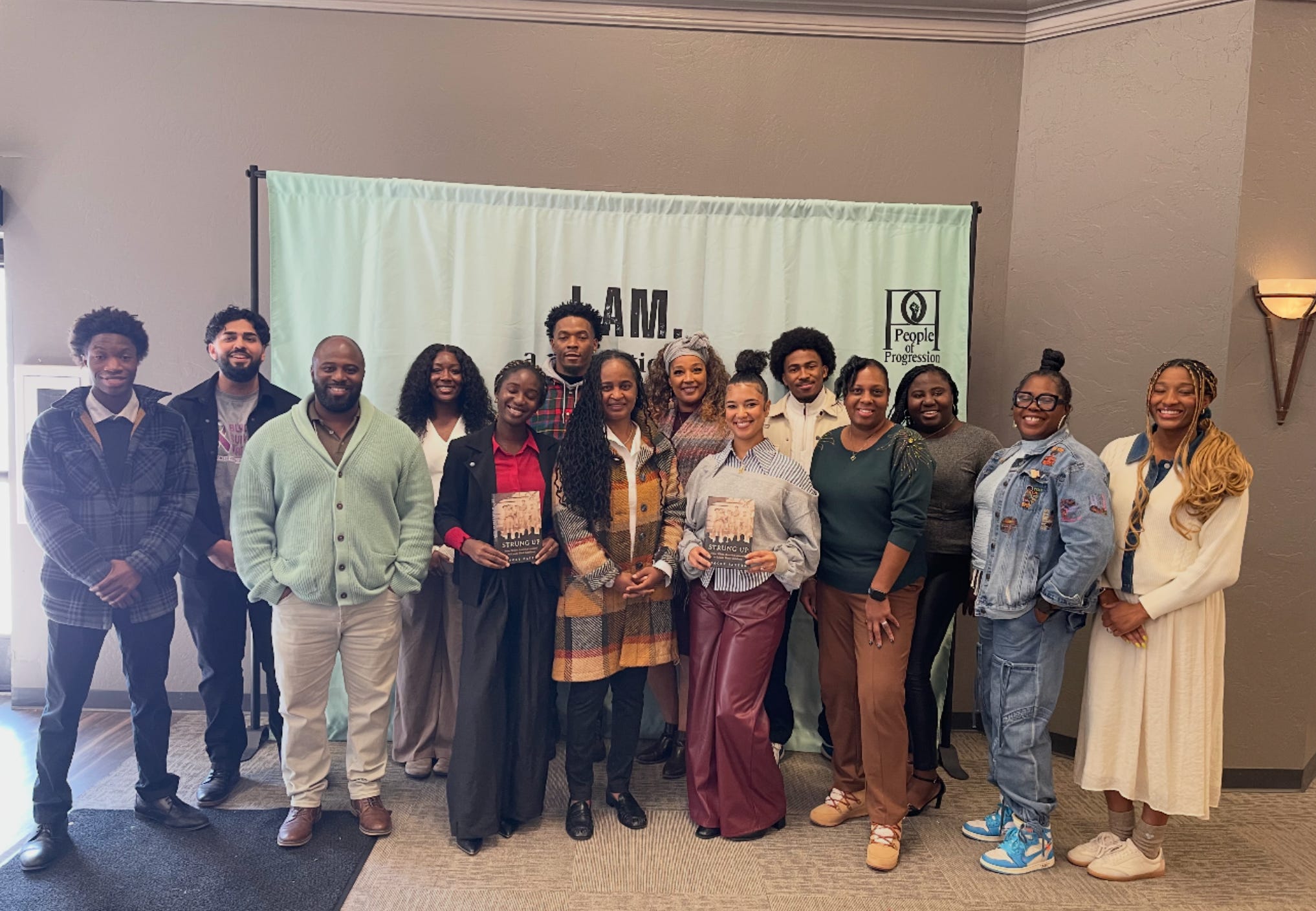
With the leaders and staff of Wisconsin’s People of Progression’s Inheritance Project two-day domestic violence summit.
Y’all, I need to tell you about this powerful moment I had yesterday.
I was attending a two-day summit hosted here in Wisconsin by a Black-led community group called People of Progression, whose work is about supporting survivors of domestic violence and breaking generational cycles of harm. The organization invited me to present to more than 100 attendees on a range of topics including, childism, physical punishment of children, school discipline, the neuroscience and ways trauma changes children’s developing brains, and the harms of digital addiction on children’s brains and learning outcomes.
At the end of the day, I was sitting at a table signing copies of my new book when an 18-year-old young woman walked into the room to greet her mother. Her mother looked at her, gestured toward me, and said, “This is Dr. Stacey Patton.”
The girl’s eyes went wide. Her mouth formed this huge O. She gasped and covered her mouth like somebody had just introduced her to Beyoncé. “Oh, for real?!”
I smiled so hard. But it also felt beautifully strange to have such a young person react to me like I was some kind of famous entertainer.
I’ve had lots of adults react this way. They’ve hugged me, cried, talked about the impact my work has had on them and their relationship with their child(ren). It’s a powerful thing when you get to witness how ideas in a book leave the page and change somebody’s perspective and way of living. But a moment like this with somebody’s child has never happened to me before. Here was this 18-year-old delightful girl who knew my life’s work had been telling the truth about what violence does to children. Rarely do I ever get to hear from the children who’ve been on the receiving end of the pain.
Some time later, she walked back over and stood close to me in the way my students often do when I’m sitting at my desk. It always makes me smile when my students want to be up under me like that. I always smile while I’m hovered over a document with a pen or tapping away on the keyboard. “Yes dear,” I sing to them as I did to her.
“My mother read your book,” she said in a gentle voice.
“This one?” I lifted up a copy of *Strung Up *that I was signing for another attendee.
“No, the other one. Spare the Kids,” she said.
“Ohhh, that’s wonderful,” I smiled up at her. “Have *you *read it?”
“Me, nooooo. I think should though. Because after my mother read it, our relationship changed. My mom is different. We communicate better now. Our relationship is much better now,” she said as her mother watched our exchange from the other side of the table.
I felt a sudden shift in my body. Then I froze as a sting gathering behind my eyes. And as she kept talking I got warm all over. Her words reached me in places that my own words could not. As she shared her testimony, she and her mother exchanged gentle, loving glances and I could no longer keep my eyes from filling with tears.
**That was a moment, Y’all. **
Such a beautiful moment when you realize that all those years of research, writing, and fighting to persuade adults that children deserve to be loved without being hit had reached into the privacy of a home, interrupted a cycle of trauma and violence, and helped make room for a different kind of love. I was standing in the presence of a mother-daughter relationship that had changed because I wrote a book.
Whewwww!
This was a woman who just a few years ago used to proudly call herself “the whupping mama.” And now, she’s a child advocate working with People of Progression, and trying to do this healing in her own family by talking to cousins, aunties, and others to stop putting hands on children.
Many people think that parents who hit their children cannot change. But here was a self-proclaimed “whupping mama” who embraced it as a an identity, which reflected her cultural understanding of child punishment, which had been normalized, justified, and celebrated this parenting tactic. But when she encountered new information, she reconsidered what she believed, and changed her behavior. As folks say, when you know better you do better. And as a result, her daughter got to stand next to me and celebrate the emergence of a different kind of relationship with her mother.
This is how intergenerational change unfolds. This young lady is entering adulthood with an experience that I hope will influence how she understand love, conflict, communication, and parenting.
I wish Y’all could have been in that space with me watching this parent and child’s soft, loving, gentle looks because that said more than either of them could have explained to me. I didn’t need to read some clinical assessment, or a longitudinal study, or an elaborate explanation of attachment theory to recognize the tenderness in that moment which reminded me why I do this work.
Some authors write books to see their name in print, to get all the reviews and awards, invitations to speak and so on. Those things are great. But for me, that’s not the point. For me, it is knowing that somewhere on Earth, a mother picked up something I wrote and encountered an argument that was powerful enough to make her stop hitting her child. And because she did that, her 18-year-old daughter was standing next to me at a summit saying thanks and looking at her mother with tenderness instead of remembering her primarily through betrayal, fear, and pain.
MY book interrupted an inheritance that could have traveled another generation. Not only did it change the language inside one Black home, it changed the way this family handles conflict, what love looks and feels like between a parent and child. And yesterday, right there at that table, years after I sat alone scratching those words on paper, the evidence stood right next to me. Not with a statistic, citation, book review, or book jacket testimonial. But a mother and daughter, looking gently at each other.
That moment was everything to me, Y’all. Everything. Because oftentimes writers don’t get to meet the people on the other side of their sentences.
I also want to say that every time I present in community spaces like this, I witness how everyday people are yearning for knowledge, tools, and healing from their own traumas. They want to help heal not just themselves, but their families and communities. One heartbreaking sentence I hear over and over again is, “I didn’t know.” And then once they know, their next question is, “What do I do to change?”
We desperately need more academics out there on the ground doing this work in community spaces because our scholarship and advocacy can have consequences beyond academic institutions. Our work can change something more intimate and consequential in people’s lives. If you’re sitting in the ivory tower producing scholarship that doesn’t liberate folk in some way, what good is all that knowledge about the problems we study if it stays locked behind journal paywalls and never reaches the people who need it most?
Above: A two-minute interactive exercise where the adults standing on the chair reenact parents who subject their children to yelling, threats, and verbal abuse. The adults standing on the floor had no idea what was about to happen and they have the same emotional and physiological responses as children.
For me, I’ve witnessed my own work create social change, get a law passed in one state, policies adopted in child welfare professions, citations and studies published. But the most powerful evidence of change comes in a moment like this. A moment when an 18-year-old young lady stands across from the mother who used to hit her, now looking at her with love. I got to sit in the space between them and witness a story about what becomes possible when a parent decides that love no longer needs to hurt.
To get to see your life’s work become somebody else’s lived reality and to meet the human consequences of your own sentences is everything, Y'all. It is EVERYTHING.
Thanks for reading and watching. If this piece moved you or made you think, please consider becoming a paid subscriber. Your subscription keeps my Substack fueled and unfiltered. Paid subscriptions also help me support HBCU journalism students who need laptops, DSLR cameras, tripods, mics, lights, software, conference travel, reporting trips, and even food from our pantry. We appreciate your support!