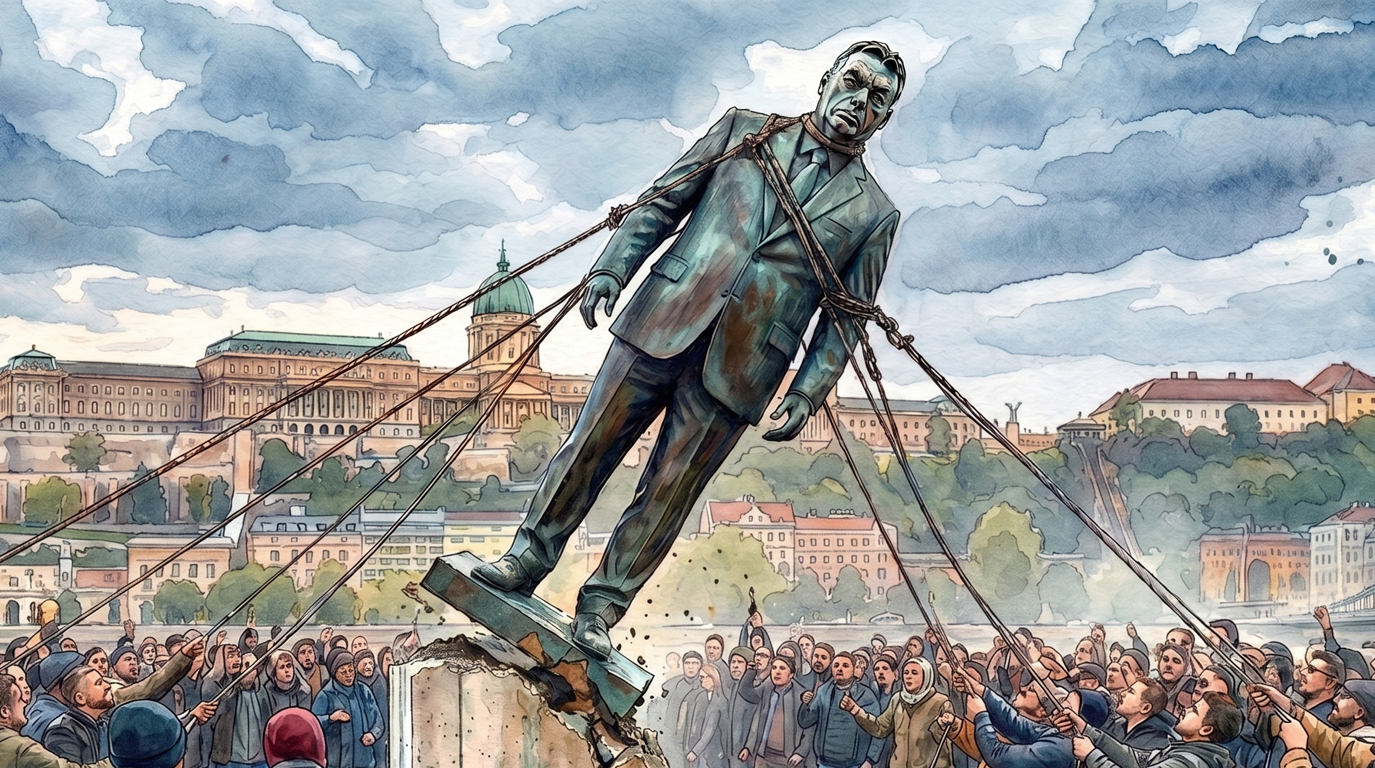
Five lessons from the Fall of Orbán.
ODESA—“Ruszkik, haza!”—“Russians, go home!”
The chant rose in Hungarian from Budapest on the night of 12 April, as a 16-year regime that had captured the state, bent the media, and invited the American vice president to save it conceded defeat.
We publish this newsletter every day at 9:05am NYC time / 4:05pm Kyiv.If you’re not already subscribing, why not do so now?
Viktor Orbán had every advantage a sitting prime minister could have. He had reshaped Hungary in his image, placed loyalists throughout the administrative bodies of the state, and taken such control of the media that his opponent and former protégé, Péter Magyar, was never once invited onto state television during the entire campaign.
Voters eventually desert those who offer only grievance, vanity, and decay.
Orbán had the backing of the most powerful country on earth—so much backing that Vice President JD Vance and Secretary of State Marco Rubio personally flew to Budapest in the final days to throw their weight behind Fidesz.
It was not enough. And that is the story.
Orbán did not lose to a left-wing insurgency, or to a foreign conspiracy, or to the exhaustion of conservative ideas. **There are five lessons to learn from his fall. **
If you speak the language of civilizational defense but
shrug at Russian imperialism, your message eventually collapses under its own contradiction.
Orbán did not lose because the public suddenly became allergic to his message of sovereignty, borders, national identity, or cultural conservatism. Hungarians still clearly support these values—after all, his opponent Péter Magyar, leader of the Tisza party, ran on all of those things as well. Orbán lost because an overwhelming number of voters concluded that his system had become closed, arrogant, and exhausted.
For both MAGA and Europe’s right-wing parties, the warning is obvious. A party cannot live forever on the charisma of one man, on old grudges, or on the memory of earlier victories. If it does not cultivate new leaders, new language, and new energy, it eventually becomes a museum that still calls itself a movement.
Politicians, beware: Both in the US and in Europe, a large majority of people see Russia as an enemy.