For most of us, there is a powerful impulse to figure things out, especially ourselves. We want to know who we are, why we are the way we are, what our experiences mean, and what kind of life we are supposed to build from them.
In nearly thirty years of working with people through religious deconstruction and reconstruction, I have watched this impulse become particularly intense when an inherited identity begins to fall apart. We often call what follows identity reconstruction. When the beliefs, roles, communities, and narratives that once told us who we were no longer hold, there is an understandable urgency to construct something new in their place.
But I have also come to see a danger in this. We can become so preoccupied with figuring out who we are that our new identity becomes another structure we have to live inside correctly. We escape one prescribed version of ourselves only to begin constructing another.
There is another kind of freedom: the freedom to be yourself without having yourself completely figured out. To change your mind. To remain unfinished. To enter a season you cannot yet name. To live fully while some of the largest questions about who you are and where your life is going remain unanswered.
In fact, I have come to believe that this is one of the greatest capacities of Existential Health: the ability to inhabit your life without requiring a final explanation of it.
That is what I want to explore in this brief article.
There is a peculiar pressure attached to being human. Somewhere along the way, we absorb the expectation that we are supposed to figure ourselves out. We should know who we are, what we want, what our purpose is, where our life is going, what our suffering means, and whether the choices we have made were the right ones. A well-lived life, we imagine, should eventually become understandable to the person living it.
So we keep working on the explanation. We construct narratives about why things happened and search for lessons hidden inside our losses. We take personality tests, read self-help books, go to therapy, explore spiritual practices, change careers, leave relationships, begin new ones, move somewhere else, reinvent ourselves.
Some of these things help enormously because human beings need language for their experience. We need ways of understanding ourselves and locating our lives within a larger frame.
The difficulty begins when understanding becomes a requirement for living, when we assume that somewhere there is an explanation capable of making the whole thing add up. Beneath much of our searching sits an assumption we rarely examine: my life is something I am supposed to figure out. I’m no longer convinced that it is.
Most of us begin adulthood carrying some version of an imagined future. We may not have planned every detail, but we inherit expectations about how life is supposed to unfold: relationships that will last, bodies that will cooperate, work that will matter, a future in which greater confidence and clarity finally arrive. Somewhere ahead, we imagine, is the person we will eventually recognize as ourselves.
Then life begins interfering with the plan. People leave. Bodies change. Careers collapse or become strangely empty. Beliefs that once organized reality stop making sense. People we love die. We discover things about ourselves that do not fit the identity we spent years constructing. Sometimes nothing dramatic happens at all. We simply wake up one morning and realize that the life we successfully built no longer feels entirely like our own.
Disorientation quickly becomes a problem to solve. We wonder whether we made a bad decision, missed our calling, chose the wrong person, wasted too many years, failed to heal properly, or somehow wandered away from the life we were supposed to have. We begin searching for the missing explanation because an explanation promises to restore the ground beneath our feet.
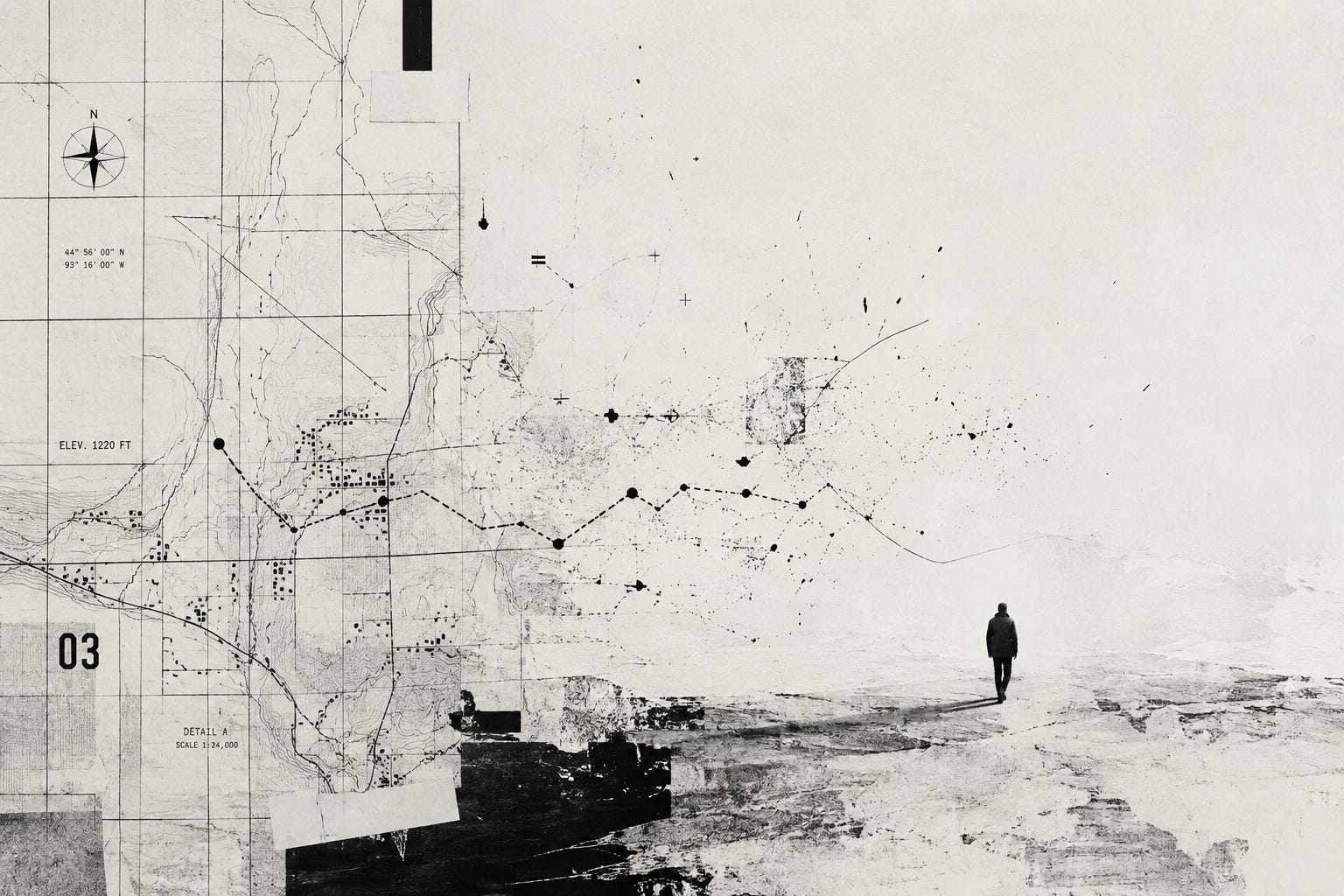
There is another possibility worth considering. Being disoriented sometimes is not evidence that we have failed at life. It might simply mean that reality has exceeded the story through which we were trying to understand it. A map becomes inadequate when the territory turns out to be larger than anyone knew.
Human beings make meaning almost instinctively. We connect events, establish patterns, interpret motives, remember beginnings and endings, and weave fragments of experience into stories that allow us to recognize our own lives. This happened because of that. I went through this so I could become that. This relationship taught me something. That failure redirected me. This suffering made me who I am.
There is nothing inherently wrong with these stories. They sometimes rescue experience from chaos and help us carry what would otherwise feel unbearable. The trouble begins when we require life to justify itself through them. Grief must become a gift. Trauma needs to produce wisdom. Failure must reveal its hidden purpose. Every detour eventually has to prove that it belonged to the journey.
Life does not always cooperate. Some losses remain losses. Some wounds leave nothing behind that we would willingly call a gift. Some relationships end without providing a satisfying lesson. There are questions we may understand differently twenty years from now and others that will accompany us all the way to the end without yielding an answer.
A human life is not a novel written backward from a predetermined ending. We live forward, without access to the final chapter, making choices from inside circumstances we only partially understand. Looking back, we sometimes discover patterns. Ahead of us lies mostly possibility, limitation, accident, desire, uncertainty, other people, and whatever tomorrow happens to bring.
One of the stranger ideas we inherit is that somewhere inside us there is a finished self waiting to be discovered. We are encouraged to find our true selves, discover our purpose, become who we were meant to be. These ideas can be beautiful, but they can also turn existence into a lifelong search for the correct version of ourselves.
What if there isn’t one? The person you were at twenty was not merely an unfinished draft of the person you would become at fifty. The person you are today is not simply waiting to be replaced by some wiser and more authentic future version. Each of these selves emerges from an actual life being lived within particular relationships, histories, limitations, discoveries, losses, desires, and possibilities.
Human identity is less like an object hidden inside us than a relationship continually unfolding between ourselves and existence. We change because life changes us. Something we once believed with absolute conviction becomes impossible to believe. A dream that organized decades of our lives loses its importance. We outgrow identities we fought hard to establish. We discover capacities we never knew we possessed and limitations we never imagined having to accept.
None of this automatically means we were previously living falsely. It means we were alive. There is tenderness in allowing our former selves to belong to us without requiring them to have known what we know now.
When I left the religious world that had organized much of my life, I assumed reconstruction meant eventually arriving at another coherent understanding of myself. I had been a pastor. I had inhabited a particular theological world. I knew the language, the role, the community, and the story that located me inside reality. When those structures fell away, the obvious question was: Who am I now?
It took me years to recognize that the urgency of the question was itself part of what I needed to examine. I was still assuming that I needed a sufficiently coherent answer before I could simply inhabit my life. I had left one system that told me who I was and was in danger of making a new identity perform the same function.
There was freedom in discovering that I did not need to replace one finished version of myself with another. I could live before I had figured myself out.
The demand to figure out our lives becomes especially intense during transitions. A relationship ends. Someone dies. A career runs its course. Our bodies change. A belief system collapses. Children leave home. The future we had quietly been counting on disappears. We find ourselves standing in territory our old maps no longer describe.
Almost immediately, the question arrives: What now? We feel pressure to construct the next identity, choose the next direction, establish the new purpose, find the new community, replace the belief that disappeared, or develop an explanation for what has happened. Emptiness frightens us because it exposes how much of our orientation depended upon structures that are no longer there.
There are periods of life, however, when demanding an answer too quickly prevents us from encountering what is actually happening. We rush to rebuild because we mistake uncertainty for danger. One identity replaces another, one worldview succeeds the previous one, one relationship fills the space left by the last. The furniture changes while the deeper architecture remains untouched: we still require certainty before we feel permitted to inhabit our lives.
Aren’t you tired yet?
Tired of having to know who you are. Tired of turning every loss into a lesson, every transition into a new beginning, every uncertainty into a problem requiring an answer. Tired of standing outside your own life trying to determine whether you are living it correctly.
There is a form of maturity in being able to say, without apology, I don’t know yet. Those words are not necessarily an admission of confusion or weakness. They can be a refusal to manufacture certainty simply because uncertainty makes us uncomfortable. Sometimes the most faithful relationship we can have with reality is to let it remain unresolved.
Something changes when we stop measuring a life by how completely we understand it. Another possibility opens when we ask how fully we are able to inhabit it. The emphasis shifts from explanation to participation, from possessing the correct interpretation of existence to developing the capacity to remain present within existence as it actually unfolds.
This asks something different of us: remaining present when we do not understand what is happening, allowing grief to remain grief without converting it into wisdom, and changing without treating our former selves with contempt. It means making consequential decisions without knowing where they will lead, loving what we cannot keep, and participating in experiences whose meaning may never become entirely clear.
These are questions of what I have come to call Existential Health. I am interested in the human capacity to remain in meaningful contact with life across uncertainty, mortality, identity change, grief, belonging, purpose, and the inevitable limits of what we can know. Existential health does not require solving the human condition. It concerns how we inhabit it.
A person can possess an elaborate explanation of life while remaining strangely absent from their own. We can know what we believe about love while protecting ourselves from intimacy, hold sophisticated theories about death while spending our lives avoiding mortality, speak eloquently about purpose while moving through our days with little sense of participation in them. Explanation has its place, but explanation and inhabitation are not the same thing.
There is a danger in spending too much of life trying to determine what life is supposed to be. We can become observers of our own existence, standing at a slight distance from ourselves and continually evaluating whether we are doing it correctly. We measure our fulfillment, inspect our relationships, question our purpose, monitor our progress, and wonder whether we have finally become authentic enough to trust the life we are living.
Meanwhile, the actual material of existence keeps arriving. Tuesday afternoon comes and goes. A person we love sits across from us. Rain gathers against a window. Our bodies become another day older. A friend calls with unexpected news. There is pain, and there is laughter. New people enter without warning while others slowly disappear from view. The world keeps offering itself before we have decided what it ultimately means.
I wonder how much of being alive consists in learning to participate before the explanation is complete. There are questions worth carrying rather than answering, identities that remain unfinished without being defective, losses that deserve to remain losses, and stretches of the journey where the most truthful orientation available to us is simply the willingness to continue without pretending we know exactly where we are going.
We do not need a final explanation for why we are here before our lives become worthy of our attention. The great task may be less about figuring out life than becoming capable of meeting it: unfinished, changing, beautiful, painful, ordinary, bewildering, and already underway.
Our lives are not waiting somewhere in the future for us to finally understand them. They are happening here, in the imperfect and unresolved reality we are already inside.
If my writing is meaningful to you, I invite you to become a paid subscriber ($50 annually). Your support helps make it possible for me to continue writing, researching, and developing the emerging field of Existential Health.
Paid subscribers also receive complimentary membership in the Center for Non-Religious Spirituality (CNRS), including access to our community conversations, workshops, discussion circles, support groups, and other gatherings exploring what it means to be human beyond prescribed answers.
Thank you for supporting this work and helping create space for it to continue.