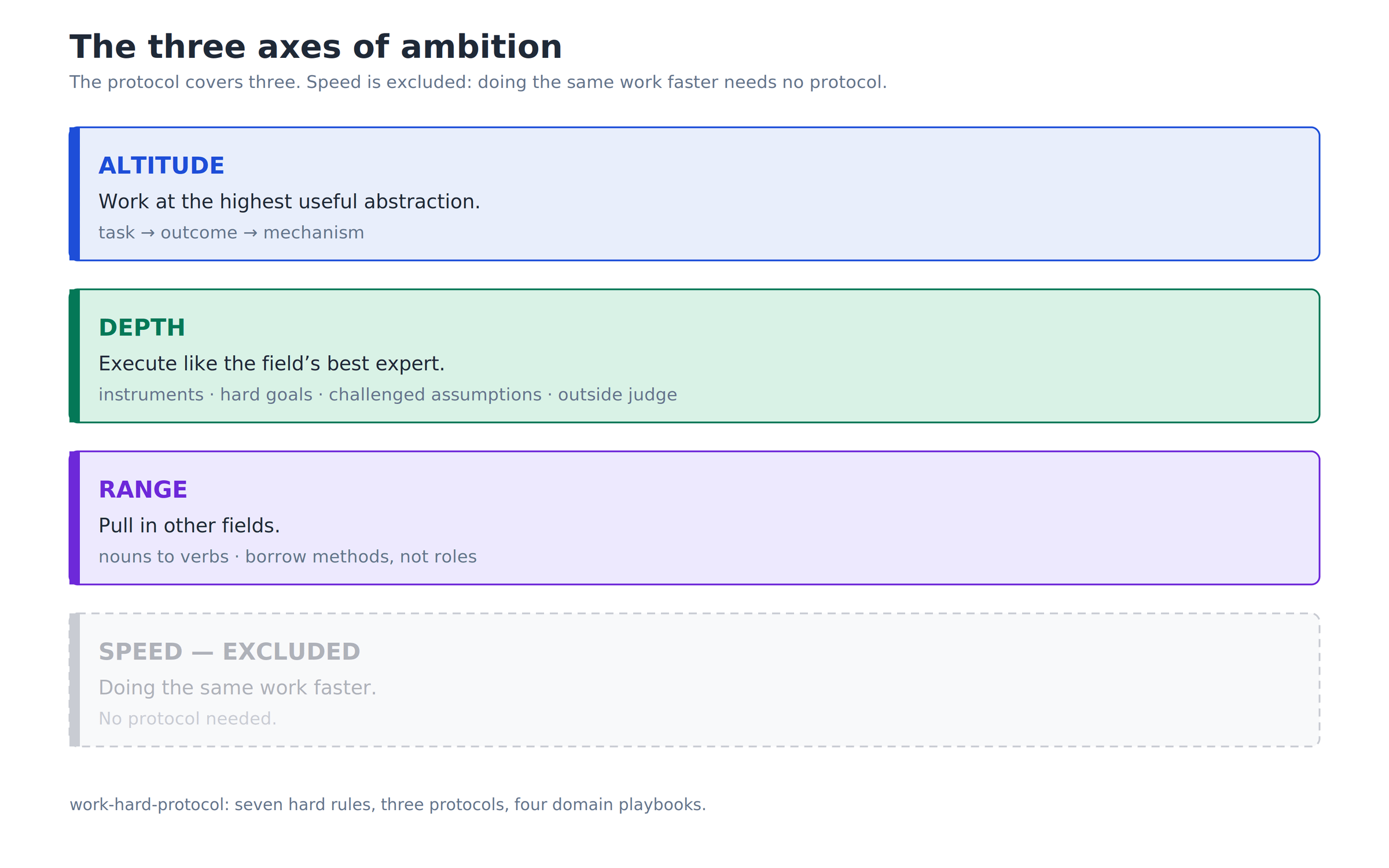
The gap between people who get remarkable results from AI models and everyone else is not the model. It is not the prompt. It is whether ambition runs as a protocol or as a mood.
On October 13, 2026, Felix Rieseberg — an engineering lead working on Claude at Anthropic — published a tutorial titled "How to be more ambitious: A tutorial for humans with models." The announcement post passed 3.1 million views. The tutorial makes one argument: model capabilities are uneven. They are astounding in some directions and inadequate in others. A few people learn to use the astounding parts deliberately. Most people ask for the capital of France.
Rieseberg sorts ambition into four types. Speed gets the same work done faster. Altitude works at a higher abstraction: it asks what you want to happen next, the goal beyond the goal. Depth executes the way the field's best expert would: it goes one level deeper and touches the underlying data, tools, and problems. Range pulls in other fields: it uses knowledge and techniques the task would not normally require. He adds one psychological observation: watching someone do the hard thing first raises what you attempt. Ambition is contagious.
The tutorial is written for humans. That is its limit. A human must remember to be ambitious on every task, under load, on a deadline. Discipline fails exactly when it matters most. We asked a different question: what if the ambition lives in the agent instead — as operating rules it runs without being asked?
That question produced work-hard-protocol. It is a single skill file. It converts Rieseberg's tutorial into seven hard rules, three executable protocols, four domain playbooks, and worked examples. It is open source under MIT. The paid section of this article walks through the full protocol and shows how to install it.
Rieseberg's starting observation deserves emphasis: capabilities are uneven. The same model that drafts a solid memo cannot reliably count. This unevenness is why ambition matters more than model choice. A few people learn where the astounding parts are and direct them deliberately. Everyone else gets the average of all directions, which looks like the capital of France.
He also leans on a psychological result: watching someone do the hard thing first raises what you attempt. Self-efficacy transfers by example. That is why his tutorial is full of worked examples instead of advice. This article follows the same method. Every protocol below comes with a worked example, because the example is the mechanism.
The discipline problem is the reason the tutorial needs a sequel. Each task is a fresh opportunity to be shallow, and shallowness is faster. Under load, on a deadline, the ambitious version loses to the quick version — every time, unless something outside your willpower intervenes. That something is a protocol: named rungs, forced statements before acting, a defined judge. The agent does not need to feel ambitious. It needs to execute the checklist.
Why prompts don't produce ambition — the model optimizes for the literal request, and the literal request is your best guess, not your goal.
Protocol 1: Altitude — the three-rung ladder, with worked examples from coding and writing.
Protocol 2: Depth — the five moves that separate expert execution from imitation, plus the depth-rewrite checklist.
Protocol 3: Range — how to borrow methods from other fields without roleplay.
The operating norms — hard goals, outside judges, and where failure is allowed.
Install and use — the repository, the install paths, the trigger phrases, and the four domain playbooks.
I built a skill for your agent to use.
The skill is open source on GitHub. The repo link is in the paid section below.