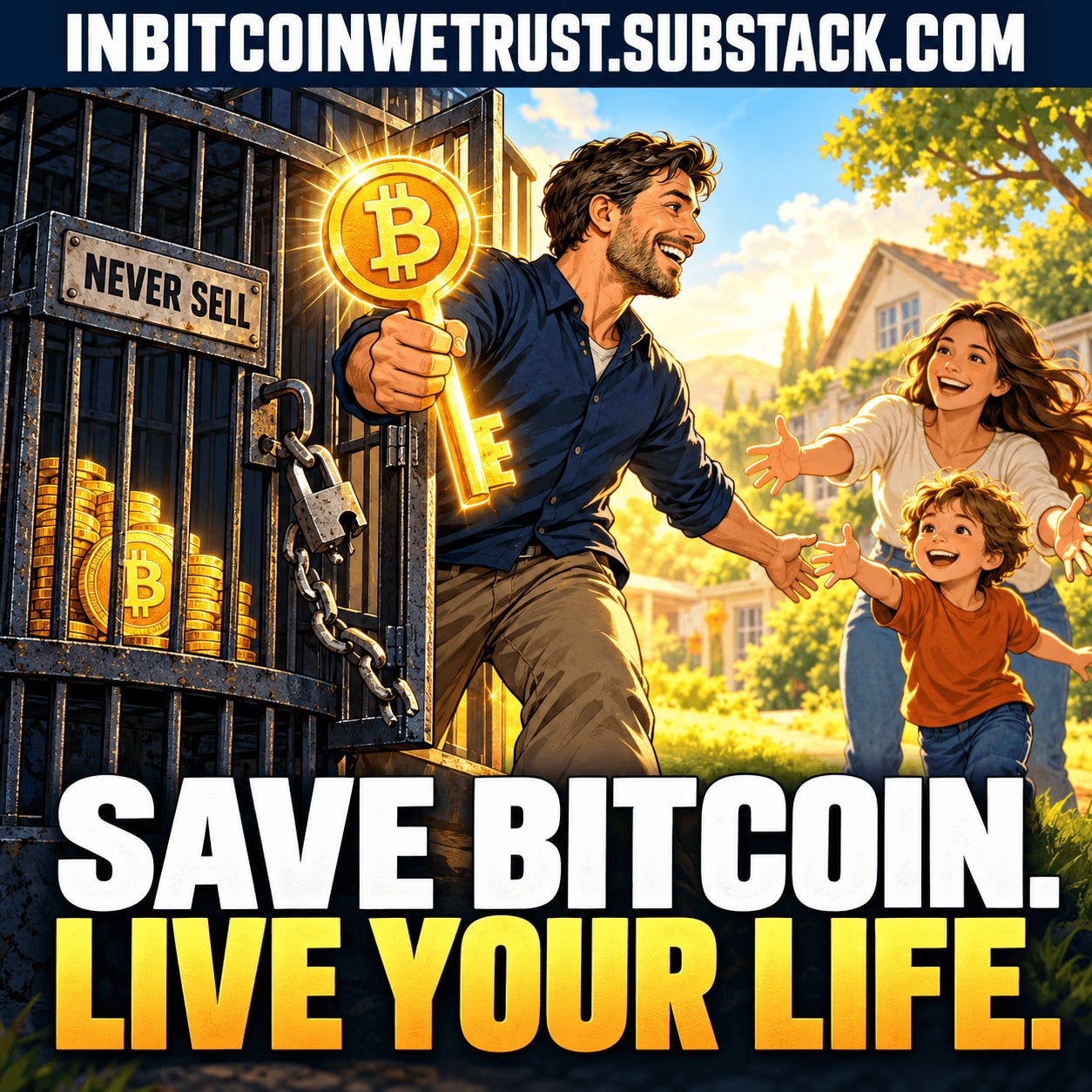
“Why would you spend your Bitcoin if you know it will be worth more in the future?”
You have probably heard this question.
Depending on who asks, it is either meant to expose Bitcoin as a useless currency or to prove that spending it is the financial equivalent of setting your future on fire.
Both versions sound convincing until you flip the question.
**If you expect your dollars to lose purchasing power over time, why do you hold any dollars at all?**Why is there money in your checking account?
Why have you not emptied it to buy food, furniture, clothes, and everything else you might eventually need, before prices rise?
Because you have a life to manage. You do not know every expense that will arrive next month. Your refrigerator has limited space. Your landlord wants money rather than a collection of discounted washing machines. Buying something unnecessary today can be a worse decision than holding cash that buys slightly less tomorrow.
You understand this without needing an economics degree. The usefulness of money extends beyond its expected return. Money gives you choices, and those choices have value even when holding the money has a cost.
Now apply the same common sense to Bitcoin.
Expecting an asset to gain purchasing power gives you a reason to hold it. That reason competes with other reasons: feeding your family, maintaining your health, improving your skills, buying back time, helping somebody you love. It does not automatically defeat all of them.
An incentive changes the decision. A rule eliminates the decision.
Much of the argument about whether Bitcoin can function as money comes from confusing those two things. So does a particularly joyless version of Bitcoin ownership: spending years building financial freedom, then feeling guilty whenever you consider using it.
Before going further, the word “know” deserves some attention.
Nobody knows that Bitcoin will buy more next month, next year, or at the precise moment they need it. A strong investment thesis remains a thesis. A constrained supply does not guarantee demand, and a predictable issuance schedule does not produce a predictable market price. Bitcoin.org itself identifies volatility as a disadvantage and explicitly says there is no guarantee of continued growth.
That distinction matters. Somebody with rent due in four weeks faces a different problem from somebody investing surplus income for twenty years. The long-term investor can believe in Bitcoin without pretending the tenant has the same room to wait.
Yet the spending objection fails even if we grant its optimistic premise. Imagine that you strongly expect your savings to buy more later. You would probably become more selective about purchases. You might delay replacing a perfectly good phone or reconsider a car bought mainly to impress people.
You would still eat. You would still need somewhere to sleep. And if a purchase mattered enough, you would make it.
The possibility of a better future does not erase the needs of the present. It changes how carefully you weigh them.
This is where the discussion of time preference becomes useful, provided we resist turning a useful concept into a personality test.
Broadly, time preference concerns how people value satisfaction sooner relative to satisfaction later. In ** Saifedean Ammous’s argument about hard money**, money that better preserves purchasing power makes provision for the future more dependable, encouraging people to discount that future less.
That is an argument about incentives. It is not a prediction that everyone will stop spending, or that every holder will make identical choices.
It also helps to distinguish patience from expected investment returns. The return you anticipate affects what waiting might buy. Time preference concerns how you value earlier and later benefits. They interact, but they are not interchangeable. A person can care deeply about the future and still decide that a particular expense belongs today.
Within the Austrian framework Ammous uses, positive time preference is the starting point: other things equal, earlier satisfaction is preferred to the same satisfaction later. We need not treat every claim in that framework as an uncontested law of psychology to recognize the practical point. Greater patience does not make people indifferent to their present lives.
Think about a parent paying for a child’s education. The payment happens now, while much of the hoped-for benefit lies ahead. Calling that parent impatient because their Bitcoin balance falls would miss the entire purpose of the decision.
Or consider someone replacing unreliable equipment in a small business. They give up savings today because the purchase may support years of productive work. The expenditure can express concern for the future just as clearly as leaving the money untouched.
You cannot read a person’s time preference from a wallet balance. You need to know what they are trying to accomplish.
A U.S. rollout planned for late October brings digital dollars into Samsung Wallet. The deeper battle is over who owns the customer when the blockchain fades from view.
The same caution applies to broad claims about fiat money. Expected inflation can make holding idle currency less attractive and can encourage earlier purchases. But people can also respond by buying productive assets, earning interest, changing investments, or keeping smaller cash balances. Inflation does not turn everyone into an uncontrollable consumer.
Nor does a household’s choice to hold fiat mean it has abandoned the future. A cash buffer can protect a long-term plan by making it less likely that an unexpected bill forces the sale of investments at an unfortunate moment.
Money influences behavior alongside income, obligations, uncertainty, access to credit, family circumstances, and personal values. Any theory that makes all those things disappear may produce a clean argument online. It will be much less useful at the kitchen table.
What I find compelling about saving in an asset I expect to preserve purchasing power is the question it puts in front of a purchase: is this really worth giving up future options for?
That question can be transformative. A sale sign becomes less persuasive. A fashionable upgrade has to justify itself. An expensive habit becomes easier to recognize when you compare it with the independence you could build instead.
But a question needs room for an honest answer.
Sometimes the answer is yes. Yes, this training is worth it. Yes, getting out of an exhausting commute matters. Yes, helping a parent now is more valuable to me than maximizing the balance I might have ten years from now.
The benefit of thinking twice is making a better decision. Thinking twice and always being forbidden to say yes is something else.
There is another problem with the claim that Bitcoin spending carries a uniquely unbearable opportunity cost. Most people apply that logic selectively.
Suppose you have $100 available and can either spend it or buy Bitcoin with it. If you spend the dollars, you forgo the Bitcoin you could have bought. If you already own the equivalent amount of Bitcoin and spend that instead, you forgo continuing to hold it.
Ignoring fees, taxes, and other practical differences, the forgone exposure can be equivalent. Labeling one payment “spending dollars” does not make its alternative use disappear.
This does not mean the payment method is irrelevant. Those practical differences can matter considerably. It means that the underlying consumption decision deserves attention before the emotional significance of which balance decreased.
Someone can proudly announce that they never spend Bitcoin while spending every dollar that might otherwise have increased their savings. Another person can occasionally pay in Bitcoin while consistently saving more than they consume. The first slogan alone tells us very little about which household is building greater resilience.
Opportunity cost also needs to include more than an optimistic future price. It means the value of the best alternative you give up. For one person, that alternative might be holding Bitcoin. For another, it might be qualifying, keeping a business operating, or avoiding a serious deterioration in living conditions.
You cannot assume in advance that Bitcoin offers the highest possible return from every decision. And many of the returns that matter cannot be expressed as an investment percentage at all.
The education that changes your working life has consequences beyond the tuition bill. The time you spend with your children has no quoted market price. Treating those benefits as zero because your spreadsheet cannot measure them does not make the spreadsheet objective.
Consider a hypothetical household that has saved steadily for several years. Then a contract ends unexpectedly, a client pays late, or a job disappears. The household still has long-term confidence in Bitcoin. It also has rent due next week.
If selling a portion of those savings keeps the family housed while income recovers, what exactly has failed?
The reserve was accumulated when circumstances allowed. It became useful when circumstances changed. That is a coherent reason to save in the first place.
There may have been ways to prepare better. Perhaps the cash buffer was too small, the concentration too high, or the income too fragile. Those are legitimate lessons. They do not turn the decision to pay rent into a betrayal of Bitcoin.
Now imagine that the same household has a chance to fund an education it otherwise could not afford. The decision deserves scrutiny: the cost, the likely benefit, the alternatives, and the uncertainty all matter. An expensive course does not become wise merely because somebody calls it an investment in themselves.
But refusing even to compare those possibilities because “we never sell” is equally careless. The asset has become exempt from the evaluation applied to everything else. A savings strategy has hardened into a rule that survives even when it obstructs the goals it was supposed to support.
Then consider the most difficult version. Your child needs an operation. There is a funding gap. Your Bitcoin can help close it.
For many parents, the supposed dilemma disappears immediately. The coins have a use more important than their possible future price. You do not need to stop believing in Bitcoin to recognize that fact.
The operation’s medical value and the best way to finance it require their own judgment. The point here is narrower: a parent who uses savings to care for a child has not misunderstood saving.
They have reached one of the moments for which savings exist.
Bitcoin can form part of someone’s preparation for uncertainty, but calling it “insurance” should remain a metaphor. It does not promise a payout when trouble arrives. Its market value can fall just as you need funds, and access depends on how you hold it. Its usefulness as a reserve must be judged alongside those limitations.
Still, when an asset you own helps you through a difficult period, its usefulness is real. A smaller balance can accompany a better outcome. Financial statements cannot tell that whole story without knowing what happened outside the account.
And we should be careful about allowing only emergencies to justify spending. You do not need a family crisis before you are permitted to benefit from years of discipline.
Perhaps you want to work fewer hours while your children are young. Perhaps a modest trip would let an aging parent see relatives. Perhaps you have reached a point where reducing financial stress matters more than accumulating the largest possible position.
None of these decisions is automatically wise at any price. Budgets and trade-offs remain real. But requiring every purchase to qualify as an emergency creates a strange relationship with money: you can use it to endure life, yet feel ashamed to use it to improve life.
Saving for an inheritance is a meaningful goal too. You may choose to hold assets throughout your life so your children or other beneficiaries can use them later. That is an intended use across generations. The problem arises when there is no purpose beyond protecting a number from ever going down.
Future possibilities deserve respect. So do opportunities that will not remain available indefinitely. Children grow up. Health changes. Relationships need attention in real time. Money can help you respond to those realities; it cannot suspend them.
That brings us to the most famous source of Bitcoin spending anxiety: the pizzas.
On May 22, 2010, Laszlo Hanyecz ** reported on BitcoinTalk that he had traded 10,000 bitcoins for pizza**. His original offer had asked for two large pizzas.
The usual retelling starts with today’s valuation, multiplies it by 10,000, and invites everybody to wince. It is memorable arithmetic. It is much less useful as a method for making decisions under uncertainty.
Hanyecz did not possess a verified chart of Bitcoin’s future. Neither did everybody else who could have acquired coins at the time. Looking backward, we know which asset survived and appreciated. Looking forward, people had to decide what an experimental system might become.
There is also another way to read that transaction. Someone wanted a real product and found another person willing to arrange it in exchange for Bitcoin. My reading is that this demonstrated a practical possibility. We do not have to claim that this particular purchase caused Bitcoin’s later success to recognize that actual exchanges helped people explore what the system could do.
More importantly, the retrospective calculation applies far beyond payments made in Bitcoin. Any discretionary dollars spent then could, in principle, have been used to acquire it instead. The missed opportunity does not become economically different merely because the receipt was denominated in dollars.
You could punish yourself indefinitely with that logic. Every holiday becomes an unpurchased investment. Every restaurant bill becomes a fraction of some asset that later performed spectacularly. Every ordinary decision gets judged against information you did not have.
That exercise has no natural stopping point. There will always be another hypothetical trade that would have made the past look more profitable.
A more useful question is whether you made a reasonable decision with the information, resources, and priorities available at the time. You can learn from an error without treating every later price increase as proof that living was a mistake.
The same distinction between incentives and rules helps explain something that can look puzzling from outside a currency crisis: people may continue holding some local currency even when they distrust it as a long-term store of value.
Lebanon requires care here. Its monetary experience has changed over time. In ** January 2026, the World Bank reported** that the exchange rate had been stable since August 2023, while consumer prices had become almost entirely dollarized and wage dollarization had increased. Describing the recent situation as an uninterrupted daily collapse of the pound would miss that development.
The broader lesson concerns the reasons for holding different balances. Imagine a household that prefers dollars for savings but expects a particular payment in Lebanese pounds. Keeping enough pounds for that purpose need not express confidence in the pound’s long-term purchasing power.
It can reflect the timing and denomination of a bill, the convenience of having funds ready, or the cost of repeated conversion. This is an illustration of how such a choice can make sense, not a claim that every Lebanese household behaves the same way.
People can assign different jobs to differen…