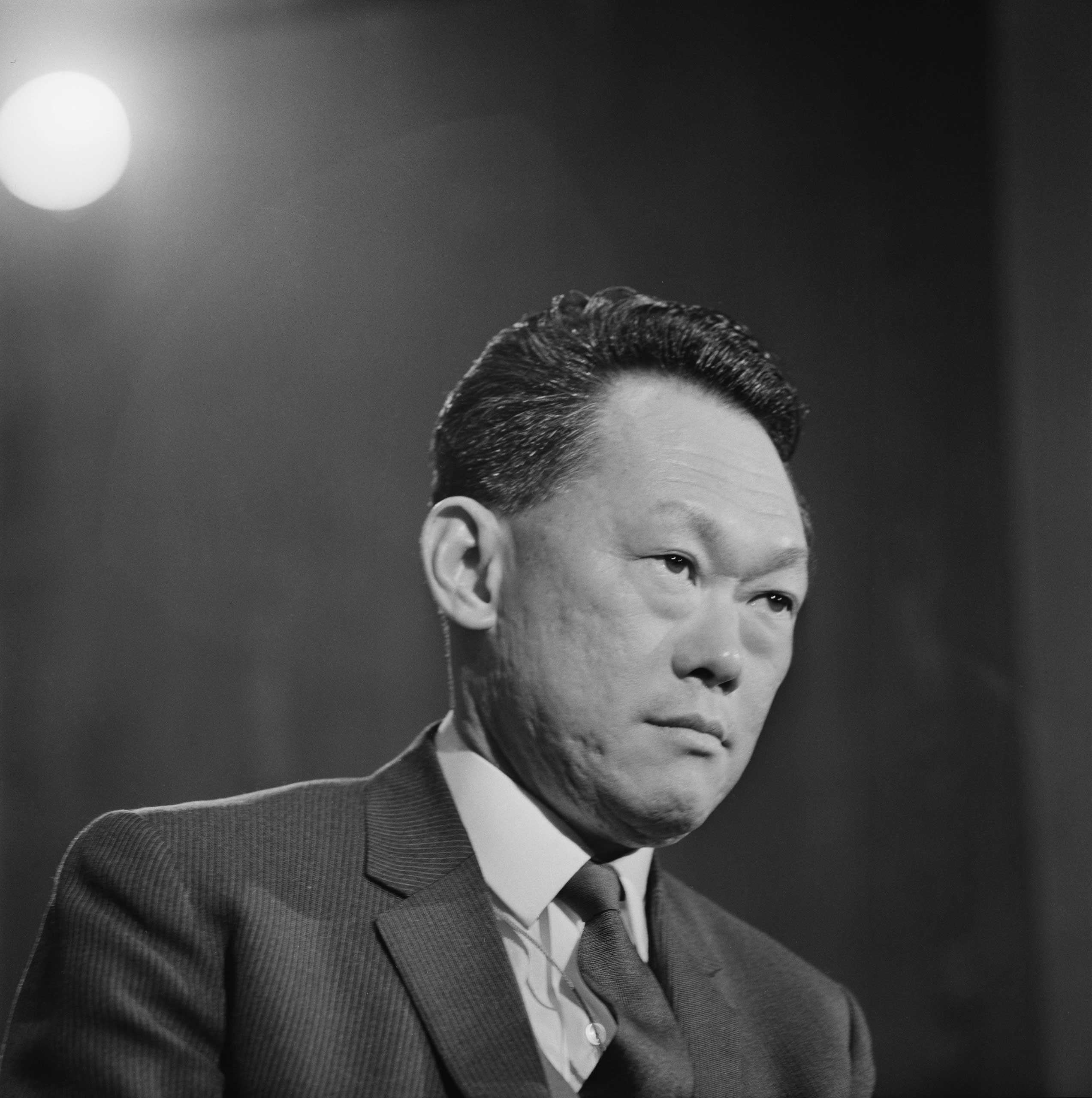
[This is one of the finalists in the 2026 book review contest, written by an ACX reader who will remain anonymous until after voting is done. I’ll be posting about one of these a week for several months. When you’ve read them all, I’ll ask you to vote for a favorite, so remember which ones you liked]
Lee Kuan Yew1 was the Prime minister of Singapore, rationalist folk hero, and one of the few world leaders to successfully become a household name despite not being primarily associated with a major war2. He was also, as it turns out, a surprisingly compelling writer. Aside from being interesting for his own sake, he also ended up implicitly producing the closest thing we have to a firsthand account of the fall of the British Empire and rise of the new world order.
His memoirs are split into two books, each covering roughly half his life. The Singapore Story covers his childhood, World War 2 and the Japanese occupation, law school, his legal career and rise in Singaporean politics and Singapore’s independence from the British Empire, joining Malaya to form Malaysia, then leaving Malaysia to finally become Prime Minister of a truly independent country. Third World to First covers his 25 years running Singapore after independence.
These books are part autobiography, part political memoir, part rationalist power fantasy. Every good rationalist, from time to time, can’t help but think Hey, if we just put me in charge of the government I would simply pass the good policies and not the bad ones, and the country would thrive. I’d just have to be clear and direct and explain to everyone why these were obviously good and reasonable ideas, they’d understand and go along with them, and our government would be popular and successful forever. All of us3 know this isn’t actually that easy, that real-life policy is hard and messy and often unreasonable and our clear bright ideas would struggle when faced with Reality. This couldn’t possibly work in real life.
Except that Lee goes ahead and does exactly that. He passes reasonable, economically-optimal policies and they work out so well that the economy booms and his party keeps winning massive supermajority elections for decades. When a race riot almost breaks out over malay recruits getting turned out of the army during high unemployment, he calmly shows up, picks up a megaphone and explains to everyone that this is all a misunderstanding, there’s no policy against employing malays in the army and they’ll all be processed and get jobs when they come back tomorrow. Everyone understands how reasonable he’s being, calm down, and sort things out the next day.
At another point he handles chinese-malay tensions by ~~writing an epic Scott-length blog post~~ giving an epic speech to the Malaysian parliament about how the new Malaysia needs to be less obsessed with zero-sum culture wars and focus on pragmatic economic policy and even the die-hard Malays stand up and clap4.
All of which raises the question: How did he actually do all this? Each book covers a seemingly-impossible task (the first, going from middle-class teenager with no connections to Prime Minister of your own country; the second, taking a third-world island nation with no natural resources into one of the richest countries in the world) that we might do well to learn from. The book implicitly offers one explanation - just be consistently brilliant, charismatic5, incredibly detail-oriented, honest, hardworking,and pragmatic continuously for decades while also having your share of good luck. Still, let’s take a look at the details.
Before we get to the rationalist power fantasy story, we take a tour through a few different genres. We start with a peaceful coming of age story.
Lee was born in 1923 in what seems like a typical middle class family for colonial-era Singapore, which is an odd mix of imperial British and a mashup of local cultures. He mostly goes by Harry Lee in his earlier years (He dropped the Harry in the late 1950s, except with his British contacts6).
Some parts of it (like the school system) feel surprisingly normal. Other parts are, well, this:
“My mother was the eldest child of this union, and when she was married in 1922 at the age of 15, the fortunes of both families were still healthy. She even brought with her, as part of her dowry, a little slave girl whose duty, among other things, was to help bathe her, wash her feet and put on and take off her shoes.”
Lee doesn’t especially respect his dad, who he considers weak, lazy and unreliable7 and learns his principles from his mother and (maternal) grandfather. He goes to British-run schools, keeps getting top marks and filtering upwards through the system, and ends up at Raffles college, the college for British-educated local elites in colonial Malaya8.
The story then takes a turn to become a school drama. First, Lee needs to get top grades in college for his dream of getting the Queen’s Scholarship to go to Oxbridge, a prestigious opportunity that only one or two students a year can get. But, frustratingly, there’s this girl a year above him who keeps outcompeting him with slightly better grades.
This is specifically the type of school drama with an absurdly powerful student council. There’s some drama between the Malay and Chinese students and, as an epic debater and naturally take-charge kind of guy, Lee ends up representing the Chinese students on their side of the argument. Everyone involved in this college dispute shows up again twenty years later as some kind of senior government official or public intellectual negotiating the fate of Southeast Asia.
Then the war breaks out, and we get a wartime story.
Lee sees the invincible British empire get stomped. The Japanese cut through Malaya in two months, crushing a British force with twice their numbers and capturing 130,000 British soldiers. The mighty white men of the British empire are helpless, hapless and cowardly, making bad decision after bad decision while completely failing to coordinate or organize a panicked retreat. By the time the Japanese get to Singapore, it falls almost without a fight.
We will get back to this momentarily, but I want to take a moment to sit and point this out. The British just lost. They were seen to lose, in a way that made them look selfish and cowardly and weak. Lee does not forget this.
Japanese occupation is a classic wartime story. The Japanese occupiers are cruel in an oddly banal, pragmatic but unfocused kind of way, occasionally kicking the locals down and occasionally ignoring them. Two interesting stories come up during this period.
First, Lee (along with most of the young Chinese men in Singapore) gets picked up by Japanese soldiers and led to a stadium. He stays there for three days, after which he’s told to leave through one gate. He gets a bad feeling about it, says something about forgetting his coat, and is allowed to leave to go back to it, managing to lose himself in the crowd again. The next day he just walks out through a different gate, and nobody bothers to stop him.
Lee was right to have a bad feeling about the first gate. The people who went through it were taken to the beach, then lined up and shot. This was the Sook Ching massacre, in which the Japanese shot tens of thousands9 of young Chinese men in cold blood across Singapore and Malaya to “suppress anti-Japanese resistance”.
Lee ended up doing a lot of business with the Japanese later as Prime Minister, asking them to come build factories in Singapore and help support the economy. He speaks highly of their organization and intelligence in the second book. That he does this after living through this story tells us something about him.
The second story Lee notes is that the Japanese set up a brothel full of their (Japanese and Korean, not local) camp followers within days of arriving. “As a result, rapes were infrequent”, he tells us. He’s impressed with their pragmatism compared to the British attitude towards the men’s needs.
Lee, meanwhile, is living a classic civilian in wartime story. Times are hard and he scrambles around doing various odd jobs to survive. At one point he starts a glue making business with the brother of Choo, the woman who kept outcompeting his grades in school. You can probably guess how that story ends.
There wasn’t any more real fighting in Singapore after the first invasion, though. The Japanese surrendered after the atomic bombs and withdrew from their empire, and the British swept back in unchallenged, coming back to rule Singapore like before. But still, things weren’t the same after that.
This is a good point to take a break and talk about the other story in this book. Both Lee’s personal rise and the later rise of Singapore happen on the backdrop (and, to some degree, as a consequence of) the fall of the British empire and its replacement with the new world order.
There’s an irony in that while Japan lost World War 2 pretty badly on the field, their actual stated goals in the war were to free Asia from western colonialism, and those goals they achieved amazingly well. They may have lost by direct force, but Lee and others like him didn’t forget how weak and disorganized and cowardly the British ruled in defeat. Western empires ruled Asia more through their aura of invincibility than through their technological advantage, and once that was lost their days were numbered and they knew it. The fall of Singapore was the single greatest military defeat the British ever had in terms of soldiers lost; it was also the battle that struck the deathblow to their Empire.
The end of the Empire was replaced with a new globalized world order that was both weaker and stronger than British rule. When the British ruled the world they cracked down on local customs we now find barbaric, like slavery or burning widows. This was rule from above and they never achieved perfect compliance (as Lee mentioned, even in 1920s Singapore there were still some forms of local slavery going on in common practice), although they did ingrain it more over time. But local cultures didn’t just revert to their old forms once the British left. Despite British rule being a distant memory, Singapore’s culture today is a lot more similar to London’s than it was in 1940 (and for that matter, so is Shanghai’s). Slavery is no longer banned with soldiers, but it has become unimaginable to practice it. We may have lost the force of the Empire, but cultural coercion lingers on in much of it10.
Lee travels to England after the war to go to law school11, which immediately leads him to despise the English and develop a burning desire to overthrow them12.
He starts off at the LSE, where many of the professors are some form of marxist or communist. He notes at this point that quite a few of his fellow students also ended up running their own third world states; the ones who tried to run their countries based on what they thought the marxists taught inevitably ran their economies to the ground13. He notes that the communist students’ main recruitment strategy is to send beautiful girls to recruit men to their clubs (this tactic comes up again later, when it’s used by the communists in Singapore14). Eventually he transfers to Cambridge, aces his exams, and heads back to Singapore ready to start a successful law career with some clear plans to get into politics15.
It’s noteworthy that Lee’s political drive starts in anticolonialism, which ties him to the Labour party, despite his eventual turn to more conservative/Thatcherite economic policy. For Americans, it’s worth noting here that traditionally the British right is more based on classist conservatism than the Reaganite free-markets-plus-church approach.
Meanwhile the British Empire is bankrupt, anticolonialism is on the rise and it’s increasingly clear to everyone that long-term colonial rule is on its way out. Lee believes (as young people often do16) that the older generations are too passive and whipped by the British and his generation needs to take a leadership role in achieving self rule, and comes back to Singapore intent on making it happen.
There’s a needle to thread here: The left is a broad alliance of everything anticolonialist from English-speaking moderates to labour unions and communist high schoolers (there’s also an actively illegal communist guerilla group in Singapore and Malaya, which the fringes of the legitimate communist political groups are connected to). Lee makes his name as a firebrand lawyer for all these causes (including fighting for unions and student groups), which leads to him successfully founding the PAP as an alliance of all the disparate anticolonial groups and eventually winning an election as their head. Once they’re in power, the communists (who hold most of the grassroots support) break off, and Lee has to make desperate efforts for the remaining moderate wing of the PAP to survive and hold onto a bare majority17.
This is probably the most important part of Lee’s personal rise and the most historically critical part, and it takes up a big chunk of the first book. It’s also boring, because it turns out Lee is really good at the boring hard work of politics and happy to talk about his craft. And I cannot emphasise this enough, the hard work of politics is dull. Lee spends pages talking about every specific person and deal he has to make to put the party together and keep its appeal, about finding good candidates for every district and negotiating with individual ministers and candidates to keep them on board. He talks about spending untold hours learning Chinese18 and going around giving speeches on his megaphone four times a night. He lists a million names of important people that I personally can’t hope to keep track of. When he gets like this (it gets even worse when he talks about geopolitical negotiations, especially because he had way more notes to work off of for those) it’s like reading an engineering documentary by a guy who insists on telling you the exact version of Kafka they used for every messaging layer when building google cloud19.
Seriously, don’t go into politics. It’s not worth it.
But it was for Lee, whose talent for remembering details and managing people and public opinion leads him to survive the crisis and keep a bare PAP majority of sensible moderates after the communists break off. Meanwhile there’s plenty of communist-tinged civil unrest of various kinds, between the labour unions and the Chinese high schoolers, but Lee (unlike his predecessors) manages to crack down on it hard enough to calm things down without just provoking more rioting and unrest20. Lee’s other political project is to push for the merger with Malaya to create Malaysia, since he believes that Singapore is just too small to have true independence on its own.
The rest of the first book is often fun, often boring, but not too illuminating. Lee spends years pushing for the merger with Malaysia, gets it passed, then spends the rest of the book trying to get Singapore fairly treated in Malaysia21. The majority Malay-first sectarian parties remain unconvinced and, seeing the PAP winning seats even in majority-malay parts of Singapore, a little nervous. Lee tries to explicitly make the case for a non-sectarian “Malaysian Malaysia”, and while his speech is applauded by all present22, the Malaysian government eventually decides this is all moving too fast and they need to break up. The Tunku (the Malaysian ruler) ends up sending Lee a signed copy of his book wi…