Imagine that you are dropped seven thousand years in the past, right in the middle of a village on a festival day. Everyone stares at you in horror: they think you’re a demon, a vengeful spirit. You are dressed in strange clothes, you are much taller than them, and you are holding a magic mirror that flashes with unexplained colors and sounds. The villagers are almost about to rush at you and kill you when the King’s right hand man, who happens to be visiting the village, comes to the front of the crowd.
– State your business, demon.
– I’m not a demon, I’m from the future.
– If you’re really from the future, what gifts have you brought us?
Oh shit. You don’t really have any gifts. You don’t know how to build an airplane, or how to make ammonia, or how to breed dwarf wheat. You think hard. Hmm… you do know one useful thing that, upon looking around, you are pretty sure these villagers don’t know. You tell the King’s right hand man what you know. He is pleased. He takes you with him to visit the King. You both arrive at court, and you sit on the sidelines as the right hand man goes up to the King to show off the new knowledge you gave him. As the King begins to speak, the right hand man demonstrates writing: IAMTHEKINGANDTHISISMYDECREE…
Wait, what?
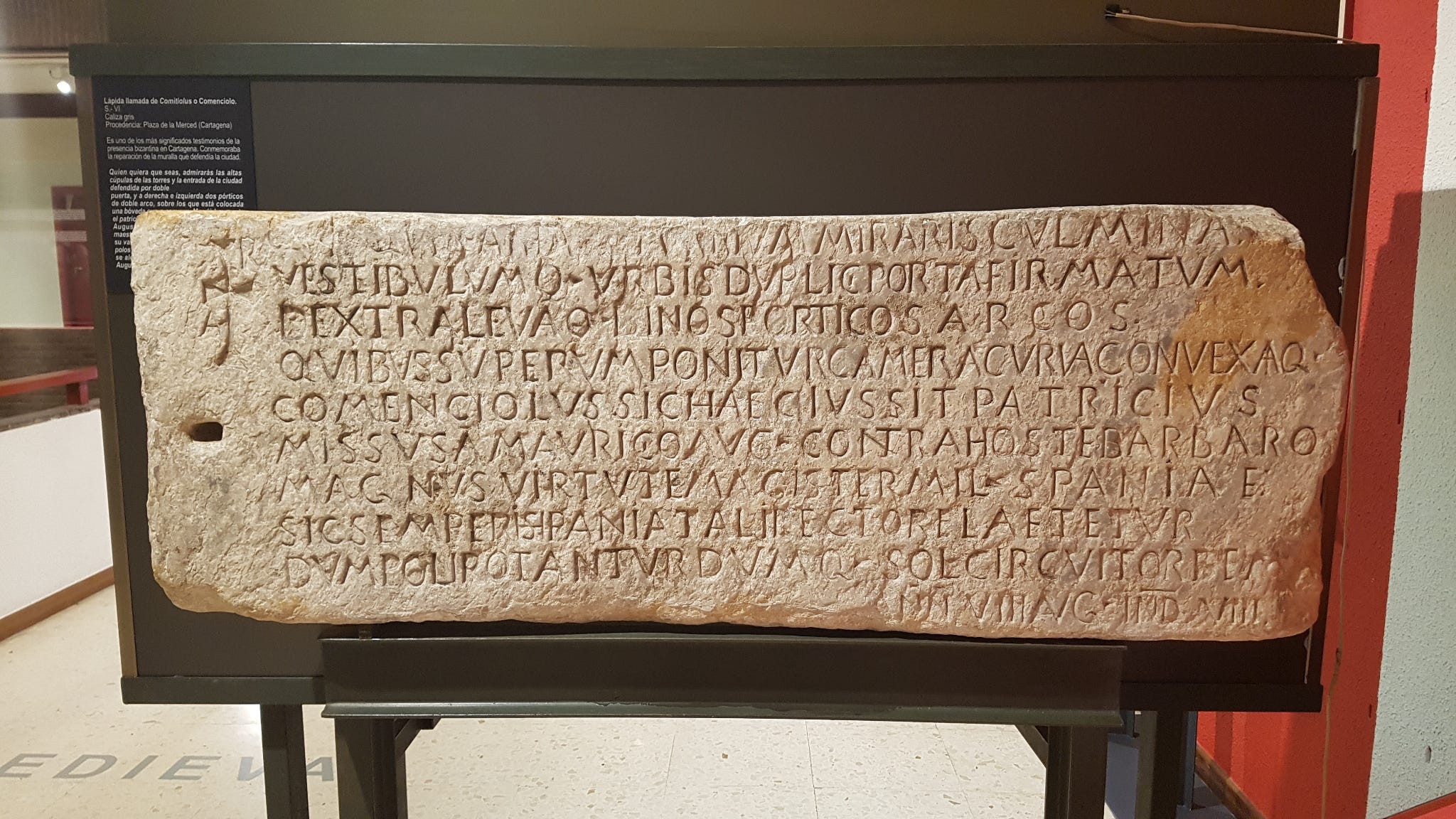
When Romans first began to write Latin, they wrote without spaces and punctuation. They simply put all the letters in a row,
Why? Because that’s how people speak. They don’t speak with punctuation, they don’t even really pause between words, they mostly speakcontinuouslylikethis. (This is very obvious to anyone who has tried to learn a second language, only to become confused at how native speakers squeeze all their words together instead of saying them one at a time.)
When it was invented, writing was very closely tied to the act of speaking. Many texts were speeches written down after the fact. And reading a text meant speaking it out loud again. It took a long time for writing to establish itself as its own thing, one with its own conventions and uses.
People often say that “language is the greatest human invention” but this is imprecise. Language is not a single invention, it is two: oral language and written language are quite different. We’ve grown up with both, so we don’t notice how these are different, but they are. Ong’s Orality and Literacy walks us through the differences.
Throughout his book, Ong is at pains to define orality on its own terms, not as an absence of literacy. This is because he wants to respect orality. But let’s you and I stipulate that we are nice people who respect everyone and then cut to the chase: oral cultures can’t write anything down, which in turn means oral cultures have extremely punishing memory constraints. They can store a decent amount of information inside people’s heads, but this is not trivially easy.
It is hard to imagine how such a society would work, but looking at very little kids gives us some idea of what a non-literate existence is like.
Little kids love using songs to learn and recall information. At my home, we have a handwashing song and a getting dressed song.
Little kids love listening to the same story over and over again to keep it alive. As Ong puts it, “when an often-told oral story is not actually being told, all that exists of it is the potential in certain human beings to tell it.”
Little kids rely on adults to remember things for them.
Little kids live in oral culture. And if they stayed there as adults, they would refine those same strategies to remember larger and more complex pieces of information.
The songs would increase in both number and length, sometimes even reaching epic-length.
They would develop routines and occasions for listening to these songs often.
Some kids would grow up to become poets whose job is to memorize the songs and sing them.
Literacy, which for our purposes means the ability to write things down, offers a lot of advantages, but the first advantage it offered was making remembrance easier.
The transformation from speaking to writing changed a lot about language. At the smallest level, it changed our words. Oral languages typically have thousands of words, but English now has more than a million. Written languages can have more words because it is quite easy to store a million words in a dictionary, but it is hard to keep them alive by speaking them in conversation all the time.
This is a list of words from last year’s spelling bee finale. No one is saying these words out loud outside a spelling bee; they would not exist in an oral language.
An advantage of a written language is that we can find a word for every mood; instead of always walking, we can schlepp, or go on a jaunt or a hike. But a small disadvantage is that, to us, words typically seem inert or dead. The names of all objects are like tags stapled to them; imagine, for example, a tree with a “TREE” stapled to it, or a cloud with a “CLOUD” stapled to it. In contrast, for oral cultures, words are magical and have real power. For them, the world is not full of tagged objects. The act of speaking the name makes it real; the words don’t exist without people to speak them.
Oral cultures also form different kinds of sentences. Their sentences are less abstract, more rhythmic. For example, a very common sentence pattern is “[something] and [something] and [something] and [something]” instead of the more modern “[something] when [something] then [something] thus [something]”. Words like when/then/thus are abstract guideposts for the sentence, but oral speakers prefer simply adding clauses with ‘and’. For one, it is easier and quicker to say ‘and’ every time, for another, using ‘and’ every time adds a pleasant rhythm to the clauses.
But maybe the most important reason is that oral cultures rarely indulge in abstraction; abstraction is a written hallmark. This shows up, for example, in the Iliad, where Homer talks about all the Greek leaders and their ships, but in the context of all of them doing something. For example:
Next those from Aspledon and Minyan Orchomenos, led by Ascalaphus and Ialmenus, sons of Ares whom the fair maiden Astyoche bore to the mighty god, for he lay with her in secret, in her room in the house of Actor, son of Azeus. They brought thirty hollow ships. The natural modern way to present this information would be as a list or a table, but an abstracted list of items undistinguished from each other is hard to memorize.
Similarly, the Bible has genealogies in the format
A begat B, B begat C, C begat D, … This is more abstract than Homer’s list, but still exhibits hallmarks of oral culture that we’ve been talking about above. Each phrase has a nice rhythm to it because of the repeating pattern. Not only does repeating each person’s name twice make remembering all the names easier, it also gives people more time to recall which name comes next. And finally, even here, people are not mentioned in an abstract bullet-point list but in the active act of begetting.
Havelock, a mentor to Ong who wrote about similar topics, in his book The Muse Learns to Write, provides examples of how sentences in the play Oedipus changed from its oral version to its written one.
Oral: The city altogether bulges with incense-burnings. Written: The town is heavy with a mingled burden of sounds and smells. Changes: In the original, there is a single vivid image. In the written version, atomistic pieces (heavy, mingled burden, sounds, smells) are glued together (using is, with, of, and).
Oral: What things I adjudicated not from messengers other than you or myself to hear. Written: I did not think it fit that I should hear of this from messengers. Changes: The written version adds abstract concepts of ‘it’ and ‘this’. The verb becomes ‘thinking’ not ‘hearing’.
Oral: Oh aged sire, speechify. You have grown appropriate to pronounce in front of these here. Written: You are old and they are young. Changes: The oral version focuses on the humanity and actions of the elderly person, while the written version focuses on the abstract concepts of being old and young.
How does an oral culture put together its words and sentences to retell, say, The Odyssey? We would read it in a book, but they don’t have books. They have to store the contents of The Odyssey the same place they store everything else: in someone’s head. But heads are small and The Odyssey has a lot of words, so what to do?
For a long time, people thought the answer was that oral poets become really, really good at memorizing, good enough to memorize a whole epic word-for-word. And to be fair, oral poets are really good at memorizing, but memorizing a whole epic is still beyond them.
What oral poets rely on instead is improvisation. They know the plot of the story, they know what meter it is written in, they know how many syllables are left in the line, and they know a huge list of clichés. If the moment calls for a six-syllable description of wine in hexameter, they can think through their huge list of clichés and find one that fits.
I am not using cliché in a derogatory sense. These days, using a cliché is considered poor form. We like stories where we don’t see the ending coming, where the turns of phrase surprise us. Novels prize novelty. All the old stuff has already been done so we demand to see something new. But for an oral culture, the old stuff is never done. If they want to hold on to it, they have to keep repeating it. In that environment, the clichés are valued.
I am also not talking about clichés to undersell oral poets’ achievements. They memorized incredibly detailed plots; memory played such a central role in their storytelling that the Greeks believed the Muses’ mother was the goddess of memory. They were good at building their poems on the spot, while simultaneously talking out loud. And they tailored their poems to their audience, tweaking bits to make sure their audience enjoyed itself. None of that is easy.
The fact that oral poets could not memorize poems in whole meant the poems were quite different from the stories we enjoy today. Unlike a novel, which has rising action, a climax, and a resolution, poems were much more loosely structured. Instead, the oral poem had thematic recurrences. This made their plots more forgiving; the poet could insert digressions or backtrack as needed. For a contrast, the story form that depends most on writing is probably detective mysteries, in which the timeline and the clues are very carefully constructed to leave the reader with exactly the right impression. This kind of a story is close-to-impossible to retell in an oral setting; the poet would invariably mess up the descriptions of the clues or the chronology of the crime.
Another difference between novels and oral poems is that novels are pure entertainment, so they can be as niche and idiosyncratic as the author wants. Oral poems are too expensive to be as idiosyncratic; an oral culture would not pay and support generations of poets to keep passing on, say, On What Matters, vols. 1-3. Oral poems were entertaining, but they also stored important knowledge for that culture, which is what made them worth preserving. For example, a poem might have a section that talks about rules for arming for battle, another about how to hold an assembly, and so on. The fact that novels can be niche while oral poems have to be more than a little utilitarian also explains why good novels have unpredictable and complex characters while classic oral poems have archetypical characters.
Sure, stories changed when society shifted from orality to literacy, but the changes went far beyond them. In a world accustomed to information vanishing just as soon as it was spoken, writing made words stick around. All of a sudden, people could have proof. This doesn’t seem so weird to us, literate people who are used to written contracts being worth much more than memories, but two examples from societies on the brink of this transition highlight just how disruptive this transition was.
The first example is a Greek play, Hippolytus. In this play, Hippolytus’s stepmother writes down a false accusation against Hippolytus and then kills herself. Hippolytus protests his innocence when he speaks to his father, and his father is torn between trusting his son’s spoken words or his wife’s written ones. The tensions of early literacy are present all over this play, from the father calling his dead wife’s letter “a song speaking aloud” to the ending of the play when the father learns that the written words were lies. At this time, unlike in our present day, oral testimonies carried much more weight during legal disputes than written records, but things were already starting to change.
The second example is of the Tiv people in Nigeria, who used to maintain their genealogies orally. Researchers noticed that these oral genealogies did not match those in records that their British colonizers kept. The Tiv would edit their genealogies to match present day social relations. The function of the genealogies was to reinforce the present day relationships, not be absolutely truthful. The written records were actually counterproductive to this effort.
The arrival of literacy also changed how people thought about the world around them. The broadest, most speculative, version of this argument is that because reading and writing are solitary activities, their rising popularity led to respect for individualism and classic liberalism more generally. But even if you don’t buy that, there are many more well-supported examples of how literacy changed people’s worldviews.
A lot of these come from Soviet neuropsychologist Alexander Luria, who worked with both illiterate and literate populations in Uzbekistan. In his fieldwork, he noticed differences in how these two populations thought. Some interesting examples:
When shown a shape, like a circle, the illiterate people would identify it as a concrete object, like a plate or a moon. However, the literate people would identify it as a shape: ‘circle’.
When presented with a syllogism like “All northern bears are white, Novaya Zembla is in the north, are the bears there white?” they refused to answer it because it seemed contrived and irrelevant. They would say things like “go there and check.”
When asked to describe themselves, they defaulted to talking about how their community would judge them.
Modern schooling has also been shaped by orality fading away. It used to be that schooling was all about rhetoric, the art of speaking well; this has now been replaced by three distinctly literate R’s: reading, ‘riting, ‘rithmetic. It also used to be that intelligence was thought of as some combination of being good at memorizing and being good at thinking quickly on your feet. The modern SAT tests neither of these things; instead, it is designed to render almost all background knowledge irrelevant, and instead focus solely on test-takers’ ability to reason. Recall that the Sphinx famously used to ask travelers riddles, a popular way for oral societies to test intelligence. Solving a riddle requires ‘canniness’ and broad knowledge about the world. But it is unthinkable to imagine the SAT ever asking test-takers to solve a riddle. That is not the kind of intelligence a literate society prizes.
The analogies section of the SAT, which used to contain questions like this, was removed for requiring too much background knowledge.
In contrast, this popular modern intelligence test requires no background knowledge, or even words.
There is a cheesy quote that goes “Knowledge comes by taking things apart: analysis. But wisdom comes by putting things together.” Well, oral cultures had a lot of wisdom.
Oral cultures stored knowledge by putting it together wi…