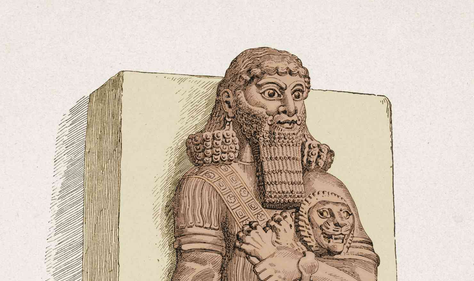
[This is one of the finalists in the 2026 book review contest, written by an ACX reader who will remain anonymous until after voting is done. I’ll be posting about one of these a week for several months. When you’ve read them all, I’ll ask you to vote for a favorite, so remember which ones you liked]
I’ve been thinking, lately, about the first epic story ever written. If you know anything about the Epic of Gilgamesh, you know that it’s old. This is part of why I find it so interesting, but not the only part.
The best comparison I can think of is the pyramids, which are just a little older. The Great Pyramid of Giza was built in the 2500s BC, around the same time as Stonehenge1 , twenty-five centuries before Cleopatra lived. It predates candles, concrete, and coins; it was centuries old when the first empire rose and when the woolly mammoth went extinct.
Around 100 BC, Antipater of Sidon wrote a list of the seven most impressive sights (‘Seven wonders’) of the world - the pyramids were by far the oldest of the group at the time, and now, two thousand years later, all the others on the list have long since been destroyed. This should remind us that the pyramids don’t just stretch far back in time - they stretch forward as well. They are piles of stone. They may be the product of the greatest minds of their age striving to put more stone in a more orderly pile than anyone had before, but still, they are piles of stone, basically artificial rock formations. They will still be there in a hundred thousand years, probably a million. They are so old they brush up against the beginning of civilisation, and yet, we are seeing them today in their youth.
The Epic of Gilgamesh was written down (in its earliest form) around 2100 BC in Mesopotamia - another cradle of civilisation, less well-known than ancient Egypt but every bit as extraordinary. Like the pyramids, Gilgamesh wasn’t exactly the first of anything; we have writing, and even written literature, that predates it. But also like the pyramids, in its time, it was completely unmatched in scale. Nothing else had the same length, the same literary gravity, the same reach. For centuries it stood alone in its class while empires rose and fell around it.
Its longevity isn’t because it was made of durable rock, and it’s not because a stray copy happens to have been found in modernity. This piece of writing lasted because it was considered of such cultural importance, and copied and imitated so extensively, that we can’t help but find parts of it, wherever we find writing from this period. The Egyptians built the pyramids to last, and the Mesopotamians put the same care into immortalising this story. It’s their gift to us, crafted not from atoms, but from bits.
That’s what I am in awe of whenever I read this book: the age, the scale, the importance. Like a rock formation, it was here long before I was, and will be here long after I’m dead.
The Epic of Gilgamesh is organised into eleven Tablets (there’s a twelfth but it’s not really part of the story and seems to have been tacked on by tradition). Tablet 1 begins with an introduction to our hero, Gilgamesh2 :
(If you’d like to hear it in the original Akkadian while you read, the ▶internet can provide.)
He who saw the Deep, the country’s foundation[who] knew the [proper ways, was] wise in all matters![He] explored everywhere the seats of [power,][he knew] of everything the sum of wisdom.He saw what was secret, discovered what was hidden,he brought back a tale of before the Deluge.
Gilgamesh’s greatness is linked immediately to the city of Uruk, where he rules as King:
He built the rampart of Uruk-the-Sheepfold,of holy Eanna, the sacred storehouse.[...] Climb Uruk’s wall and walk back and forth!Survey the foundations, examine the brickwork!Were its bricks not fired in an oven?Did the Seven Sages not lay its foundations?
[A square mile is] city, [a square mile] date-grove, a square mile is clay-pit, half a square mile the temple of Ishtar: [three square miles] and a half is Uruk’s expanse.
The city of Uruk is prominent in this story, and that’s no coincidence. Mesopotamians associated it with ancient wealth and glory. They were right to venerate it: Uruk is the site of an epoch-defining shift in human history.
Some historical context. The Epic of Gilgamesh comes from Mesopotamia, a stretch of land between the Tigris and the Euphrates rivers, roughly corresponding to modern day Iraq and Syria (and part of the Fertile Crescent). It’s tempting to think of this region as a dry desert, but six to ten thousand years ago it was much wetter, and an ideal environment for agriculture. From the end of the last ice age in 9700 BC, up to about 500 BC, there was nowhere else on Earth where the transition from hunter-gathers to settled societies went so fast. This is where farmable strains of wheat, barley, lentils, peas and flax were first bred; where goats, sheep, cattle, pigs, and cats were domesticated; and where the wheel was invented.
In Mesopotamia, technological progress met with a critical mass of population density to create the world’s first city: Uruk3 . Uruk is so old it predates the literal Ur-City. In 3000 BC it might have had a population of eighty thousand, an unparalleled mass of people for the era. Uruk was the first place in the world to develop a state society: taxes, centralised authority, institutional control over land and labour, professional bureaucracy - the works.
As part of this development, Uruk’s administrative elites pioneered key developments in the practices of accounting and contracts. These systems began as verification systems for contracts and aide-mémoires for city bureaucrats, grew increasingly sophisticated and complex, and culminated, around 2500 BC, in - blessing of blessings for historians - a writing system.
But Uruk’s greatest legacy may be that it spurred the development of similar cities elsewhere. By about 3000 BC, Uruk’s singular dominance was beginning to fade, making Mesopotamia a patchwork of territories governed by multiple prominent city-states, with names like Ur, Lagash, Kish, and Nippur. They were loosely linked by language, culture, and religion (similar to classical Greek city-states like Athens and Sparta, though much earlier). This region was called Sumer, and residents were Sumerians.
During this time - somewhere in murky proto-history, perhaps 2700 BC - a king named Gilgamesh ruled the city of Uruk. (At least, probably - there’s some chance he is fictional4 .) We can assume that some kind of oral history grew up around Gilgamesh in the centuries after he lived. Around 2000 BC (at least 500 years after he died), administrative and religious texts began to mention him being given offerings and being invoked in rituals, functioning as a sort of minor deity. Eventually Gilgamesh and the stories about him were written down, formed into a single narrative, and became the ancient world’s first true piece of literature.
Gilgamesh is a bad king.
At least, he starts out that way. We are told he acts “like a wild bull lording it”, that he holds constant contests to exhaust the men of his city, and “lets [no] girl go free to [her bridegroom]” - meaning he exercises his right to have sex with newly-married women, before their husbands do.
His people plea to the goddess Aruru to deliver them from Gilgamesh’s tyranny. She decides to help them, with an unorthodox method: she will create a new man to be Gilgamesh’s equal, distracting him from harassing his subjects.
The goddess Aruru, she washed her hands,took a pinch of clay, threw it down in the wild.In the wild she created Enkidu, the hero,offspring of silence, knit strong by Ninurta.
All his body is matted with hair,he bears long tresses like those of a woman:the locks of his hair grow thickly as barley,he knows not a people, nor even a country.
Hairy, unkempt Enkidu is initially wild like an animal, running with herds and grazing on grass. A nearby hunter notices him, and asks first his father, and then King Gilgamesh, what to do about the wild man. Both tell him to take a ‘temple harlot’ named Shamhat5 to Enkidu so that she can seduce him.
This unusual strategy is successful - a week of sex with Shamhat turns Enkidu into a tamed beast6.
She treated the man to the work of a woman,his passion caressed and embraced her.For six days and seven nightsEnkidu was erect, as he coupled with Shamhat.
When with her delights he was fully sated,he turned his gaze to his herd.The gazelles saw Enkidu, they started to run,the beasts of the field shied away from his person.
Enkidu had defiled his body so pure,his legs stood still, though his herd was in motion.Enkidu was weakened, could not run as before,but now he had reason and wide understanding.
Having sex has both ‘defiled’ Enkidu, and also elevated him and given him reason. This juxtaposition tells us a lot about how Mesopotamians thought about the ‘pure’ existence in the wilderness versus the ‘wide understanding’ of urban life. Mesopotamian literature in general seems very aware of these two modes of living. It may have been common for individuals to move during their lives between living off the land and living in cities. Whenever I read this section about Enkidu, I keep wondering how common it was for men in particular to want to run off and live wild, but be tempted back into settled society by “the work of a woman”.
After welcoming him into civilisation by giving him beer and bread, Shamhat tells Enkidu about Gilgamesh’s terrible behaviour. On hearing this, he cleans up, gets dressed, and heads to Uruk. He arrives just in time: Gilgamesh is about to have his way with a new bride. Enkidu and Gilgamesh are set up for a big fight:
Enkidu with his foot blocked the door of the wedding house,not allowing Gilgamesh to enter.They seized each other at the door of the wedding house,in the street they joined combat, in the Square of the Land.
The door-jambs shook, the wall did shudder.
But then, the next moment, we cut to Gilgamesh introducing Enkidu to his mother, calling him his friend. This jarring break exists because we don’t have the part of the text which tells us why or what happened in between. Here we have to acknowledge an important part of this story: the part that’s missing.
To say that gaps (‘lacunae’) are everywhere in Gilgamesh is to have it backwards: lacunae are the rule, and any text we do have is a precious, hard-won exception. Gilgamesh comes to us in the form of tablets - blocks of clay, densely indented with cuneiform symbols. Dried or baked clay is durable enough to survive three millennia buried in the desert, but also vulnerable to being smashed. So, so vulnerable. Realistically, Gilgamesh comes to us in the form of fragments of tablets.
A part of Tablet 11, from the British Museum. This is one of the better-preserved fragments we have - most are much smaller than this and in worse condition.
While lacunae sometimes make for a frustrating reading experience, they are also part of the aesthetic of this work. They feel like what they are: partial transmission, a reminder that this is something half lost, something that could easily have slid away from us into the inky nothingness of pre-history. The path from the 21st century BC to the 21st century AD was epic and dangerous, and every word has beaten the odds to find its way. I am grateful for each syllable.
Some lacunae are easy to reconstruct, because the context makes it obvious what word is missing, or because the same lines are repeated later in the poem7 . These are represented in translations by [square brackets]. Other lacunae, like the clash between Enkidu and Gilgamesh, are trickier.
We can get some clues to what happened from an older version of the text (the ‘Old Babylonian version’), in the Pennsylvania tablet 8. It says:
Gilgamesh and Enkidu took hold of each other, backs bent like a bull,they smashed the door-jamb, the wall did shake.
Gilgamesh knelt, one foot on the ground,his anger subsided, he broke off from the fight.After he broke off from the fight,said Enkidu to him, to Gilgamesh:
‘As one unique your mother bore you,the wild cow of the fold, the goddess Ninsun!High over warriors you are exalted,to be king of the people Enlil made it your destiny!’
In this version, during a pause in the fighting, Enkidu starts spontaneously complimenting Gilgamesh’s skill as a warrior and his singular glory as a king. This tablet also cuts out here, but maybe that’s all we need to know: they stopped fighting because their urge to bro out became too strong to resist. As we’ll see later, this wouldn’t be out of character.
We’ve just seen a good example of two versions recounting the same events with different wording: the Old Babylonian’s “they smashed the door-jamb, the wall did shake” (c. 1700s BC) becomes the Standard Babylonian’s “The door-jambs shook, the wall did shudder” (c. 1100s BC).
It’s easy to think of the many versions of this text as a distraction or an annoyance, but we should resist the temptation to ignore anything except the ‘proper’ version. The Epic of Gilgamesh is best thought of as an evolving work of art, honed by generations over a thousand years. It may not have a singular definitive text, like the Odyssey, but neither is it a vaguely-similar body of tellings and re-tellings, like Robin Hood or Batman.
To understand the different versions of Gilgamesh in detail, we need more historical context.
By about 2500 BC, Sumerian cuneiform - the art of recording words - had become complete. Anything you could say, you could write down. This is where pre-history ends and history begins. Uruk, the birthplace of writing, was now one of many city-states (though an important one) forming the combined culture of Sumer, in southern Mesopotamia.
Sometime around 2330 BC, an aggressive upstart called Sargon of Akkad conquered all of Mesopotamia, uniting it under what’s often thought of as the world’s first empire. The Akkadian empire lasted into the 2100s BC, but suffered badly under the climatic convulsion known as the 4.2 kiloyear event9 , and had probably collapsed by 2150 BC10 . Shortly after, between about 2100 and 2000 BC, the region was ruled by the third dynasty of Ur (known as ‘Ur III’). Ur III represented a resurgence of Sumerian supremacy in Mesopotamia, along with Sumerian language and culture. Their seat of power was in the city of Ur (about 60km south-east of Uruk).
Ur III was into writing in a big way. The kings of this dynasty seem to have viewed writing as an asset for both political clout and to give them a technological edge. Just as modern nation states trumpet their investments in AI and datacentres, the kings of this era made a point of establishing scribal schools (eduba) and libraries. Writing made their state more efficient and capable, and recording the history of their rule was a way of ensuring their legacy for the centuries to come. King Shulgi, a literate scribe himself, [said](https://etcsl.orinst.ox.ac.uk/sec…