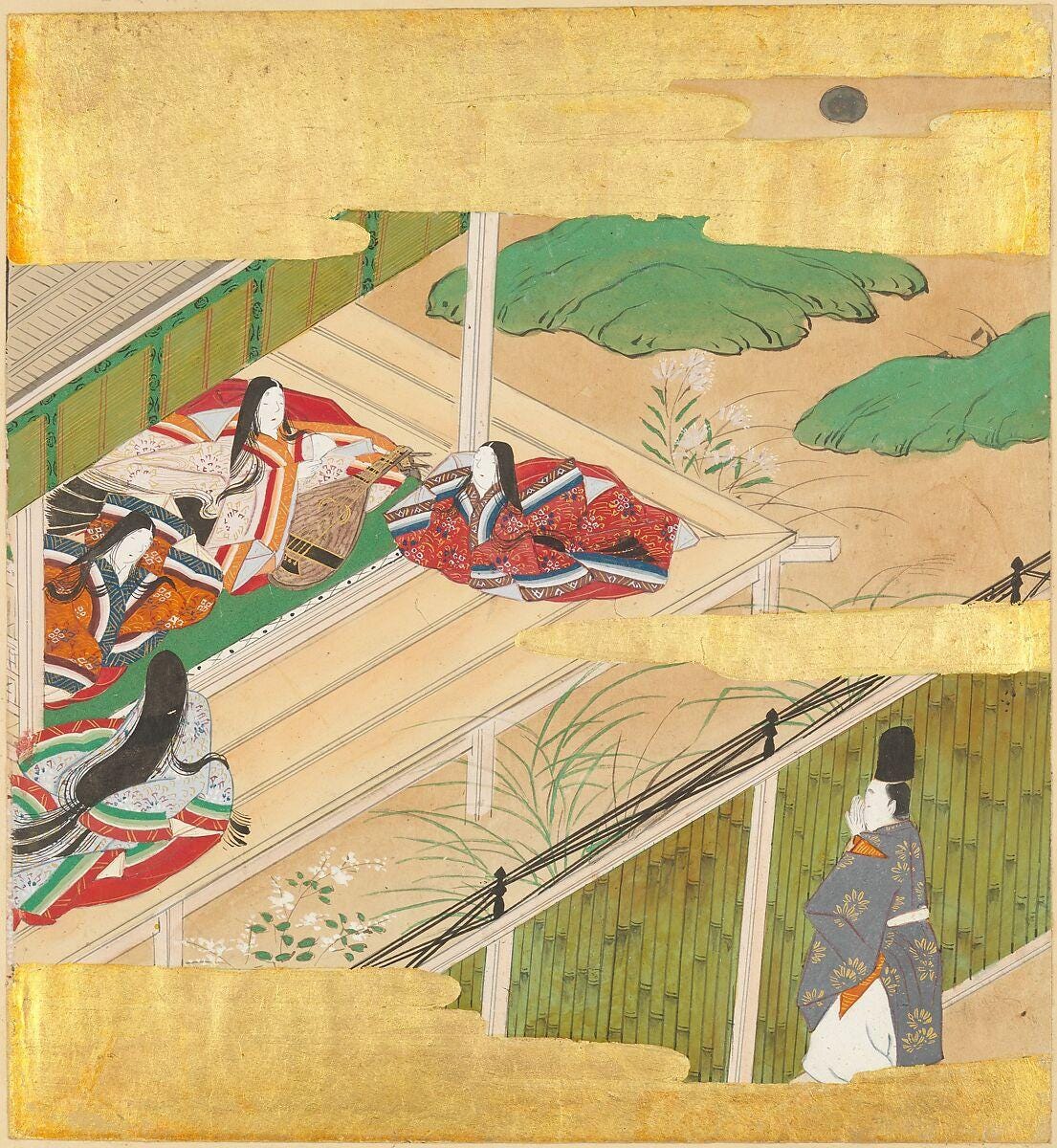
[This is one of the finalists in the 2026 book review contest, written by an ACX reader who will remain anonymous until after voting is done. I’ll be posting about one of these a week for several months. When you’ve read them all, I’ll ask you to vote for a favorite, so remember which ones you liked]
[Content warning: Sexual and relationship practices from a thousand years ago, from a time and place with a very different morality than what you probably subscribe to.]
Around the year 1000, the Imperial Court of Japan in Kyoto was a world of opulence, aesthetics, and ambition. Isolated from the lives of regular commoners, every aspect of the lives of the elite were governed by complex etiquette rules, and relationships were thoroughly intertwined with politics and the ambition for power and wealth. High-ranking women and men lived lives so separate that they might have a passionate love affair without properly seeing each other’s faces.
It was in this world that Murasaki Shikibu, an intelligent and educated lady in Empress Shōshi’s court, wrote The Tale of Genji, which is widely considered to be the world’s oldest novel. It is an extraordinary masterpiece and a highly questionable soap opera, and I’ve never read anything like it.
Royall Tyler (2001) begins the introduction to his translation of Genji like this:
The Tale of Genji was written a thousand years ago in Japan, but anyone can read it today. The notes are useful but not required. So great a classic, written in an ancient language about a vanished world, has been studied intensively, but its characters’ thoughts and feelings remain as fresh as ever.
I disagree with Tyler, hard. The footnotes are critically important if you want to understand a world so completely different from the one we live in, and the characters generally behave, think, and feel in ways that are so outdated as to be completely unrelatable. In this review, I will walk you through my experience of reading Genji and learning about its world, so that you can judge for yourself whether Tyler is right and anyone can read it today.
The Tale of Genji tells the fictional tale of Genji, the son of the Emperor and one of his low-ranking concubines, throughout his life. A few things to know about Genji:
He is incredibly beautiful. Men and women weep at the sight of him.
He is magnificent. Monks and nuns weep when he leaves, distraught that someone like him has to live in this wretched world.
He is better than others at nearly every skill that marks a sophisticated and educated man, such as composing poetry, calligraphy, playing music, singing, dancing, painting, and knowledge of Chinese literature. When he demonstrates these skills, everyone weeps.
He dresses and behaves immaculately. Pretty sure someone weeps about that, too.
He falls in love a lot, and is known for his numerous romantic conquests.
He doesn’t have the official title of Prince, nor is he in the line of succession to become Emperor, and he has to work hard to advance his political career in the Court.
But most of the story focuses on him longing after and pursuing various women, whether it’s a good idea or not, and often it’s not. Usually all involved parties weep.
He often thinks about resigning his worldly life and becoming a monk, but, unfortunately, he has so many worldly attachments that it would be pretty difficult.
I will gladly admit I fail to relate to Genji and his struggles. The narrator and the other characters try to convince the reader of Genji’s absolute magnificence, while Genji himself is busy doing the opposite. Please enjoy the following reconstruction of my early days of reading Genji, as I kept interrupting whatever my partner was doing to tell them what Genji is up to:
“God, this book. Okay, so… the Emperor had a favourite… concubine, I guess? And he had a child with the concubine, and that child is Genji, but his mother died because… all the other women in the Emperor’s court were jealous and mean to her? Anyway, the Emperor took a new wife because she looks like Genji’s mother, and she is SIXTEEN. Genji is, what, twelve? And the Emperor wants the two of them to spend a lot of time together so that she can become a new mother to Genji. At sixteen. A mother to a twelve-year-old.”
.
“Welp, now Genji has fallen in love with his stepmother. His dad is just happy that he managed to find a new mother for him.”
.
.
“What!! You won’t believe this. Genji is hanging out on a mountain and comes across a house, and sneaks around peeping through holes in the walls and sees a lovely 10-year-old girl who reminds him of his stepmother. Then he finds out the girl actually is the niece of his stepmother, so of course now he wants to have her. He is 18. And he is imagining how great it would be to raise the child himself, so he could be sure to shape her into ‘the perfect woman’.”
.
.
“Oh good, the girl’s guardians think she’s a bit too young to go live with Genji, so he has to go back to Kyoto alone.”
.
.
“Aaand he just got his stepmother pregnant.”
.
.
“Aaand he went back and kidnapped the girl.”
It’s hard to imagine a world in which a female author writes about an idealised male character, and the male character is… this. But I’d also argue there are few historical human cultures more alien to a contemporary observer than the Heian-era Imperial Court, and you can’t understand Genji the novel or Genji the man without understanding how the culture was organised and what mattered within it.
And just to be clear, the story wasn’t just one writer’s insane fever dream; Genji was written as a serialised story that reflected a lot of the Imperial Court’s realities, and it was highly popular since its beginning. It’s likely that Murasaki Shikibu got her position in court to serve Empress Shōshi because she was a talented writer, and possibly specifically because her initial chapters of Genji were already popular. There are accounts of the story being read to Emperor Ichijō himself, who praised the author. Murasaki Shikibu complains in her diary that some unfinished chapters have been stolen from her chambers by overeager readers. It would be anachronistic but fitting to consider Genji an immediate bestseller.
Interestingly, as alien as this part of human history is, it’s relatively well understood. There are several surviving texts from the same time period by different authors explaining life in the Imperial Court, including The Tale of Genji and its author’s personal diary, and most translations of Genji contain a sizable section explaining the historical and cultural context in which the story was originally written and read. In the following sections, I will introduce a few key characteristics of the culture of the Imperial Court, which are commonly discussed as historical context to Genji, and about which there is significant scholarly consensus.
It’s impossible to overstate how important beauty and aesthetics in all their forms were in the world of Murasaki Shikibu. The Imperial Court was a highly isolated world where the elite lived in luxury and without having to worry about the struggles of normal people. Everyone lived and breathed arts in all their forms, and an individual’s aesthetic accomplishments played a huge part in their standing in society. In this world, it was almost a requirement to be beautiful. In fact, Genji is so beautiful from the moment he is born, that it is evident to everyone that he is destined for greatness. It seems aesthetics and morality went hand in hand, and for someone to be beautiful and produce beauty in the world is the same as them being a magnificent person. If a character is described as being physically unattractive, they are usually also deficient in other ways, such as being slow-witted, having clunky handwriting, writing unimaginative poems, or being unaware of proper etiquette.
And just like today, there were trends and fashions, and it was important to keep up with them. Not only were there strict expectations of what kinds of garments, colours, and patterns were appropriate for which person, occasion, and season, but those things kept changing, and it would have been embarrassing to be seen as unfashionable or outdated.
Of course, what’s considered beautiful is culturally determined, and some of their preferences were pretty unique. This is the time and place in human history when women blackened their teeth to be extra attractive, and also their eyebrows were plucked completely and drawn back on higher on the forehead. It was such a normal thing at the time that even though Genji contains ample description of women’s looks, black teeth are mentioned only twice. And of these two occasions, one of them is in the context of a girl whose grandmother was so old-fashioned that the girl’s teeth had not been blackened yet, and the other one is in reference to a six-year-old boy with tooth decay that made his teeth darker, which made the boy’s mother think about how beautiful he would be as a girl.
The Imperial Court and its world was a place of extreme hierarchy. There was a highly complex rank system among the officials, and one’s standing was determined by factors such as birth and background, wealth, level of education and accomplishment, whether one had powerful supporters, and whether one was able to play their political cards right. Interestingly, the emperor himself held practically no power over what happened in Japan, and most of the high-ranking positions were also entirely ceremonial. Most of the actual power was wielded by powerful families like the Fujiwara, who were wealthy and solidified their position by supplying the Imperial family with wives and empresses over several generations. A Fujiwara man could not become an emperor, but he could become the father or grandfather of one, and many did. Meanwhile, Genji contains stories of emperors being unable to prevent their politically powerful wives from mistreating each other, including Genji’s mother, who is effectively bullied to death by his other wives and concubines.
Naturally, the higher in the hierarchy you are, the more people you have around you, taking care of everything you might need. When Genji travels, he has a huge procession of men with him, who make sure the road is clear, deliver messages on his behalf, and generally make themselves available for whatever he might need, day and night. However, if he chooses to travel in utmost secrecy, he might only bring four or five trusted men with him. Messages were often delivered by other people even if the sender and the recipient were currently in the same house. Aristocratic women would likewise always be surrounded by other women, both companions and servants, who don’t play a huge part in the story overall, except when a woman’s companion might be persuaded to help a man deliver a message to her mistress or convince her to meet him.
The hierarchy is everywhere in the story, including the language. The classical Japanese which was spoken at the time had a complex grammatical system that allowed for the precise communication of the relative statuses of everyone involved, which is largely lost in translation. Often it’s not obvious why something was offensive or that someone is trying to overstate their status, and sometimes the translator has to figure out who is talking to whom and about whom based on the politeness forms they are using in their speech. A lot of the time, characters behave in ways that can be difficult to understand without knowing their precise social standing. Why can that person not marry that other person? Why is that child given to this other woman to raise? Why is this man offended that this other man doesn’t want to marry his daughter? Why are these people upset? Why is everyone weeping?
There is a melancholy that permeates The Tale of Genji, which can be traced to the concept of mono no aware, or the sensitivity towards the fact that everything is transient and there is a sad beauty found in impermanence. This concept is still alive in present-day Japan, where cherry blossoms are viewed with the bittersweet knowledge that their beauty lasts only for a short while.
In Genji, nobody seems happy or even content, even as they live in relative luxury and privilege. A significant share of communication between lovers is lamenting how they must soon part, how much they will miss each other, and how the other person will probably forget them. Life seems to be continuous existential suffering, and many people dream of becoming a monk or a nun and devoting the rest of their lives to the service of Buddha, hoping for salvation after death.
In their world, spirits are a natural part of life, and there are complicated beliefs around what rituals and behaviours must be observed to be safe from evil spirits and the wrath of gods. Sometimes a person’s spirit can wander around doing bad things even while the person is alive and well, and without them being aware of what their spirit is up to. When a person is about to die, or has died, various rituals will help prevent them from becoming an evil spirit, and some particularly qualified monks might be summoned to conduct the rites if the dead person was important. To avoid untimely death or other dangers, people should be especially careful during yakudoshi or “years of trouble” which for women were the 19th, 33rd and 37th years of her life, and for a man his 25th, 42nd and 61st years.
Another unusual feature of the world of the Heian Imperial Court was their nearly complete gender segregation. It was not proper for an aristocratic woman’s face to be seen by a man unless he was a lover or a close family member. Her face should be hidden even from her brothers once they reach puberty. In practice, she would spend most of her life either indoors or in private gardens, and if she left, even to visit a family member a few houses over, she would travel in a closed carriage with only narrow slits through which she could observe the world. Naturally, she would stuff her voluminous, multi-layered sleeves through those slits to communicate to the outside world that she is elegant, rich, and has an impeccable fashion sense.
And it wasn’t just her face that she had to guard. If a man paid a woman a visit, for example to pay his respects to her after the death of her family member, he would be seated well away from her, outside or in a different room, and one of the lady’s female companions would act as an intermediary in the conversation, passing their messages back and forth. If the lady came so close that they would be able to discuss directly, with only a screen separating them, that showed very high familiarity, and might be risky for the lady’s reputation. There is even an example in Genji where a woman is given the responsibility to raise a 12-year-old boy she is unrelated to, and she apparently does this from behind screens; it’s mentioned that the boy is surprised when he “happens to see a glimpse of his guardian” and discovers she’s not very beautiful, unlike the other women he’s seen before. But, the boy thinks, it would be wonderful to find a woman as kind and gentle as she is. So apparently she was able to play a significant role in his upbringing, even as she had to hide from his view.
In the case that a man and a woman are having a secret relationship, he naturally has to sneak in at night, and he should take care to leave before sunrise. Such meetings would have been in complete or near-complete darkness, and it might take several meetings until the lovers would be able to see each other’s faces properly. Genji himself gets into a pickle by pursuing and spending nights with a lady who is quiet and bland, and when he finally sees her in daylight, she turns out to also be unattractive. Her nose, especially, is a disaster: unbelievably long, its tip drooping towards the floor, limp and red, like t…