[This is one of the finalists in the 2026 book review contest, written by an ACX reader who will remain anonymous until after voting is done. I’ll be posting about one of these a week for several months. When you’ve read them all, I’ll ask you to vote for a favorite, so remember which ones you liked]
In 1940 the Empire State Building was the tallest man-made structure in the world, and if you stood at the top of it you could see the future.
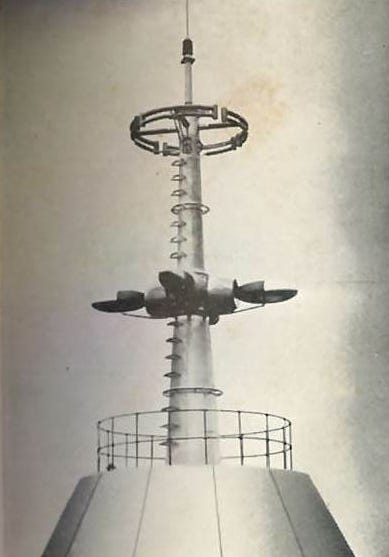
Specifically, you could see this: the first NBC television broadcast transmitter, intermittently blasting 49.75 MHz audio and 46.5 MHz video signals across a hundred-mile swath of megalopolis.
A turnstile antenna, a ring of linked dipoles, and a crowning lightning rod formed the sharp point at the literal apex of human achievement. This is the lance that scraped the sky deeper than it had ever been scraped, the tip of the spear for a high radio modernism that would soon conquer the world. This is the needle that pierced the veil of the corporeal and pulled the thread of human culture into a realm of deracinated ghosts forever haunting the invisible airwaves.
Maybe this sounds overwrought and spooky. But I’m not just editorializing on my own here: this is how some of the guys who invented television talked about it!
I found this out by reading We Present Television, a collection of essays by various stakeholders in the earliest American TV broadcast systems—“televisionaries”, as they are occasionally referred to in the text. I rescued my copy from being pulped after it was weeded from a library. What got me to look at it was the odd handwritten title on the spine, and what got me to keep it was the shockingly early copyright date of 1940. This is not a pat description of a settled feature of American life; these pieces were written from the bleeding edge of a brand new technology. They were intended for the edification of a public for whom TV was a curious experimental luxury that only your richest friend’s richest friend might own1.
The essays read roughly 90% as prosaic technical notes on the state of the art and 10% as wild-eyed futurist prophecy. Both modes offer a fascinating glimpse of a transformative new art in the process of being born. It is an approachable, Scientific American-style primer, but also, at times, the closest thing I have ever found to a dread grimoire written by the successful summoners of an Elder God.
In my mind, prior to reading We Present Television, the history of TV was a pretty firm thing stretching from the present back to the early 1950s and I Love Lucy. What was on TV before Lucy? I had no clue really. I suspect most people don’t. Lucy stands as a cultural totem of “early TV” the way that The Wizard of Oz and Frankenstein stand in for all of “early film” in the popular imagination.
But here was a book about television from a decade before Lucy and Desi ever got up to a single shenanigan! What could possibly have been going on on TV back then?
The answer is, for the most part, some weird stuff that it’s impossible to watch today. To continue the film analogy: “Talkies” as a medium have the advantage of a single solid genesis point with The Jazz Singer in 1927, just as “Classic TV” has the genesis point of Lucy being shot on 35mm film that allowed it to be preserved for future generations. The nascent television documented in this book is more akin to film in the 1900s and 1910s: a frontier technology still undergoing rapid technological progress and gradual artistic maturation2. And like those flammable early films, early TV was seldom preserved to leave any kind of cultural footprint, rendering it forgotten to all but a scholarly few today.
We Present Television is in large part the textual equivalent of a How It’s Made episode for “1930s television programming”. It comes at the subject from every angle and through every stage of the process, and ends up illuminating why early TV evanesced from the cultural memory even as the concept of television pervaded culture.
If you associate “inventor of television” with a single name, it is likely Philo Farnsworth, the Utahan tinkerer who received the first US patent for it. The fabulously-named Waldemar Kaempffert, science editor for The New York Times from 1927 to 1956 and author of We Present Television’s introduction, thinks that’s a load of crock.
Kaempffert was evidently fond of technocultural prognostication (he got the NYT gig after writing an essay for Forum magazine on “The Social Destiny of Radio”), so a lot of his introduction falls into the realm of Prophecy and will be covered later in the review. But he also does a bit of historiography right at the top. In Kaempffert’s telling, television was inevitable from the moment the first fax machine was conceived in the 1840s3, and it was midwifed into existence not by any one nameable genius but by the concerted effort of technocapital itself:
“What strikes the student of social sciences and the historian of technology is the manner in which this dream of television became a fact. The early facsimile telegraphers, cinematographers, phototelegraphers, and television empiricists all belonged to what may be called the laissez-faire school of invention. It was a school that educated itself by cut-and-try experimenting, that converted attics and cellars into laboratories, that had to hawk its patents until at last some imaginative capitalist bought them. Just as the laissez-faire school of economics gave way to planning, so the laissez-faire school of invention is giving ground to planned research. And for the simple reason that the attainment of television demanded a deeper knowledge of theoretical physics than any garret inventor could possess… [Television] is probably the very first great invention deliberately developed by organized research and born full-grown in most of its essentials.”
Kaempffert’s precis of the development of television goes on to describe an ever-increasing rate of advancement in which “time was telescoped”, driven by wildly extravagant capital investment that “probably exceeds $20,000,000”. The fruit of this investment is not just the television receiver that goes in your living room, but the television station that the rest of the book will go on to describe. One cannot profitably exist without the other.
The station is also the concern of our first proper essay, “Raising the Television Curtain”. This one was written by Alfred H. Morton, Vice-President in Charge of Television at NBC (which was, of course, primarily a radio concern at the time). Morton is proud to run the premier TV station in the country, though he graciously mentions the Don Lee broadcasting system in Los Angeles and the GE transmitter in Schenectady4 which intends to relay programming from NYC to the Capital Region. These three islands form the archipelago of early American television.
Both Kaempffert and Morton are a little defensive about how long it has taken for commercial broadcasts to begin in the United States. NBC’s TV broadcast debut at the 1939 New York World’s Fair lagged several years behind the BBC’s first efforts. Morton and others later in the book attribute the delay to a coordination problem. Morton speaks enviously of the concert with which the BBC was able to initiate its television programming:
“In England, where broadcasting is supported out of license fees levied on every radio receiver, the British Broadcasting Corporation established a television service at London in November, 1936. Being a monopoly, the BBC settled the troublesome question of technical standards by itself laying down what it considered, after due study, the best practicable specifications. Radio manufacturers thereupon made receivers to conform to those specifications.”
Simple! But in the free-market USA, independent actors from the broadcasters to the television retailers to the FCC had to somehow agree on technical standards, all the while hoping that the results were sufficient to turn a profit once offered to consumers. American television had to stand on its own two feet from day one, with no subsidies or license fees. So the development process was a game of everyone waiting out small marginal improvements to get to the minimum viable product.
Morton analogizes the experimental broadcast standards to the (then-)familiar concept of railway gauges. How foolish the would-be railroad tycoon would feel building out a network of narrow-gauge tracks, only to find out that the only trains capable of earning him any money require wide-gauge ones! So too with building broadcasting equipment which was capable of matching up with TVs anyone actually wanted to buy. Every scrap of resolution could make a difference in the viability of the new systems. Morton:
“[In] July 1936… NBC’s transmitter went on the air with the all-electronic system yielding an image in 343 lines, at the rate of thirty complete images a second. It was decided after some months of trial that a higher standard, namely, 441 lines, was necessary to provide sufficient entertainment value for the viewer.”
The terminology of ‘lines’ may seem odd to a reader accustomed to thinking in terms of pixels. In Chapter 2, “The Technique of Television”, whiz-kid radio engineer Donald G. Fink (who had started as an editor at Electronics magazine in 1934, aged 23) breaks down the technical aspects of television for the interested layman. This is the longest chapter in the book and goes into much, much more detail than I can provide here, but we can briefly cover the basics. The one key concept we must know, Fink starts by telling us, is that “television pictures must be sent on the installment plan.”
Essentially, the early TV camera tube (at the time, in the US, the iconoscope was standard) and the early TV receiver were the same technology, running in opposite directions. In both cases, a beam of electrons was carefully steered through an array of horizontal lines by the precise modulation of magnetic coils outside a vacuum tube.
In the iconoscope, the beam bounced off of a mosaic of tiny photosensitive silver capacitors which would get “full” if they had been exposed to light in the last 1/30th of a second, or sit empty waiting to eat up the electron beam if they hadn’t. This mosaic would be exposed to the light of the subject to be televised, creating the frame for the electron beam to read. The remainder of the beam, once it had hit the mosaic, was then passed on as the broadcast signal: strong and bright in spots where the capacitors were full, weaker and dimmer in spots where they had siphoned off some of the electrons.
On the other end, in the TV set, an electron gun with strength determined by the modulation of the received radio signal was steered by similar magnetic coils and aimed at a corresponding array of fluorescent dots (“usually a compound of zinc, oxygen, and silicon or sulphur”). So the image received by the iconoscope was recreated in sequence, one line at a time.
And this all happened thirty times a second.
Fink is very impressed with the sheer volume of information being blasted over the airwaves in this manner (“The ancient Chinese have said that a picture is worth ten thousand words”, he tells us while comparing the bandwidth of a TV signal with that of a telephone line, “which is not such a bad guess”). Even on a 441-line television, each individual frame consisted of 200,000 points of light. It’s no wonder that the art of television couldn’t take off until all mechanical elements like “whirring belts and spinning disks” were abandoned: only a diaphanous electron beam manipulated by invisible magnetic fields was practicable for such precision work done at such immense speeds.
There is an inherent romance to this level of analog craft. Reading from the transistor age, when none of this photochemical wizardry obtains, it still kind of seems as miraculous as it must have back then. Nowadays “television” is just a subset of our generalized ability to program LEDs to emit arbitrary types of light, but back then it was a bespoke silvery magic.
The best part of Fink’s chapter is this diagram, which shows the “complete television system”:
The casual inclusion of a skyscraper in the system enchants me. It is emblematic of the high radio modernism that pervades the book. The skyscraper is Part Of It. The world the televisionaries imagine is a world where we are all within eyeshot of the Empire State Building, or perhaps some grander edifice yet to be conceived.
So that’s the technical side of the coordination problem solved, for now. 441 lines of light on a screen no larger than an A4 sheet of paper (and more often the size of an index card) were deemed sufficient to provide “entertainment value”. But the content side is still a big question mark. What will people actually watch?
Well, one non-negotiable is that they will watch ads. Securing sponsorships was (until the invention of cable many years later) the only way to extract money from the televiewer after they made their initial hardware purchase. In Chapter 10, “The Finance Problem”, Radio Daily staff writer Benn Hall breaks down the prospects of TV advertising relative to radio. He concludes that in addition to “double barreled” commercial spots shilling a product for both the ears and eyes, a great amount of “indirect advertising” (what we now think of as product placement) could eventually be worked into TV programs. But this circles back to the original question: what programs will lure people to watch the advertisements?
In Chapter 4, “Programming”, NBC Programming Director Thomas H. Hutchinson, who was paid to think a lot about every possible thing that television could do, starts by telling us he’s not quite sure:
“The basic problem that besets the program manager is stated quite simply: What is a television program? Therein lies both hope and despair. No one knows for sure what makes a good television program. There are as yet few rules for the building of either a television program or a television schedule.”
Despite this uncertainty, Hutchinson is able to suss out a few basic categories that form the backbone of the early television station’s programming. He enumerates the TV’s capabilities thus:
“Television can tell a story, with a technique which is a hybrid of stage, motion picture, and radio practices. It can also explain a process or portray the results of a process, which is the basis for many an interesting educational feature. Television is also capable of simple transmission of entertainment previously prepared for other media, such as vaudeville and motion pictures. Finally, its mobile units can rove about to relay actualities occurring in the city streets, and an indoor arena or an outside field. Studio shows, motion picture transmissions, and outside programs have, therefore, been the basis of our program experimentation since 1936.”
These silos formed the organizing principle for NBC’s production department. As Morton lists:
“[NBC] had a single television transmitter, one studio designed for the presentation of live talent programs, one studio for the scanning of motion picture film, and a complete mobile television station for relays of such outdoor events as we considered of general public interest.”
Let’s take a tour of the early studio and see what the rest of the book has to say about these three modes.
Live, in-studio performances and exhibitions were the most distinctive part of the early television schedule and their description takes up most of the middle of We Present Television. Anything…