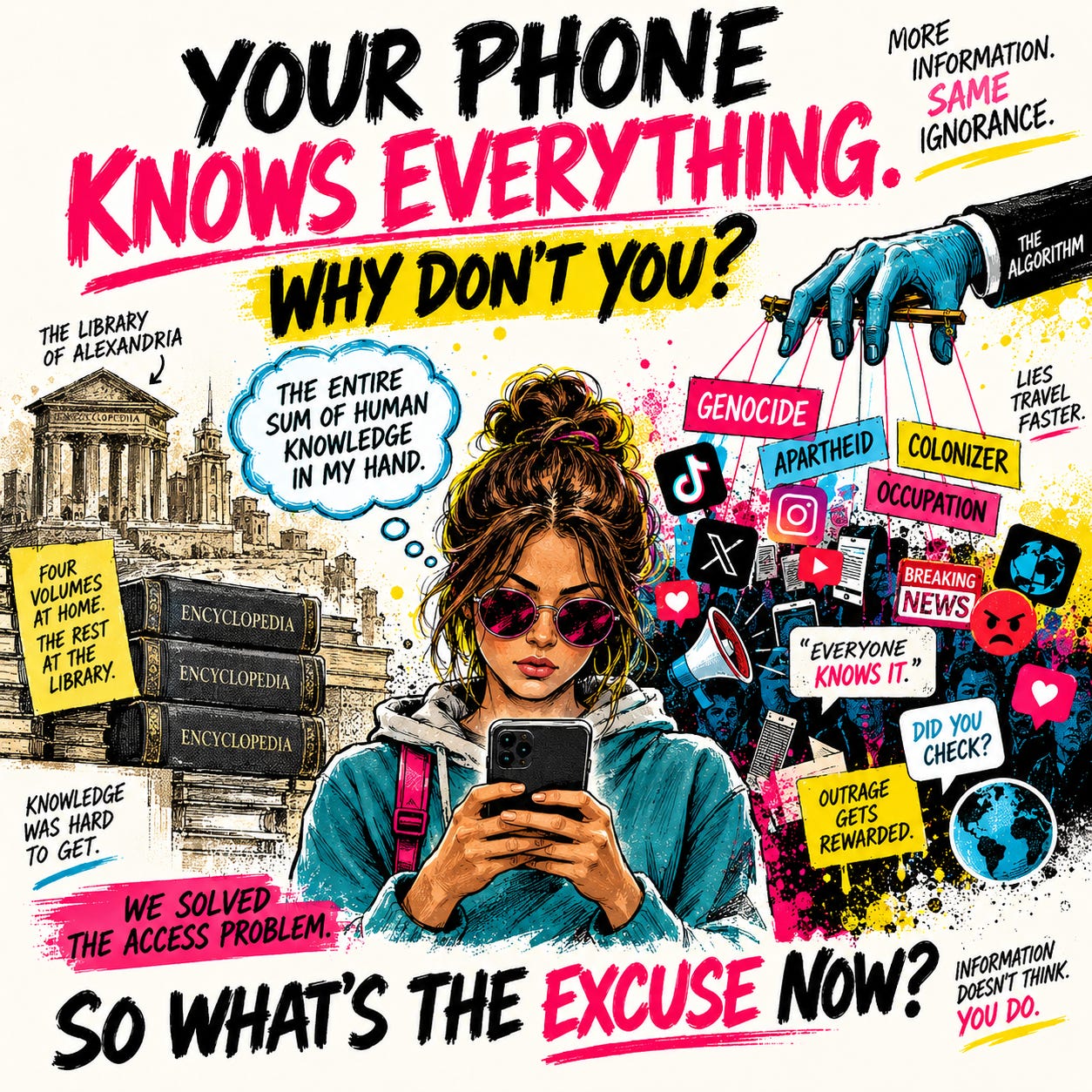
The entire lump sum of human knowledge is sitting in our pockets and purses. Except, we’ve gotten so used to the convenience of having smartphones that I don’t think we really think about what that means anymore. We complain when a page takes three seconds to load. We get annoyed when the Wi-Fi goes out. We walk around carrying these little rectangles everywhere we go without considering how completely mind-blowing they would have seemed to previous generations.
There used to be a saying when I was growing up. I heard it a lot from my parents: “You’d forget your head if it wasn’t attached to your neck.” Well, apparently we’ve solved that problem. The smartphone is practically attached to us. We take it to work, dinner, bed, the grocery store, the bathroom, everywhere. We panic when we can’t find it for 30 seconds (even though it’s usually in our hand. And oh, your glasses are on top of your head).
We almost always remember to bring our phone wherever we go. Yet somehow…there are some who forgot to bring along their brains. That little device growing roots on your palm gives you access to more information than any human being in history could have dreamed of having. And still somehow we are living through an age when people can be spectacularly, LOUDLY, publicly, wildly, epically wrong…all while holding the very device that could help them figure it out. Literally...it can right a whole lot of wrong thoughts almost instantly.
It’s hard to recognize just how difficult knowledge was to get for most of human history. The Library of Alexandria became legendary because the Ptolemies tried to collect the written knowledge of their world in one place. Nobody knows exactly how large the collection became, and estimates vary wildly, but it contained tens or perhaps hundreds of thousands of scrolls and attracted some of the great scholars of the ancient Mediterranean. Kings spent fortunes acquiring texts, and books arriving on ships were reportedly taken, copied, and added to the collection.
Fast-forward a couple thousand years and some of us grew up with another version of this sitting in our homes: encyclopedias. Remember those? We didn’t even have the whole set when I was growing up. We had four sample volumes an encyclopedia salesman left at our house and, for whatever reason, never came back to collect. So if whatever I needed for a school report happened to fall inside those four volumes, jackpot. For the rest of the alphabet, my parents dropped me off at the library.
That’s how you found things out. You went somewhere, looked through the card catalog, hunted down the right book, and hoped the library had what you needed. If it didn’t, you tried another source or figured something else out. Whatever was printed in that encyclopedia was also frozen on the day the volume went to press. The world could change the next morning. Your encyclopedia couldn’t.
Encyclopaedia Britannica’s last printed edition eventually filled 32 volumes of carefully compiled knowledge. This was a pretty impressive thing to have sitting in your house. Now compare that to your phone. You can pull up newspapers published 150 years ago, look at ancient manuscripts, read scientific studies before you’ve finished your morning coffee, search museum collections in countries you’ve never visited, look through government archives, read court decisions, examine historical maps, translate documents, watch university lectures, and look at archeological discoveries while sitting on your couch in pajamas. Your phone doesn’t contain 32 volumes. For all practical purposes, the shelves never end.
This was supposed to make us smarter. Maybe nobody actually sat down and wrote that promise on a piece of paper, but wasn’t that always part of the excitement about the internet? Information was being democratized. Geography wouldn’t matter. Anyone who wanted to learn could learn. And all of that happened, which begs the question...why are so many people still so incredibly uninformed?
In 2011 researchers Betsy Sparrow, Jenny Liu, and Daniel Wegner studied what the internet was doing to the way we remember things. They found that when people expected information to remain available later, they were less likely to remember the information and more likely to remember where they could find it. The internet had become a kind of external memory.
How many phone numbers do you actually know now? I can still remember phone numbers from childhood. Today, if my phone disappeared, I’m not entirely sure how many people I love I could actually call. I’m going to guess two, and that could be overestimating. We don’t have to remember directions because GPS does it. We don’t have to remember the name of that actor because Google knows it. We can hum an incredibly out of tune rendition of a song to poor Siri, and still find out the artist. We don’t have to remember what year something happened because we can look it up in five seconds.
Our brains have always offloaded information. We had books, calendars, Rolodexes, address books, Post-it notes, and other people. But something changed when the amount of information available became essentially endless. Our capacity to pay attention didn’t become endless with it.
Now we have an almost unlimited supply of information fighting for a very limited amount of human attention. When we’re overloaded, we skim. We take shortcuts. We rely on people we already trust. We pay attention to whatever grabs us fastest, and social media has become exceptionally good at figuring out what that is.
Headlines, videos, memes, notifications, group chats, screenshots, breaking news alerts, TikToks, posts, and whatever somebody just sent because we absolutely have to see it. We have the ability to check almost everything, but we don’t have the time or patience to check all of it. And sometimes…we simply don’t bother.
Psychologists have a name for something we’ve all experienced…the “illusory truth effect.” Hear something enough times and it becomes familiar. Familiarity makes information easier for our brains to process, and eventually that familiarity can start feeling like truth.
In 2015 Lisa Fazio and her colleagues tested something even more interesting. What happens when the repeated false statement contradicts something a person should already know? Repetition still increased belief in false statements, even when people had knowledge that should have helped them recognize the statements were wrong.
Now think about the words we’ve been drowning in since October 7: genocide, colonizer, apartheid, ethnic cleansing, occupation. Someone sees “genocide” in a TikTok video. A friend posts it on Instagram. It’s written across a protest sign. A celebrity repeats it. A professor uses it. It’s in a headline. A politician says it during an interview.
How many independent pieces of evidence did that person encounter? Maybe none. They may have encountered the same accusation eight times, but after a while it doesn’t feel like an accusation anymore. Everybody says it. Everybody knows it.
Except...how does anyone actually know? Was the evidence examined? Was anything that challenged the accusation considered? Did the person repeating “genocide” even check what the word means, or has it been repeated so many times that nobody remembers when it became accepted as fact?
In 2018 researchers at MIT published a massive study in Science looking at the way true and false news traveled on Twitter. They examined around 126,000 stories tweeted by about three million people more than 4.5 million times. False information traveled farther, faster, deeper, and more broadly than true information. Political falsehoods did especially well.
And we can’t just blame the bots. Bots spread true and false information at similar rates. Human beings were driving the difference. False stories tended to be more novel and generated reactions including surprise, fear, and disgust.
Other researchers have found that moral-emotional language helps social media posts spread and that people who are rewarded with likes and shares for expressing outrage are more likely to express outrage again. Someone posts something angry. People like it. They share it. They tell the person how right they are. So they do it again.
Meanwhile, the claim keeps circulating. People encounter it repeatedly, so it becomes familiar. Their friends believe it, so it feels credible. Sharing it earns approval, so more people share it. We’re training each other, and we’re doing it on the same phones we could use to check whether any of it is true.
More information only helps when someone actually wants to know whether they’re wrong. Political scientists Charles Taber and Milton Lodge studied how people respond to arguments about issues where they already have strong opinions. People were more accepting of arguments supporting what they believed and more critical of arguments challenging them.
Again...does anyone find this surprising? We don’t approach the giant library in our pockets as perfectly neutral fact-finding machines. We bring our politics, friends, prejudices, experiences, loyalties, anger, fears, the people we trust, the people we don’t trust, and sometimes an opinion we’ve already announced publicly 87 times and would now rather die than admit might have been wrong.
Two people can search the same internet and come away believing completely different things because one searches What happened? while the other searches Where’s the proof that I’m right? The internet will happily accommodate both.
The historian and the conspiracy theorist live in the same phone. The peer-reviewed study and the manipulated infographic are a swipe apart. A primary document can appear on a screen five seconds before some influencer confidently explains something that never happened. The Library of Alexandria never had to compete with social media. We do.
Researchers have also found that something ridiculously simple can improve what people choose to share: make them think about accuracy before they hit the button. Gordon Pennycook and David Rand combined 20 experiments involving more than 26,000 people and found that small prompts to consider accuracy improved the quality of what people shared, largely by reducing their willingness to share false headlines.
That raises a pretty uncomfortable possibility. Sometimes we aren’t sharing something because we’ve decided it’s true. We haven’t even gotten that far. We’re thinking, This is outrageous. This proves my point. My friends need to see this. The emotional reaction got to the SHARE button before the factual question did.
And the question is ridiculously simple: Is this actually true?
Professional fact-checkers have another habit worth stealing: they leave the page. Stanford researchers watched professional fact-checkers, Ph.D. historians, and Stanford students evaluate unfamiliar websites. The fact-checkers were faster and better at figuring out what they could trust because they opened other tabs. They checked who was behind the source, what other sources said, and where the information originated.
So when a perfectly polished graphic lands in the feed with an outrageous claim printed across it, don’t ask the graphic to prove the graphic. Open another tab. Find the original source. See who else reported it. Check the date. Look for the document, study, video, court filing, transcript, or whatever supposedly exists. Make the claim survive contact with the rest of the internet.
This is the question that started this whole thing for me. With all of this knowledge right there in our hands, why are people still repeating things about Jews and Israel that they could check?
Take the claim that Jews are foreign colonizers in Judea. Think about how bizarre it is that anyone can say that in 2026 while holding a smartphone. Roman records refer to Judea. Jewish coins have been dug out of the ground. Ancient Hebrew inscriptions survive. The Dead Sea Scrolls exist. The Arch of Titus still stands in Rome depicting Roman soldiers carrying the menorah away after Rome destroyed the Jewish Temple in Jerusalem in 70 CE.
Jewish sources aren’t even necessary. Christianity begins among Jews in Judea. Jesus was Jewish. The Christian Bible is filled with Judea, Jerusalem, the Temple, synagogues, and Jewish religious life. Islam arrived centuries later, and the Quran itself repeatedly talks about the Children of Israel. None of this is buried in some heavily guarded archive. Anyone with a phone can find it.
So what happens when someone has access to all of that and still repeats the lie? There are plenty of answers…repetition, social pressure, algorithms, outrage, intellectual laziness, a genuine desire to defend Palestinians, fear of questioning the group, sometimes antisemitism, and sometimes the lie is simply more useful than the truth. Eventually we arrive at a question I don’t think we ask nearly enough.
There was a time when people had a pretty good excuse for not knowing something. The book wasn’t available. The newspaper didn’t report it. The archive was 5,000 miles away. Nobody had translated the document. The local library didn’t have it. Maybe the encyclopedia salesman left four sample volumes at the house and disappeared, so the rest of the alphabet required a ride to the library.
Those barriers aren’t completely gone. Sources conflict. Governments lie. Journalists get things wrong. Experts disagree. Propaganda doesn’t introduce itself as propaganda. Finding reliable information still takes some effort. But come on. It’s 2026.
Accusing an entire country of genocide should come with some responsibility to know what genocide means and examine the evidence. Calling an entire people colonizers should involve learning where those people came from. Repeating a historical claim to thousands of followers should involve spending five minutes finding out whether it happened. And hating someone because of something seen online ought to begin with making damn sure the thing was true.
We carry maps, archives, libraries, newspapers, museums, scientific journals, ancient manuscripts, government records, translations, photographs, and thousands of years of recorded history everywhere we go. All day, every day, it’s right there in the hand we use to post.
At some point, “I didn’t know” deserves a follow-up question:
Did you try?
https://pubmed.ncbi.nlm.nih.gov/21764755/
https://pubmed.ncbi.nlm.nih.gov/26301795/
https://pubmed.ncbi.nlm.nih.gov/29590045/
https://www.pnas.org/doi/full/10.1073/pnas.1618923114
https://pubmed.ncbi.nlm.nih.gov/34389534/
https://onlinelibrary.wiley.com/doi/10.1111/j.1540-5907.2006.00214.x
https://www.nature.com/articles/s41467-022-30073-5
https://news.stanford.edu/stories/2017/10/fact-checkers-outperform-historians-evaluating-online-information