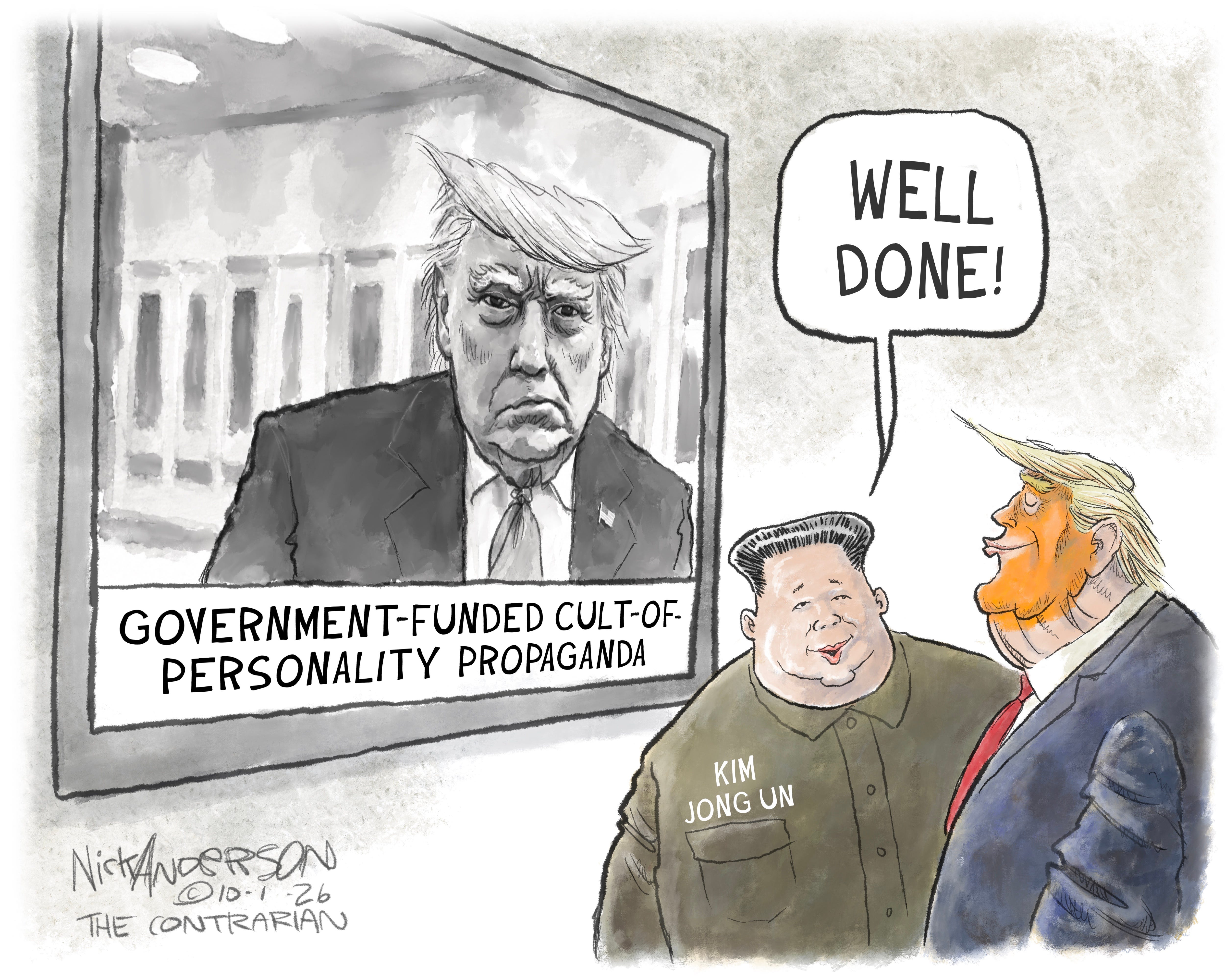
The Trump administration has launched a multimillion-dollar advertising campaign celebrating President Donald Trump just weeks before the 2026 midterm elections, setting off a dispute over an old but sometimes murky boundary in federal law: When does legitimate government communication become taxpayer-funded political propaganda?
On Thursday, Democratic Reps. Jamie Raskin and George Whitesides asked the Government Accountability Office and Office of Special Counsel to investigate the advertisements, determine how they were funded and examine whether administration officials violated federal law. Their letter alleges violations potentially involving appropriations restrictions on “publicity or propaganda,” the Hatch Act and other federal spending rules.
The scale of the campaign makes the question more than academic. The Associated Press reports that the Department of Homeland Security has tapped $20 million for the advertising effort, using money Congress provided for Customs and Border Protection. AdImpact estimated that more than $2.5 million had already been spent airing three ads in a single week. The ads have appeared across broadcast, cable and streaming outlets and during high-profile programming, including college and NFL football.
The White House calls the spots “public service announcements” and argues that previous administrations have also used taxpayer money for public-information campaigns featuring presidents. It has also argued—absurdly—that the advertisements aren’t campaign ads because Trump himself isn’t on the ballot in November.
That comparison, however, is ridiculous because traditional government PSAs generally have an identifiable public-information purpose: explaining Medicare benefits, encouraging vaccination, recruiting for the military or telling citizens how to use a government service.
These ads look markedly different. One promotes Trump’s tax cuts, manufacturing policies and support for police while footage of Trump plays over a song repeatedly singing “love me.” Another uses Trump’s Fourth of July speech to herald a new American “golden age.” A third resurrects footage identical to Trump’s 2024 campaign advertising, including his warning of a “final battle” against “globalists,” “warmongers” and the “sick political class.” All identify themselves as “Paid for by the U.S. Government.”
That last disclosure is legally significant. Congress has included restrictions on spending appropriated money for unauthorized “publicity or propaganda” for decades. But Congress never precisely defined those terms, leaving the General Accountability Office to develop standards through a long series of decisions.
The GAO says prohibited government communications generally fall into three categories: covert propaganda, purely partisan material and self-aggrandizement.
The GAO has held that “covert propaganda” generally involves concealing the government’s role in producing a message. The more consequential questions are the other two categories: partisanship and self-aggrandizement.
GAO precedent allows administrations considerable latitude to explain and defend their policies. Government communications don’t have to present both sides of an issue, but GAO also says taxpayer money cannot be used for communications that are purely partisan or principally designed to promote an official personally rather than advance a legitimate governmental purpose. I’d say the ads violate those two categories in spades.
The ads are airing roughly five weeks before congressional elections in which Trump’s agenda is itself *the *central campaign issue. They echo Republican themes and, in at least one case, are virtually identical to Trump’s previous campaign material. Reuters reports that ethics experts and lawmakers from both parties have criticized the campaign. Republican Senate Majority Leader John Thune said the advertising “shouldn’t be paid for with taxpayer dollars,” while Republican Sen. Thom Tillis compared the spots to government promotion associated with Hungarian Prime Minister Viktor Orbán.
The administration’s argument that Trump isn’t personally on the ballot doesn’t hold up. The Hatch Act generally prohibits covered federal employees from using their official authority to interfere with or affect an election and restricts partisan political activity conducted through government positions or resources. But its application is complicated: presidents and vice presidents aren’t covered in the same way as ordinary federal employees, and some presidential appointees have different rules.
So any Hatch Act investigation would likely focus heavily on which officials authorized, produced and distributed the advertisements and for what purpose, rather than simply on Trump’s appearance in them.
Where the $20 million came from could be equally important. According to the Associate Press, Democrats say the money was drawn from DHS resources Congress appropriated for Customs and Border Protection under Trump’s major 2025 tax-and-spending legislation. The Office of Management and Budget reportedly moved $20 million from DHS resources to the advertising effort on September 19; the following day, a $20 million “National Media Campaign” contract was awarded to Maryland-based LMD Agency Inc.
That creates a second issue distinct from whether the ads themselves constitute propaganda: Did the executive branch use appropriated money for the purpose Congress authorized?
Raskin and Whitesides are asking GAO to trace the money, determine the statutory authority used to spend it and examine whether any spending violated federal appropriations law.
The controversy also contains a peculiar media subplot. The administration purchased advertising on CNN and MS NOW even while Trump was trying to restrict those organizations’ White House access. AdImpact found 38 of the government-funded spots purchased on MS NOW and 10 on CNN in local markets. A federal judge has temporarily blocked the White House bans while litigation proceeds.
In effect, taxpayers were paying news organizations to broadcast advertisements praising the president while the administration was simultaneously fighting those same organizations over their ability to cover him.
But the real test is governmental purpose. Strip away the partisan arguments, and that’s what makes this case potentially important. There’s nothing inherently improper about a government telling citizens what it has done. The Justice Department’s Office of Legal Counsel has previously concluded that appropriated funds can legally finance advertising when the campaign reasonably advances an authorized governmental purpose.
But there is an obvious reason Congress has historically tried to police the boundary. Every administration controls enormous communications resources. If those resources can be used simply to promote the president’s accomplishments, attack political adversaries and recycle campaign messaging whenever an election approaches, the practical distinction between government communication and incumbent political advertising becomes meaningless.
That’s why the investigation Raskin and Whitesides requested could matter beyond these particular commercials. The ultimate question isn’t whether Donald Trump can appear in a government advertisement. It’s whether the federal government can spend millions of taxpayer dollars telling voters, five weeks before an election, how wonderful the president is.
Kim Jong Un would certainly approve.