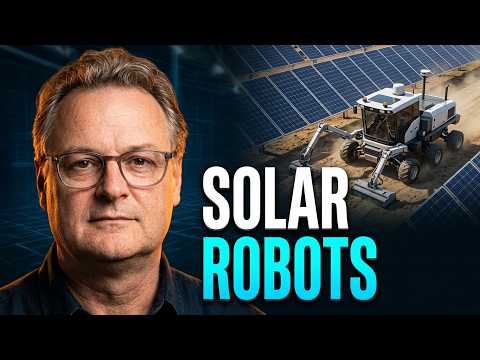
What's up, party people? My name is Sunny Ray. This is the Sunny Ray Show. I've got my sixth interview today and it's going to be on one of my favorite topics with the guy named Ian Cooper of Renu Robotics on why real world solar sites demand more than autonomous navigation and how purpose-built robotics can make maintenance safer, faster, and scalable. So, with that said, how you doing, Ian?
Hey there. Good. boiling in sunny San Antonio as usual.
Nice. Okay, good to hear. So what is rain robotics? I guess what's the problem you're solving and yeah why should people care?
Yeah. So I think most people think vegetation management is a deeply unattractive topic. You know everybody hates going out to the yard and mowing. try doing that on thousands of acres of solar site which there's a reason solar sites are in remote locations on poor quality land is because it's pretty much not used for anything else. So again you know vegetation can impact significantly solar operations whether it's shading the panels impacting the tracker mechanisms recent statistics from a major solar operator highlighted they had 19 they call them thermal events but they're really fires in just two months. it's an industry that's got human capital shortages and pretty restrictive insurance requirements now given those wildfire risks. So, it seemed to be ripe for robots and again, you're seeing it across the solar industry. You're seeing robots for solar construction. You're seeing drones for solar site inspection. so again, it seems ripe to address vegetation management with robots.
I love it. You know, let's maybe slow things down a little bit. I wanted to ask you a couple questions. I was so intrigued. 28 years at Schlumbberger and then emissions monitoring now robots I guess like what's the thread Ian?
So I got a PhD in meteorology so the outside world definitely interested me but fundamentally a mathematician and a scientist and liked addressing problems with technology. So joined slumberge straight out of the PhD. It was either join the Canadian weather service or join Slumber and I'd been a poor student too long. So ended up designing and implementing software for offshore rig and then ended up managing kind of drilling and frack technology and then was asked to find and develop new technology via a formation of corporate venture capital. the most fun job I have to say I ever had in a large corporation looking at new technologies every day and how we could adapt adopt and accelerate them into the oil field initially and then into the energy transition. So that's where kind of the love of kind of clean techch related technologies and robotics came in. We did a number of robotics investments while I was at found it a fascinating topic ahead of its time and obviously very synchronous with what's happening in the AI world and agentic AI systems now. Gotcha. Super interesting. so you founded SlumberJ's corporate venture capital arm. What did investing teach you about operating? the that's a very difficult topic to go into in a 20-minute podcast or streaming because there's the management team and the effectiveness of an executive management team in a startup is important. Getting the right kind of funding, not all good money is good. working closely with customers who expect you to be the equivalent of a schlam and 100,000 person company when you're a 50 person company. managing customer expectations and timelines particularly those that want free pilots of new technology when you know you're trying to get revenue demonstration. sitting on the boards of startup companies really gives you an insight into the financial management of those companies and the messaging and the effectiveness of the board as well. And again I always felt that boards should be additive to any company in terms of network commercial visibility governance experience and so try to bring all of that into the companies I've the smaller companies I've now been in. What did see teach you about selling new technology into conservative energy buyers?
That they're hungry for it but they want to commoditize it as soon as possible. So again pricing models are critical. you know we took sops from essentially a domestic operation to 33 countries around the globe and the difficulties of implementing new technology varies country to country. it's not a trivial exercise at all, but again when you're working with some of the world's largest energy providers, they can help you as well. so again, finding the right people that align with your vision within those large customer organizations certainly was a critical part of COP's growth.
And why take the CEO seat at Renu in June, I guess 2025 specifically?
Again, you know, I've done a number of robotics investments. I wasn't specifically aware of this flavor of robotics and was certainly a neopight in the solar world but was intrigued by what they developed to date some of the challenges they faced around the technology development the harsh environments and again my background was truly developing technology in harsh downhole environments so felt I could add some of that commercial technology development now some process into a company that was kind of transitioning from that agile startup into something that was scaling. and again, yeah, we're continuing to scale and now looking now at our first foray outside of the US.
Got it. And you said robots are ready. I guess what specifically changed to make that true now rather than let's say 5 years ago.
Again, there's a lot to go in making a robot reliable even in what may seem like a fairly benign environment like a solar field. They're not. They're and again that's where the comment they're not golf courses. They have ruts, ridges, standing water. Again, particularly if you visit one of our sites a couple of hours from our office in San Antonio. you know, there can be standing water, you know, almost up to the panels one day and then it's gone, you know, a week later and vegetation is fast growing. but you know, there can be erosion issues then. So, the robots tend not to like to swim. and so you know you want to be able to geoence and use all of the latest additional technology and sensors to enable you to navigate in that environment. you know being able to navigate in GPS denied environments that technology has come a long way the communication systems to enable you to interact with your robots in these remote locations in that environment. So again, we use cellular and switch automatically between strongest providers and then satellite if there's no cell signal, which can often happen in these locations. So really adapting all of the peripheral technologies and the maturity in those applications perhaps in other markets have really made it now ready for this market in an integrated sense. And again, you know, this is I wouldn't say it's a robotic lawn mower. It's really an integrated sensor platform that happens to be ruggedized for a harsh environment. It happens to have a mode deck attached to it.
Super interesting. So solar fields are not golf courses. So like what does everybody get wrong about mowing under panels?
So again I think you always see the pristine you know standard images of sheep grazing nicely under panels. It's glorious. The grass is kept at a nice 2-in height. go out to a solar site you know anywhere and you'll see large patches of vegetation that have been left or unknown. you'll see again sheep sleeping under the panels when they should be really eating the grass and the dogs that are supposed to be hurting the sheep are sleeping under the panels as well. So you know it's an environment that's kind of ripe for neglect I would say. and again I think it's you know it's a significant cost as well and particularly if you have to call out you know after a rainstorm for an additional mow that maybe wasn't planned in your annual budget.
Having a resident robotic system that essentially can mow on demand one gives you predictability in the budgets and two enables you to address any issues around rapid vegetation growth post storm that you wouldn't necessarily have budgeted for. you know what did you understand about field operations that maybe a robotics founder from software would miss?
Plan for repair. again make sure that you've got enough field support to support those bots that are in the field. you know we're a service company so the customer does come first. So we want to make sure that we can get the bots mowing as much as possible. that's another reason why again it's a resident system that stays on site. It has its own little recharge pod that it goes into. Maximize the amount of time that you are mowing. Minimize the amount of time you are charging. So again, looking at things like fast charging, all the things that are coming from the automotive world where we can adapt, adopt or accelerate those into our field as well. and really pay attention to the customer. You know, see what they really need. you know, if they need an area that's moan, you know, a little faster or they need us to stay clear of a zone, you know, gence that area off. Communication with the asset management is critical. And again, that very much comes from an oil field background where again, you have a very close relationship as a service provider, whether you're a Schlumbumberge baker or a Hallebertton and work very closely with your shell or BP. it just so happens now of course the energy domain is a lot broader and often many of these customers are the same. So I think that the same dynamic works.
So inside an energy operator like who has to be one over before a robot ever gets on site.
It depends. I mean if it's centrally managed then you're looking at headquarters and you know even up to the seauite in some cases particularly as you know there is a certain skepticism about robotics and certainly fully autonomous robotic systems. I know people that still won't get in the Whimo for example. but realistically who we talk to and who we interact with best are the asset managers. Those that are really responsible for that day-to-day operation of the site. You know there it's a profit and loss center and so you know anytime a solar panel is down it's not generating electricity and again we want them to focus on power generation and not have to worry about vegetation.
Got it. Can you explain Renu to a solar asset manager who's happy enough with his mowing contractor? so again typically the incumbent is a manual mowing crew. again we know they've had difficulties in retaining access to those crews. There is a human capital shortage in that industry particular right now. they typically charge you know a number of MOS per year. so it's a fixed dollar per acre per mo. which leads to an annual budget. I would say, you know, we tend to be cost competitive after that second mow because again, we're resident, we're on site, we don't have to mobilize. and so if there's additional mowing, and again with with climate change, we're certainly seeing more MOS are required than really are budgeted or speced out, particularly by the manual mowing crews. that quickly escalates particularly if there is a storm that's come through there's rapid growth everybody's competing locally for the same mowing crews and there they can charge a premium then so again we charge a fixed fee essentially a fixed fee a dollar fee per acre per year and they can mow as many times as necessary there so their permo cost is significantly less.
Got it wow can you explain reu to a solar asset man well I guess you just answered that one labor is getting harder to find right in the field. How much of your demand is really about that?
I would say it's driven by that the insurance requirements interests in testing robotic system. It comes back to that they now seem to be ready and there's I think a natural inquisitive to try them out. Again you know we do pilots initially. It's very much a land and expand business model. And those pilots can be pretty, you know, extensive and over a long period. Again, the operators tend to want to see over at least a full mo season, if not two. So that can be, you know, a year and a half, almost two years of piloting. and again, they really want to understand the capabilities and limitations of it. And again, not just the financial implications, but the operational aspects of, you know, how many times do I have to pull this out if it falls into, you know, a muddy area? what if it does collide with a panel? what are those implications there? So, they really want to test out the whole domain. and again, I think that's that natural inquisitive that comes from, you know, companies that are willing to test new technology, which of which most are. So I think whilst the fundamental drivers are probably economic, there's also I think a willingness to look to the future because ultimately you know they want to put these across their whole domain and again each royalt looks after about 150 acres which is a pretty significant area.
And I guess what do the next 90 days have to prove like is it more units a new site type or.
Sign signing a big contract expansion contract is my most important thing in the next 90 days. again, we've got a range of maturity of customers. Some where we're just starting those pilots, somewhere kind of six months in, some where we're expanding the number of bots on a single site, and then some where we're, you know, we've been working with them a while, they're comfortable with the solution, and now we're looking to actually broadcast the number of bots on a broader range of sites now across maybe a whole state.
And where else does this platform go once the fleet and the autonomy stack exist? So this is again it's a device that's really useful for I would say personnel denied and remote environments. And so again we've been operating on US air bases. We've had successful trials on international airports. as you can imagine the FAA approval process for having robots running around on commercial airports is long and torturous. they don't necessarily need want you near the runways or even some of the aprons. and again that's where that work with the US Air Force has really helped so we can demonstrate the security and you know there's a strong IT security component to this. No one wants someone to hack into a bot and put it on a runway when an F-15 is coming into land. So again really being able to demonstrate that security side is important as well. But you know there's landfill is another market that can be addressed with this. today, you know, landfill operators have to measure their methane every quarter and they have to mow the grass before they send someone over measuring with a walking survey around all those gas collection wells. And again, it's a topic that's ideally suited for robotic systems.
And if you look ahead three years, like what does the ideal solar site maintenance model look like?
So I again I try to envision a future where the solar operations and maintenance is fully autonomous. So again, you've already seen construction being autonomous. I know Breakthrough Ventures just did an investment in in a nice autonomous construct company. Civ Robotics is already out there. you've already got people like Raptor Maps with their drones doing visual inspection of sites and again looking for hotspots and again overgrowth. you've got robotic cleaning systems. So, you know, we slip in there as kind of the vegetation management and again, you know, we're not just doing mowing, but we're looking at trimming and spraying as well and all of those kind of traditional manual vegetation management operations. But ultimately, you know, the real value here is data. again, if you can imagine a digital twin of your solar site and you've got all of these autonomous operations essentially talking to each other,.
They need to have again a standard data model. very much like what was developed in the early days of the oil field. So again you know Baker's tools and Hallebertton's tools and Schlumbumber's tools all talk the same language and so you know that I see as the vision is a future of full autonomy across solar sites from construct construction operation maintenance and then ultimately abandonment.
Love it. guy. I mean my name is Sunonny Ray and I spent 10 years in robots. So, I love what you're building. I guess what has to happen for a pilot to become, you know, a full fleet rollout. Ian,.
Again, the economics have to work for the customer. We have to be able to demonstrate that. Again,.
Bottom line is they just want their grass cut. Again, they want to avoid what is an expensive headache and obviously could be a very expensive headache with a thermal event. So it is again doing what we say on the box, you know, making sure that their grass is kept below that mandated threshold, ensuring we don't have any issues or collisions. ensuring that the robot has sufficient uptime to keep up with the grass growth. yeah,.
Again, you know, I said, you know, each bot looks after 150 acres. Obviously, that depends on the individual environment. We've got robots in Hawaii that are mowing, you know, much more frequently than we do in upstate New York. understanding, you know, we have a statement that we understand and learn from every blade of grass we mow because there's a lot of different grass types across the country. And this feeds into the AI and machine learning systems, the computer vision that we use to characterize that grass. So, we can have the deck automatically raise and lower depending on the type of vegetation we have.
So, realistically, it's being able to demonstrate all of that we've promised up front to the customer and save them money.
I love it. Ian, where do people follow Renew Robotics and learn more?
Yeah, we're www.renewrootics.com. I am at Ian, Scottish spelling of Ian, I ain.cooper renewbot.com. we're in San Antonio. We welcome visitors to come see this the robots being built. and if you're out on a solar site and you see a little green thing operating under a solar panel, that's us.
Awesome. I'm going to bring it to an end. Ian, hang out for one minute. Thank you all for tuning in live and I appreciate all of you. Until next time. Cheers.