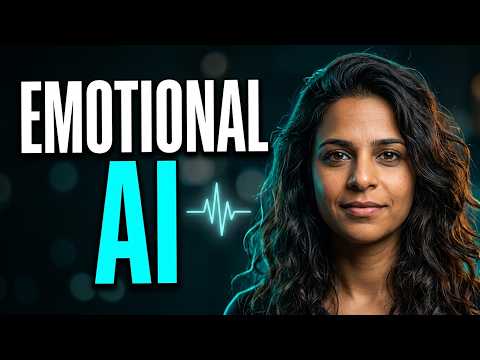
What's up party people? My name is Sunny Ray. My next guest, her name is Sama Daman Huri on we're going to be talking about building emotionally intelligent AI privacy first storytelling tools and games designed for curiosity over agency urgency not agency. talk to me somehow. Where are you calling in from? California, Bay Area. Hi everyone.
Hi everyone. Cool. So I guess take us right into the deep end. What is it that you're building it? Is it blendbound? Am I saying the name correctly? And what problem are you solving? Why should people care? We'll just go right in the deep end and then maybe go a little bit slower after that.
Yeah, totally. So, I'm the founder of Blendbound and what we're doing is we're gamifying how we collect emotional intelligence data. And we're starting by building sandbox or emotional sandbox games specifically for Gen Z's who are trapped in their own emotions. There is no safe space for them to express that. And the game is about a black and white world where through solving the puzzles and connecting to other people, they bring back the colors. And through that whole experience they get to experience a lot of emotions. And through our business model we can collect identify and assume these data and these data can be feed to AI automation and many other technologies that will yet to come.
Fascinating. Hey, just to u maybe like go back a little bit. You know, I was reading so you were the Arabic language producer for Siri at Apple.
Yeah.
What does building a voice assistant in a second language teach you that building it in English never would? So Arabic language has many dialects and therefore many cultures. That's something I would never recognize in the English language before knowing that about Arabic. It really made me see that even the American accents from one state into another is completely different. It's a completely even different mindset and approaches and that widened my perspective of how diverse Americans are in general. For example,.
Yeah, for sure. Yeah, I would say so as well. I mean, that's one of the things that always strikes me about the United States. It's just like how like when you go from city to city, it's got like every city's got its own kind of vibe. So, I was going to ask you, know, you trained in literature and linguistics, then, you know, creative writing and ended up shipping software. So, I guess where do those two tracks like kind of converge for you? Yeah, believe it or not, if you go deeper into English or like language and theories and learning how to prove one point that can take you into law, into solving problems, into simplifying things. And it made it easy for me to go into tech and really learn the basic of like why these teams are here, how do they communicate and how we can simplify that through my major and my studies.
Got it. Hey, Paper City screened at seven festivals in 2020 and and Folded is set in the same world. So like why take a short film's world and kind of rebuild it as a game?
Yeah. the when that movie was selected in seven film festivals and it brought like an impact for a smaller group of people and then history changed. AI came into life and there was a need for new imaginary worlds to come to life, specifically for younger generations to really like bring more stability and grounding in everyday life basically to solve escapism like every time a person escaped they go into a different world and if we can create a safer world around that. So the big the bigger idea is to expand and have a longer movie from the short movie that we did. As AI was evolving and the need for creating more interactive experiences and VR and AR then we shifted the same concept into a game.
Got it. And you worked at Apple Meta HBO.
What?
Yeah. Genantic, Genvid. What did you learn about how big companies decide what gets built?
It's very different from one company into another. I'm not going to mention names, but some companies they really care about one specific market and empowering one specific voice and they would do anything to empower that. Even if they go internationally, their perspective is always from that clear one approach. other companies they care about their reputation. So it's all designing the product, building the team, taking actions, etc. and some they really just care about money. So whatever that makes money for them.
And what made you leave production work to start a studio rather than you know pitching this as a project inside one? Yeah, believe it or not, Sunny, I never wanted to be a CEO. I never wanted to start a company. I just fell in love with the problem. I did a lot of research about fairy tales and fables, happily ever after. How can we change people's narratives? And completely just fell in love and I was following the step one by one. And one day I got a message in my LinkedIn from Techstar. They're like, "Hey, can you apply on this link?" I applied and I got accepted for their first cohort here in East Bay for like women founders and then another excellator program high founders and a total of six cohorts and I was like okay maybe some there is something in here that I need to explore and blend bound was born. That's a beautiful story and you've said the future of AI is not about efficiency but about emotional systems identity and connection. So what convinced you of that?
Yeah. So through the research and the studies and everything that I have been learning since I started this journey. So it's like right now about five fears that emotions it's a very difficult concept at the beginning but then if you go deeper and you're you want to simplify it and identify it or just like name it there are so many tools that we have already been using for so many generations that we're not aware that we're actually translating all these emotions. So emotions at the beginning they come as a strong wave into our bodies and it's really hard to explain and the easier things to explain is through our voice or our immediate actions but through history actually we have learned to simplify and translate these emotions into like movement into meditation into eating healthy into sleeping well. even how we word our sentences and the approaches and the perspectives these actually are all emotions believe it or not. So imagine if we can identify more emotions, simplify more emotions, apply it to humans first to become more emotionally mature and then feed all of these data to the technologies. What type of world will be possible for us?
Very interesting. And can you describe Folded to someone who only plays, let's say, combat games. Like what are they actually doing for the first 10 minutes? Like if I'm talking to, let's say, my business partner, Charles. Yes. Well, hi Charles. You're about to play a game. it's a puzzle game, emotional puzzle game, and you enter a black and white world, and your task is to solve many PL puzzles and help us bring back the colors.
Got it. Interesting. Cool. Okay. You ever after AI is alive MVP, right? So what has to be true before you would call it a product rather than a proof?
Yeah. so Ever After AI will be a solution by itself but also a plugin in the game. it's the AI aspect of the game that we are building. We want to create a safer communities or spaces for gamers to communicate with each other. We want to create NPC characters that really implement all the tools and the resources that we have learned to build stronger characters for the gamers every time they interact with our games. So that's an aspect of it. The other aspect of it is literally focusing on happily ever after. basically creating our own SLM, small model language, small language models and really identifying these patterns that we believe that if the users change the narratives around it that there is a possibility for more people to believe in themselves for just have a better life and better approach in this reality. you know a memory dependent product that refuses memory is a hard you know engineering position. So how do you make it useful anyway?
About the memory.
Yeah.
You mean like data.
Privacy?
Absolutely. so far we're we want to also add the diversity aspect and how we're collecting the data. So we're trying our best to keep it anonymous. We're only collecting what we need to identify these emotions. So that means we're not really caring about like the geography, the backgrounds, the gender and all these informations that will u make us break some privacy consents around that. At the same time, the MVP right now does not collect any privacy data that anyone would feel that we breach their privacy. But at the same time, slowly we're learning as the data privacy collecting is evolving, what is the best way, how can we navigate that, how can we make sure that they are aware of what type of data we're collecting, etc. There is also a future plan that we're implementing devices as well. So just navigating the way.
So I was going to ask you so just give me one.
I've got like a party happening over here. The girls are just home from school. Sorry. I was going to ask so.
Happy to hear that.
So can we go deep into like can the overall thesis? So you said like the future of AI is not about efficiency, right? About emotional systems. Can you just go deeper into that thesis because that resonates. I do struggle to think like I mean just AI and emotional systems in the same sentence is a bit of a just seems like a bit of a conundrum or something right so can you go deeper into that.
Yeah totally so AI and automation is inevitably going to happen whether people like it or not we will have more technology we'll create more convenient systems it's part of how we can systemize a lot things that we have been repeating for so many generations and many time and that by itself we all know it's going to evolve and it's going to become smarter and more intelligent. What we are haven't been paying attention a lot to is the emotional aspect of these technologies and now it became like a scarcity and a fear. People are afraid from these technologies to evolve. They're really afraid that they might take over and there are so many gaps in the evol in the in involvement of making the new technologies and also the evolution of it. One of the biggest problems is emotions. We're fully aware that if these technologies take over then us human, we're not going to be valuable anymore. The only thing that we're valuable for is our emotions because our emotions really help us navigate how we take actions, how we move forward, when to slow down and etc. Like these things are really connected to our emotions that these technologies still don't have. And imagine if we implement these data into these technologies, we'll finally live in a world that it's all about. For example, if we meet again in a podcast, how can we become friends? How can we support each other? How can we have fun? rather than really talking about businesses and other perspectives. Another aspect that I have learned is emotional intelligence data is only 1% from all the data in the world. So there is a huge gap. There is a need to identify that and go deeper into that route. It's so fascinating. You know, Folded still says coming soon, I think, on Steam, right? So, I guess what has to be finished before you can put a date on it.
Yeah, we already have a demo. Please go and play it. Let us know what you think. It is on Steam. You'll find two links. One is like the trailers and then the demo. it will take five to 15 minutes to finish. So it depends on how much excited you are to solve the puzzles. we are right now about to go into production to build the actual MVP or like the vertical slice of the game around 10 hours of play. so that's why it is soon.
And you've got like a wish list campaign running right on Steam demo like you said. So what's actually working to find the players who want this?
What is actually working for what?
Yeah. Like how are you finding the players who want to play?
Yeah. GDC. So the game has been selected at GDC. We were able to secure more than 300 gamers. They fell in love. we are engaged in many gamer communities here in California. We're already going deeper into Saudi Arabia market and Sweden. we have met many parents who have been concerned about the games. So through parents as well we found another channel to reach out these gamers.
And of course social media.
So games are where you know auton autonomous agents get tested against real humans before anything physical does. Right. So do you see your work that way a little bit?
Tell me more what you mean. like you know how I don't know about if you follow this up but like AI for example a lot of the early work was always like chess right and then it came to like things like Starcraft and you know video games so I wonder like do you ever think about that like now in this like highly agentic world and AI is there or do you ever I mean do people even design around aentic players or is it always around human players.
Well there are a lot of fentic players right now I don't know if you're aware of it or Not. Oh, not really.
They're even like they win the games. They Yeah, they even have their own channels where people watch them. It's already happening.
Yeah. Are you asking about my opinion like of the future of gaming or.
Yeah, I'm just curious like where AI, you know, falls into this mix because I do talk a lot about AI obviously on the platform. and I'm also curious on the other side of it is do you use it in terms of development or do you see it being beneficial there?
Oh absolutely. I have my own agents on my own computer of course I love AI. I I'm a pro AI. I still see a lot of hope for a better future for all of us. And when it comes to gaming, I see the power of these imaginary worlds and how AI can really amplify that if we create the right prompts feed it with the knowledge that we believe that will create more imaginary worlds for us to finally live this reality with more joy, more responsibility and more fun. just an information our prefrontal cortex that it comes mature when we turn 25. So before that all the informations all the narratives everything that we have learned it just going to hit at that age and it will create like what is purpose what is goal what is passion and how you can become a responsible adult and if you look at today's generations once they hit that age they go deep into depression addiction trying to fit in is because of all what we have been learning before that day. and the wish for us and with the evolving of AI is to create new imaginary roles that really change that conversation.
So, take me 5 years out. Does an emotionally intelligent AI companion become normal software or does it kind of just stay a category most, you know, companies avoid?
Oh, it will become very normal. were already discussing a B2B collaboration with wellness and health companies. they are already taking that deeper seriously having companions as you're checking on your health taking exercises, talking to a therapist. It's just going deeper and more precise of like what type of companion from these agentics that you want to have.
Cool. will help me land the plane. Where do people learn more about you guys? Where do they get in touch with you? Are you on LinkedIn or Twitter?
Yeah, we're all we are on all social media folded game. You'll find us everywhere. please play our game at steamfolded and our journey. you can always visit our website blindbound.co co and learn more about us. And there is an email there if you have any questions, if you want to follow up, if you want to be part of what we're building, we'd be more than happy to talk.
Awesome, Sama. Sounds good. Yeah, bring this one to an end and thank you all for tuning in live as well. Until next time. Cheers.