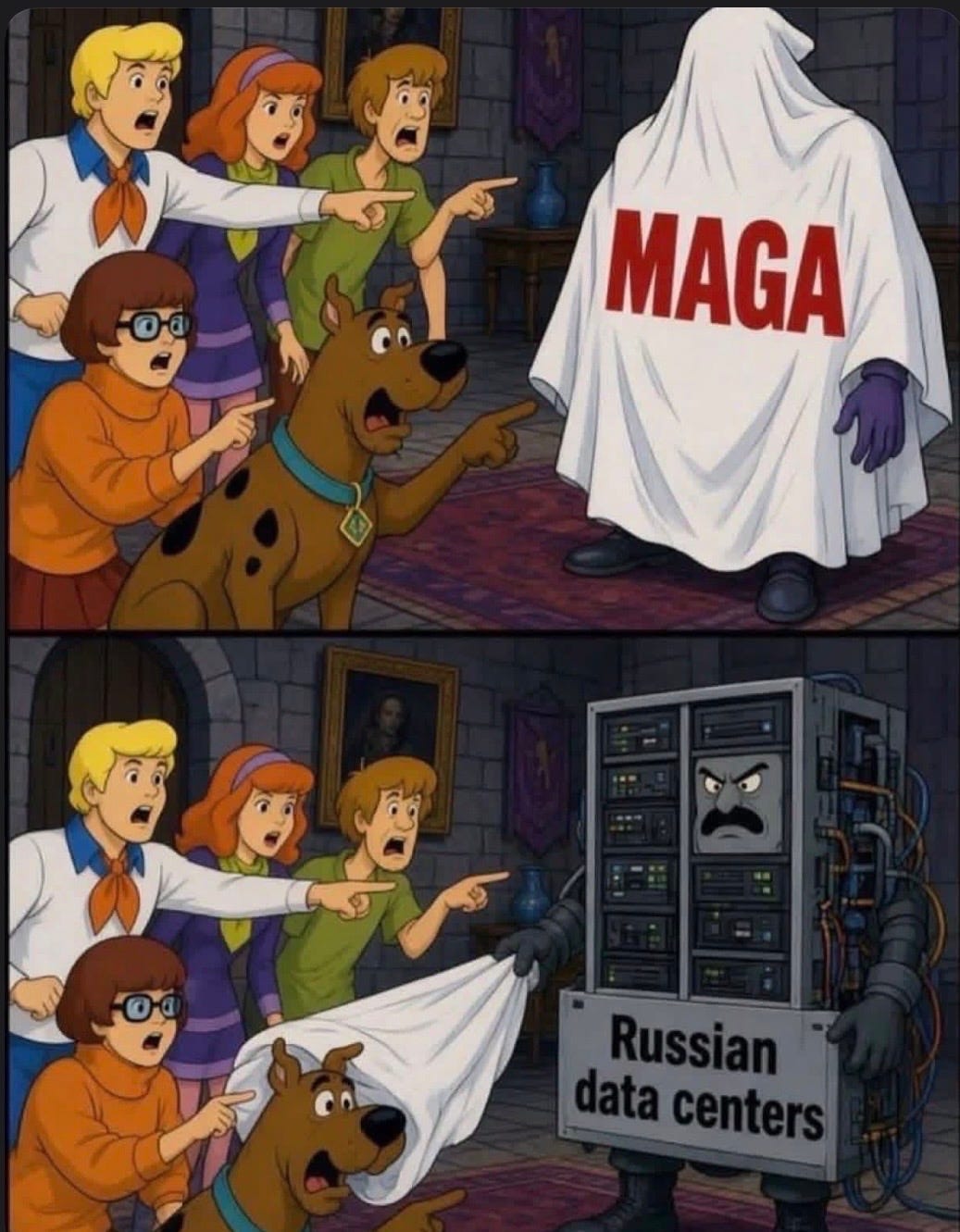
Scooby-Doo really summarizes one of the major challenges we have as a nation: we expect easy answers, and yet we are shocked when the simplest explanation turns out to be true.
If you did not waste untold hours in front of a television as a child using your feet to turn the channel, knowing full well your mother told you to use your hands, allow me to explain the plot of literally every Scooby-Doo episode ever. There is a mystery. A dog and his four human friends appear in their van. The team, called Mystery Incorporated, runs around, gets scared, makes a few jokes, and eventually catches the bad guy, only for his mask to be removed to reveal the actual bad guy.
Now, I was, like many of my readers, in gifted and talented, so the format and the reveal did not surprise me. I was there for the good vibes and the jokes.
But in the Scooby-Doo script format, there are some lessons for the 21st-century news consumer. First and foremost, the reveal gag on Scooby-Doo plays on the idea of cognitive dissonance. As a viewer, you suspend disbelief, allow yourself to be taken through the chain of events, and feel the pleasure of the reveal. The surprise is meant to be pleasurable rather than a cause of fear. A reveal feels like understanding, even when it’s only a plot twist. That feeling is what gets shared. The regularity of surprise reveals demystifies the process. In comparison, our educational system in the United States is largely structured to imply validity by focusing on factual moments rather than conceptual structures. As a result, in adulthood, when people see a disparity between what they had learned and new information, the reveal creates a cognitive dissonance that is hard to handle. If you read that Thomas Jefferson was an amazing human being who wrote eloquently about the rights of people, only to later learn that he also repeatedly raped and impregnated a teenager who he owned, the distance between ethical man and repeat offender is hard to conceptualize.
Many Americans learn history as a series of episodes with a clear villain and the US as the hero. While this format works great for a Saturday cartoon with a talking dog, it largely does not prepare people to understand the complexity of humans working within broken social structures. The same habit that makes us struggle with Jefferson makes us easy targets online: we were taught to expect one villain, one reveal, and one clean ending.
The Internet has heightened the challenge of cognitive dissonance in that content that confuses and content that engages often get the same attention, while content that requires further thought gets less. As a result, the most titillating or shocking Scooby-Doo-like reveal becomes the most watched, independent of its actual validity or quality. We’re pulling the masks off of things, only to miss the fact that there might be another mask there, because the content creator either has a bias or has framed the content to be misleading. We’re often not trained in media literacy, and so we cannot be like Velma, who can see that second mask. Think of the last viral “exposed” clip you watched. Someone pulled a mask off a company, a politician, or a stranger, and it felt great. Did you check who filmed it, what was cut, and who benefits from you believing it?
So how do we counteract this? Before you share the reveal, ask three things. Who is taking the mask off? What do they gain? What would the next mask look like? One of the things the Scooby gang had on their side was moxie. They knew they would solve the problem however many ghosts, swamp creatures, and ne’er-do-wells chased them. Scooby was also often on the wrong track, but affably accepted the actual villain. We all need to be like Scooby.
In fact, I am writing this because I found myself questioning my assumptions. The other day, when it felt like bot traffic was down, I believed Zelenskyy when he said the bots were down thanks to Ukrainian drone strikes. I then noticed a real drop in bots. Having read a recent Mother Jones article highlighting how the attack might have only decreased web crawlers, I now wonder if there was any disruption in bots at all. Did I just believe what I wanted to?
The real world is not simple, and very often we’re handling online mysteries without our gang or our Scooby Snacks. Memes like the one at the top offer us clarity but not necessarily truth. Is it really a simple reveal or more complex with the bots? Here’s the thing. Simple answers often circumvent the truth. That said, the simplest answer might be the truth.
As a kid, I vividly remember being exhausted by the stupidity of the multiple reveals. Just pull off all the masks at once, I’d think. Get down to it quickly. As an adult, I know that drilling to the bottom of a problem is challenging, particularly when you’re faced with a new mystery. Cognitive challenges do not come labeled: this one is the simplest answer and this one is oversimplified. Lifelong learners find ways to distinguish the two. Like Velma, we learn to figure out which will be a one-mask or five-mask problem. Zoinks, the more we do it, the better we get, just like the Scooby gang. And when the mask comes off a little too easily, check for a second one.