The part of Mark Zuckerberg and Alexandr Wang’s ▶Cheeky Pint interview that stayed with me was the connection between rebuilding an organization and changing how people get things done. Zuckerberg describes a focus on personal and professional agentic capabilities, while the conversation also examines the talent reboot behind Meta Superintelligence Labs. Those two subjects belong together. A company trying to become the starting point for everyday decisions needs more than a capable model. It needs an organization that can repeatedly turn research into dependable products.
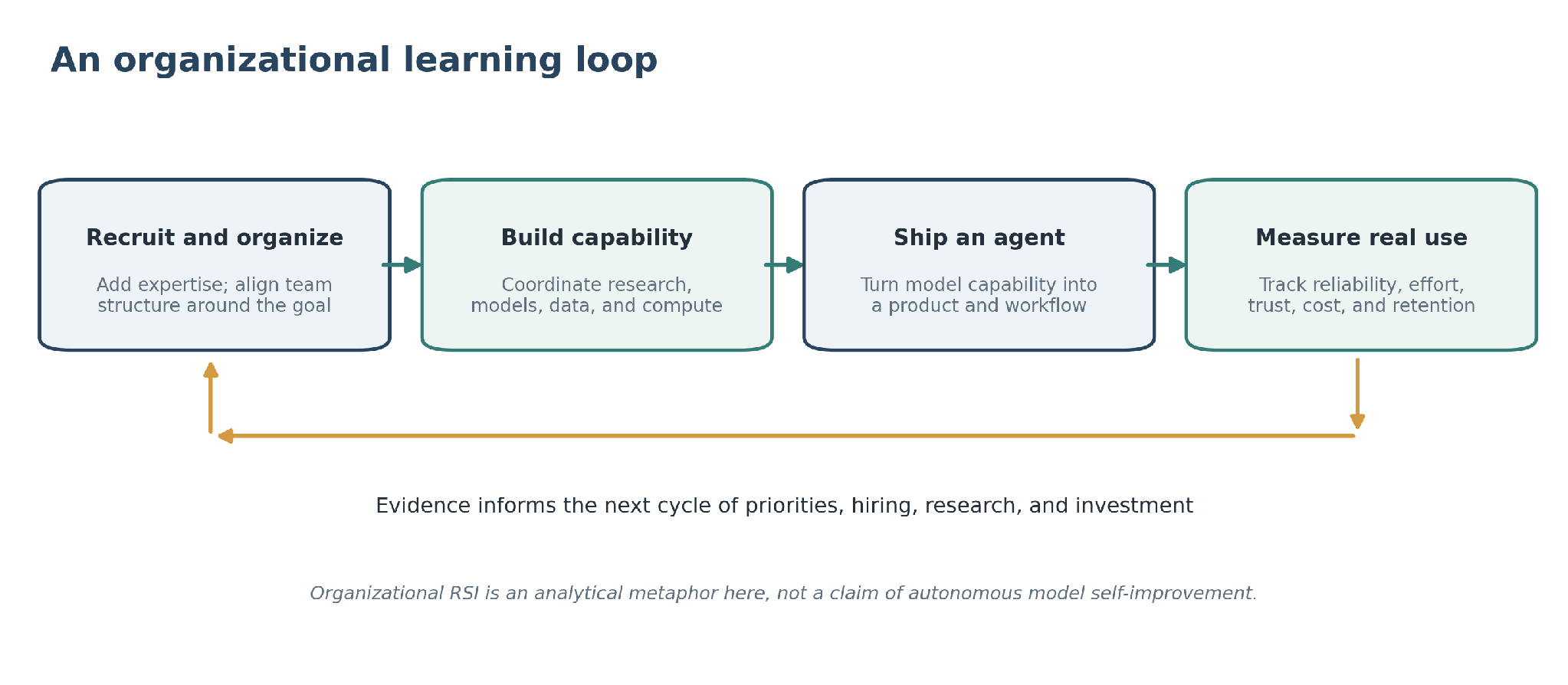
I think of this as organizational recursive self-improvement. The phrase is a metaphor for a company that changes the machinery through which it learns: who it hires, how teams make decisions, what they measure, and where it invests. Better capabilities can then improve the next round of products and attract the next group of people. The relevant question is whether these changes produce a reinforcing process that survives beyond a launch. That is a different claim from saying that Meta has demonstrated an AI autonomously redesigning itself into progressively greater intelligence. The interview provides a basis for examining the organizational process; it does not establish that stronger technical claim.
My central argument is that Meta’s opportunity extends beyond offering another place to chat. A personal and professional agent could become the front door through which a person coordinates work and everyday life. The person would begin with an intention, such as preparing for a client visit or organizing a family event. The agent would translate that intention into activity across calendars, documents, messages, merchants, and specialized software. Existing applications would still perform their functions, but the user would spend less effort deciding which application to open and how to carry information between them. This is a possible direction of development, not a description of a finished universal system.
The history of Zuckerberg’s earlier bets helps explain both the opportunity and the uncertainty. Meta’s metaverse ambitions did not quickly produce a self-sustaining business on the scale of its social applications. Reality Labs recorded a $4.62 billion operating loss in the second quarter of 2026, although the segment includes virtual and augmented reality activities beyond any single metaverse product (Meta, 2026a). That experience supports skepticism about the distance between a platform vision and its economics. It does not establish that every capability developed along the way was wasted, or that the next product built with those capabilities must follow the same trajectory.
The glasses story also needs to be separated from the broader metaverse narrative. EssilorLuxottica reported sales above seven million units across Ray-Ban Meta and Oakley Meta AI glasses in 2025 (EssilorLuxottica, 2026). That is evidence of customer demand for a particular category of wearable technology. It does not show that every proposed immersive experience has succeeded, and it does not prove that glasses will become the dominant interface for agents. It does make a blanket description of Meta’s glasses as a failed bet inaccurate. Different experiments can produce different outcomes inside the same company, even when they share research, hardware teams, and a long-term ambition.
For me, the management lesson is about how a company responds when its assumptions meet reality. An organization can defend an original plan, abandon it, or extract useful capabilities and apply them to a different problem. My reading of the current strategy is that personal agents offer a new destination for several existing investments: perception, voice interaction, consumer devices, and large-scale computing. That interpretation should be tested against product results rather than accepted because the story sounds coherent. A useful organizational learning process must be able to stop projects as well as continue them. Otherwise, every disappointing investment can be retrospectively described as preparation for the next one.
In the interview, Zuckerberg explains that conversations with prospective recruits helped shape the decision to rebuild the AI effort. Wang’s emphasis on talent density influenced that approach, alongside recruiting external researchers and drawing on people already inside Meta (Cheeky Pint, 2026). The analytical point is that recruiting can be a mechanism for learning about an organization’s limitations. Candidates reveal which conditions make serious work possible, which structures discourage collaboration, and where a company’s internal assessment differs from the outside view. Hiring then becomes an input to organizational design, rather than simply a way to fill positions on a predetermined chart.
Paying for recognized researchers is only the beginning of that process. A productive research environment also requires access to experiments, dependable infrastructure, clear decisions about priorities, and incentives to report disappointing results. If a team must protect a favored narrative, additional computing capacity can make an ineffective approach more expensive without making it more informative. If teams can identify failures quickly and change direction, each experiment can improve the next allocation of effort. This is the mechanism I have in mind when using the RSI analogy: a change in the organization’s ability to learn, not a claim that expensive recruitment automatically produces compounding returns.
The analogy also identifies where the process can break. Researchers can compete for prestige rather than share evidence. Product teams can optimize visible demonstrations while ignoring recurring failures. Infrastructure commitments can make leaders reluctant to reconsider a direction. A successful release can produce confidence that outruns the evidence. Organizational self-improvement therefore needs deliberate resistance to its own success narrative. A company should be able to explain which decisions changed because of a failed experiment, which capabilities improved under comparable tests, and which customer outcomes justified additional spending. These are observable questions. They turn a broad management metaphor into something that can be assessed over time.
Figure 1. An organizational learning loop. This interpretation connects Meta’s talent reboot, model development, infrastructure investment, and product evaluation.
Meta’s current product structure gives that process several distinct outputs. Meta released Muse Wonder through the Meta Model API and Muse Code on October 12; Muse Wonder Full became available to Muse Code subscribers. Integration into Muse experiences would follow (Meta, 2026e). Muse itself is the personal agent product introduced in September, initially powered by Muse Spark and able to work through connected services and a cloud computer (Meta, 2026b). Muse Charm is an announced pocket-sized device for interacting with Muse, including through real-time voice (Meta, 2026c). These layers have different purposes and different evidence requirements.
The model contributes capabilities such as interpretation, reasoning, and generating the next useful action. The agent product must turn those capabilities into a continuing relationship with tasks, tools, permissions, and results. A physical device determines how easily someone can reach that agent in the middle of an ordinary day. My assessment is that these layers should be evaluated separately before evaluating their combination. A model benchmark cannot establish whether a household trusts the agent. An engaging device cannot compensate for unreliable execution. A useful agent application does not by itself demonstrate that users need additional hardware. Their interaction is the strategic proposition, but none of the layers removes the others’ obligations.
Figure 2. Product layers and access surfaces described or announced by Meta. Status and rollout differ by product.
This distinction changes how I interpret early success. Shipping models, an agent application, and business integrations shows that the reorganization is producing deliverables. It provides more evidence than a recruiting announcement or an infrastructure plan alone. Yet sustained success requires a different set of observations: people returning after initial experimentation, tasks completed with acceptable supervision, customers choosing to pay, and operating costs that support continued service. Charm adds another future test because an announced form factor has not yet established its place in daily routines. The strongest defensible conclusion is that Meta has produced concrete results from its reinvention, while the durability and economics of the full strategy remain open.
Table 1. The model agent and interface have different jobs
The phrase “personal and professional” describes a larger design problem than either category alone. A person does not divide every decision neatly into a consumer application or a workplace application. A business trip has professional objectives, household consequences, personal preferences, and company spending rules. A parent who runs a small business may coordinate deliveries between school appointments. A researcher’s conference schedule may involve institutional funding, collaborators, travel documents, and family plans. The value of a continuing agent would come from understanding these dependencies without requiring the person to rebuild the context every time a task crosses an application boundary.
There are also several different meanings of a professional agent. One serves an individual in their professional role, helping them prepare, organize, and execute authorized work. Another belongs to an organization and carries out a defined responsibility under its policies. A third is a specialist service that provides a narrow capability to other agents. These arrangements should not be collapsed into a single personality with universal access. They differ in who sets priorities, who owns the records, who can revoke permission, and who bears the consequences of an error. A person might experience continuity across them while the underlying systems maintain separate identities and responsibilities.
This is where the front-door idea becomes more precise. A front door is the place where a person expresses a goal, sees its status, and resolves decisions that require attention. It is not necessarily the place where all information is stored or every operation occurs. The agent might request a report from an employer’s approved system, ask a travel service for options, and coordinate time through limited calendar access. Each service could retain its own authority and records. The agent would organize the interaction from the user’s perspective. Its power would come from reducing coordination work while preserving the constraints attached to each source and action.
Figure 3. A shared entry point can coordinate goals while keeping personal and employer governed contexts separate. Proposed design model.