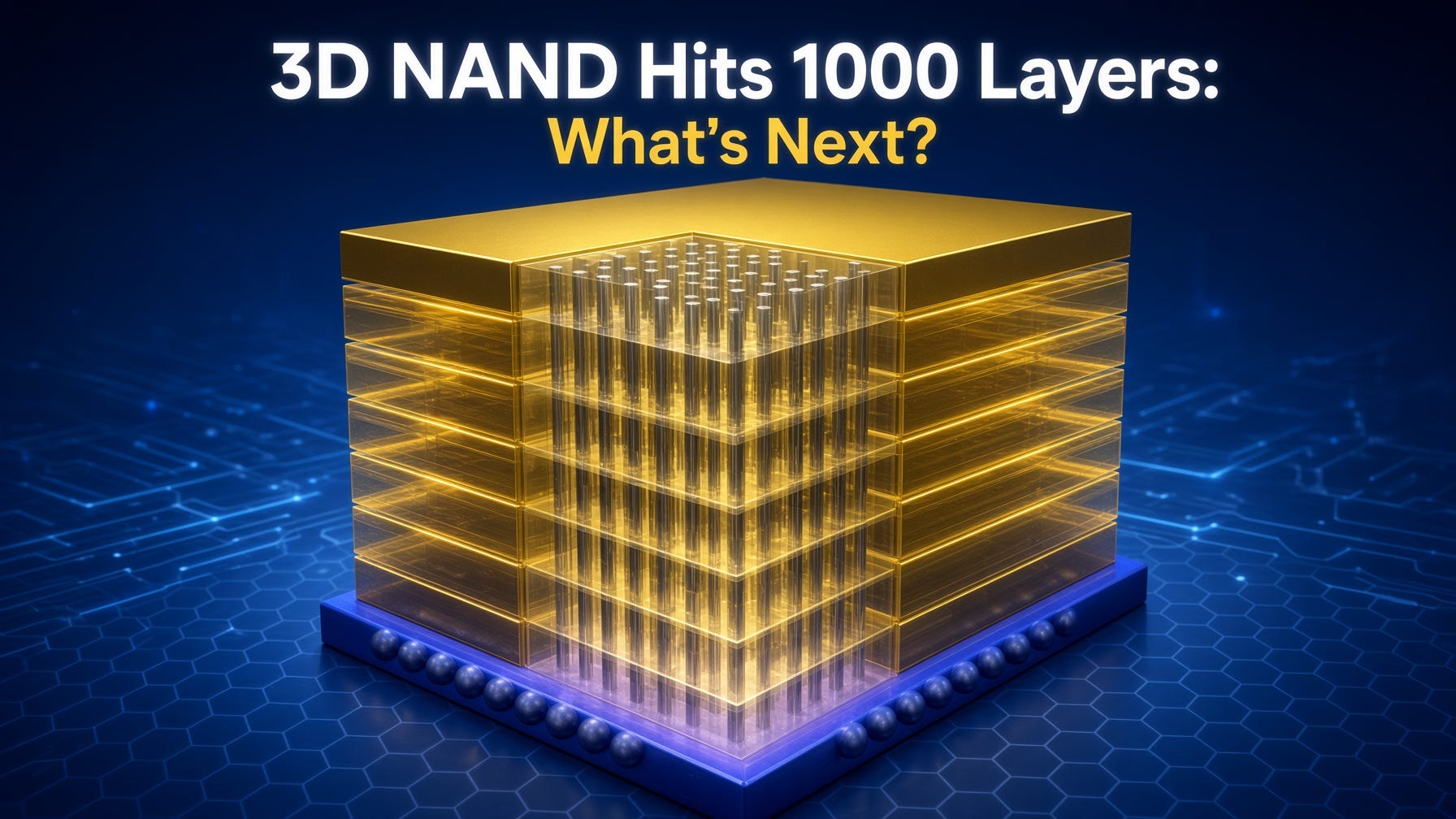
3D NAND flash memory has become the foundational non-volatile storage platform of the AI era, supporting workloads ranging from model training and large-scale inference to cold-data archiving.
As technology roadmaps push toward “kilolayer” stacking and the integration of trillions of memory cells on a single die, further scaling of storage technology is no longer primarily limited by process integration or lithography. Instead, it is increasingly constrained by the physics of charge storage itself: lateral charge migration, electrostatic coupling, read disturb, and charge-transport limitations are driving the technology into a “margin-constrained” regime. In this regime, these factors do not act in isolation; they interact to progressively compress the operational margins of each successive generation.
Recently, experts from companies including Samsung and Applied Materials, together with academic researchers, jointly published a paper examining these converging bottlenecks. They argue that continued scaling of NAND technology cannot rely on a single device technology roadmap alone; instead, it requires application-specific co-optimization. Under this framework, conventional charge-trap flash, ferroelectric memories, novel channel materials, and system-level integration should be viewed as complementary solutions, each serving different tiers within data-centric computing architectures.