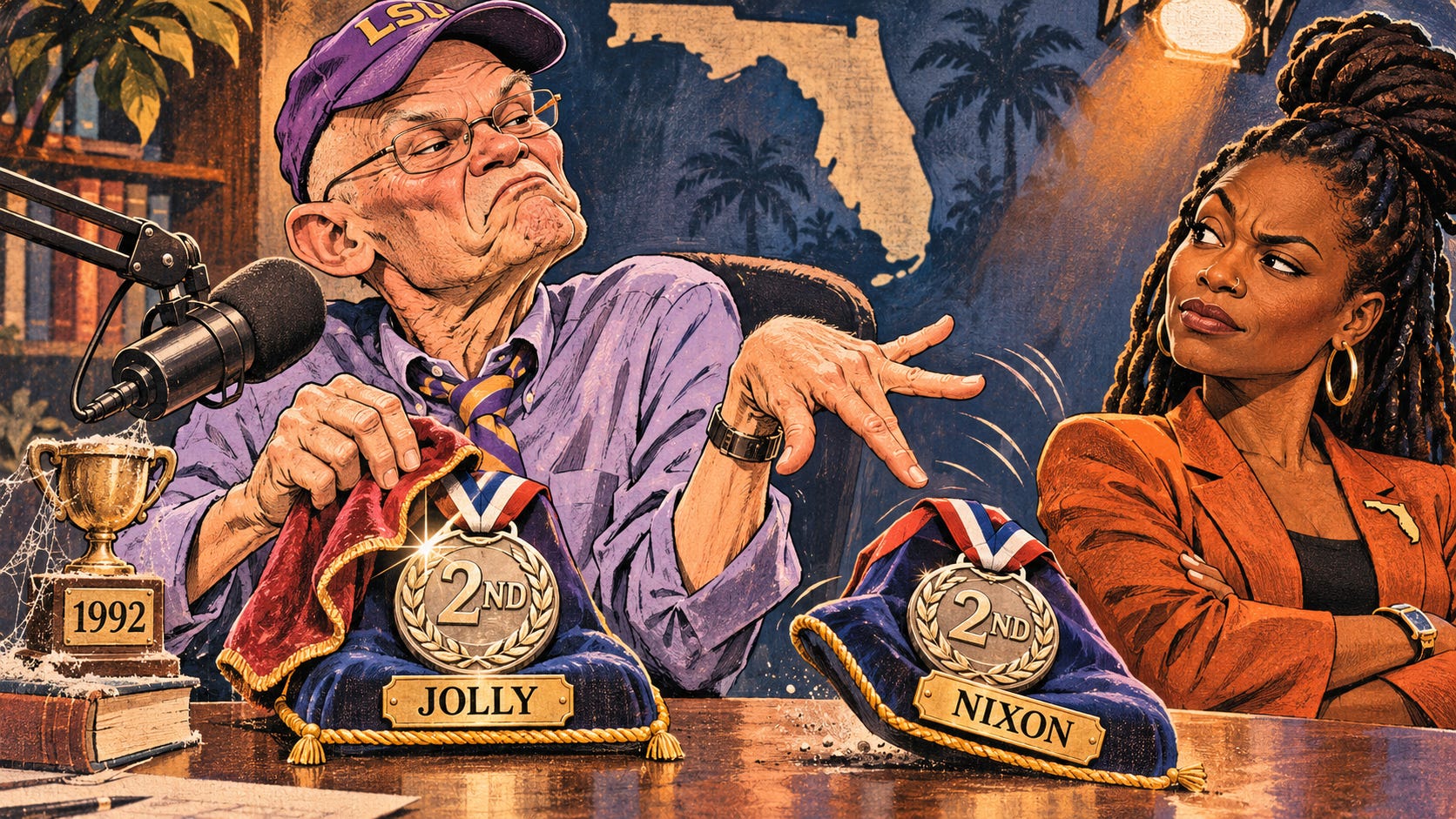
On the post-election episode of Politics War Room—titled “We Like Winning,” which is hilarious given the logic James Carville was about to deploy—the 82-year-old strategist and co-host Mark McKinnon brought on 22-year-old Aidan Kohn-Murphy, the founder of Gen-Z for Change, ostensibly for a midterm victory lap. Instead, it turned into an accidental live demonstration of Carville’s brain short-circuiting in real time.
Kohn-Murphy calmly pointed out the math in Florida: Angie Nixon and David Jolly finished in virtually the exact same spot. Nixon ran roughly half a point behind Jolly, mobilizing a massive, under-resourced constituency in the process. Carville’s immediate diagnosis? Nixon wasn’t an overperformer; she was an anchor dragging Jolly down with her. He declared—as if reading from stone tablets—that Democrats had “a uniquely bad senatorial candidate in Florida” and that she was “a uniquely uninspiring Senate candidate. That is for a fact.”
When Kohn-Murphy pushed back and noted that Nixon had actually inspired his generation, Carville snapped back, “Well, thank you, but she didn’t win.” Then he launched into a full-blown meltdown over “ideological purity,” yelling, “In fact, I can’t stand it! I can’t stand people who think they’re more moral than other people. The most important thing in politics is winning and when you lose, I don’t like you.”
Read that sentence again. “The most important thing in politics is winning and when you lose, I don’t like you.”
Two seconds later, Carville wrapped up the debate by saying, “I’m more of a David Jolly Democrat and you’re more of an Angie Nixon Democrat, but okay, good. We’ll agree to disagree.”
David Jolly also lost.
He didn’t win the governor’s mansion. He didn’t break the tape. He got the exact same silver medal in a two-person race that Angie Nixon got. By Carville’s own newly minted, ironclad rule of political physics—when you lose, I don’t like you—David Jolly should have been dead to him before the precincts finished reporting. Yet when that glaring contradiction was pointed out to him, Carville didn’t offer a grand strategic rebuttal or a breakdown of swing-county margins. He just shrugged and said, “Well, I like David Jolly.”
Days later, Nixon went on ▶Roland Martin Unfiltered and said out loud what a lot of people watching that clip were already thinking. “I mean this man clearly everything that he was saying he’s racist,” she told Roland. “Like I can’t put it any other way.” Then she widened the lens to Black candidates across the South—herself, Scott Colom in Mississippi, and Jamie Davis—all dismissed, kept off the radar of national leadership, and left begging for funding at the last minute.
And just in case you didn’t hear her the first time, she doubled down on ▶The Joy Reid Show. She called Carville “a racist,” said the way he keeps downplaying the campaign work and turnout of Black candidates is disrespectful, and said he needs to be called out and should retire instead of being handed a platform, warning that his rhetoric risks a mass exodus of Black voters from the party. Speaking to Carville directly, she rejected the idea that she dragged anybody down the ballot. Her operation, she said, turned out Black voters, young voters, and lower-propensity voters everywhere she organized.
I have been saying for years that James Carville’s time has come and gone. More often than not he sounds like the old man yelling at clouds—an 82-year-old political museum piece still trying to apply 1992 triangulation to a 2026 electorate. Like white MAGA Republicans and some centrist Democrats, he uses the word “woke” as a pejorative. I have argued that he has been living off his 1992 accomplishments for decades, and I wrote an entire piece about it. I have also argued that Carville didn’t have to do much in that campaign except ride the wave of Bill Clinton’s charisma. I said some version of this in June, when he wanted a Democratic nominee denied a seat in the caucus, and again in August, when he threatened to leave the party over Hasan Piker.
But what Nixon brings up is interesting, and it leaves us with a question we have to answer: Is James Carville racist?