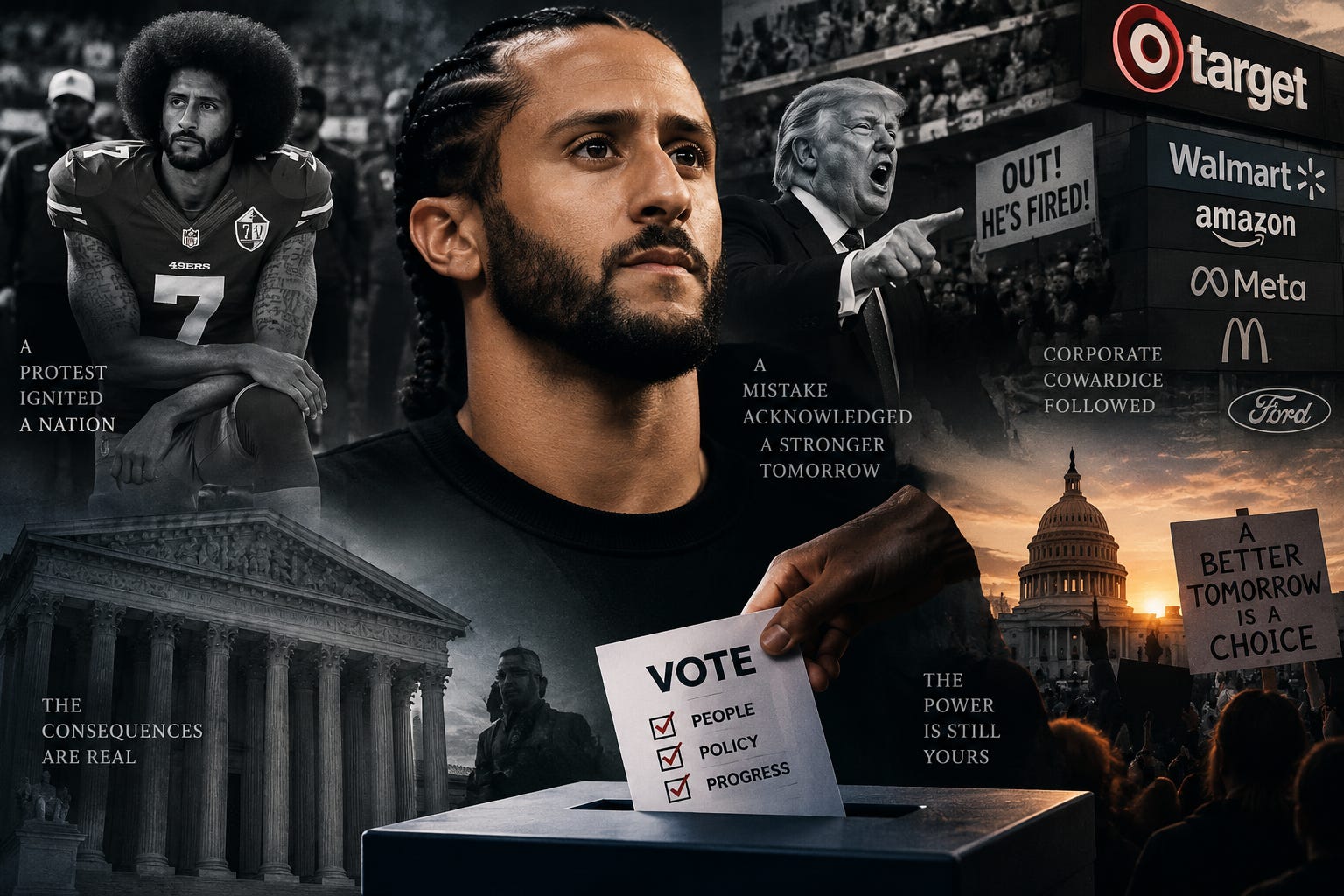
Colin Kaepernick has a new book out, and he is on the kind of media press tour that makes you wonder if he’s secretly discovered a 25th hour in the day. There are so many podcasts, sit-downs, and panels right now that my YouTube feed looks like a dedicated Kaepernick algorithm experiment.
I’m not complaining. Watching is part of the job. As someone who analyzes political psychology, I spend an absurd amount of time studying how voters, politicians, celebrities, and media networks ping-pong off each other in the culture wars. Kaepernick’s press run is a masterclass case study in how public figures manage their own histories.
When he first started his protest back in 2016, I was all for it. Bringing raw, national attention to police violence and systemic injustice was necessary, and he paid a massive personal price for taking that stand.
Then November 2016 hit, and he completely lost me. My first thought at the time was that his stance was pure, uncut political illiteracy. I try not to expect high-level political sophistication from athletes or celebrities—we’re talking about a culture where people treat basic civic duty like an advanced calculus exam—and he was still young. But he was also an immensely influential figure, and words carry weight whether you intend them to or not.
I can only describe what he did next as an anti-voting disaster class. With Hillary Clinton and Donald Trump on the ballot, Kaepernick told reporters it would be “hypocritical of me to vote.” He then doubled down with the college-freshman-after-one-political-science-lecture line: “the oppressor isn’t going to allow you to vote your way out of your oppression.”
Ten years later, Kaepernick is making the rounds for his memoir, The Perilous Fight, and I’ve watched his sit-downs with Karen Hunter, MeidasTouch, and NBC News. This piece isn’t about the book or the tour itself. It’s about what he said regarding voting—and how genuinely glad I was to hear it.
That gladness matters because genuine, unhedged accountability in public life is about as rare as a quiet Trump tweet. I’ve written before about the creative gymnastics public intellectuals use to dodge responsibility, most recently in The Luxury of Moral Purity: What Joy Reid and Ta-Nehisi Coates Get Wrong About Politics. It happens constantly with figures like Eddie Glaude Jr. and Marc Lamont Hill: they’ll admit they were wrong about a prediction or a strategy, and then, in the exact same breath, perform Olympic-level mental flips to justify why they were secretly right in spirit anyway. I’ve never understood the impulse. If you took an L, own the L and move on.
I draw a hard line at the ballot box. Voting isn’t a holy sacrament, and it isn’t a love letter to a politician—it’s basic political mechanics. It is the absolute bare minimum, even as Trump’s second non-consecutive term brings renewed efforts to make it harder. You can’t dismantle a system if you refuse to touch the steering wheel.
To his credit, Kaepernick didn’t turn his admission into a self-pity tour. He acknowledged that systemic issues remain, but he explicitly pointed to the judiciary, telling NBC News, “We’ve seen it with the Supreme Court. We’ve seen it with federal judges.” That is the exact reality I was screaming from the rooftops in 2016 while political purists were busy performing ideological purity tests.