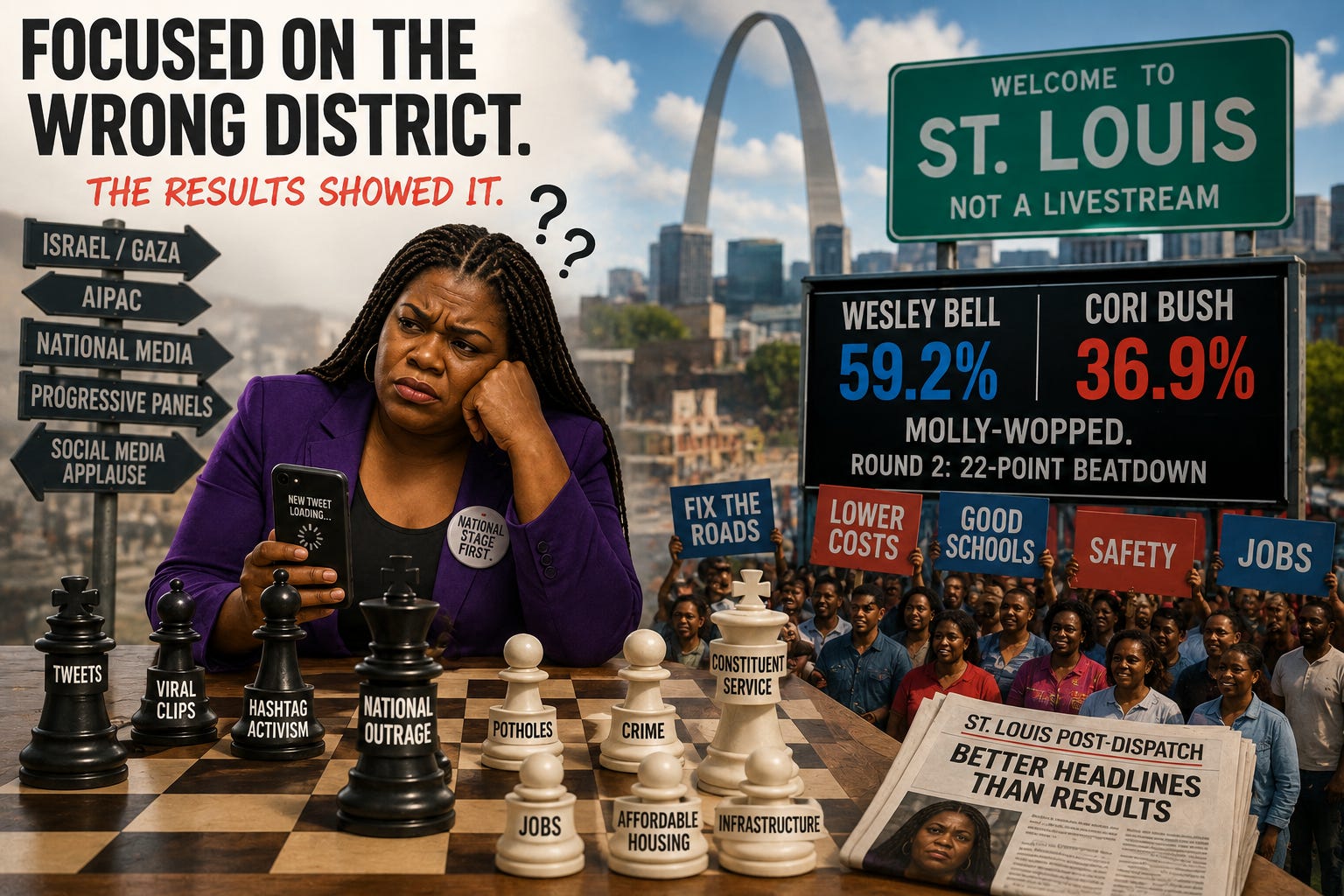
Wesley Bell beat her 59.2% to 36.9%—a 22-point blowout. Cori Bush did not simply lose this election. She got molly-wopped. This was not a close race that broke the wrong way because of bad weather, low turnout, or one unfortunate precinct reporting late. This was the electoral equivalent of looking up at the scoreboard halfway through the fourth quarter and realizing the other team had already started letting the equipment manager get some minutes. The district looked at a candidate it already knew and said, emphatically, no.
What should trouble anyone paying attention is not merely that Bush lost. It is that she lost by substantially more the second time. In 2024, Bell beat her by roughly six points. Two years, one previous defeat, and an entire campaign cycle later, the margin nearly quadrupled. Usually, when a candidate gets a rematch, the idea is to correct the mistakes from the first fight. Bush came back for the sequel and somehow made the original look competitive. This was not Rocky II. This was Apollo Creed returning from the dead just to knock Rocky out again before the opening credits finished.
I liked Cori Bush. I encouraged people in her district to vote for her. I genuinely understand her concern about Israel and Gaza, and on the substance, polling suggests that many Democratic voters share those concerns. But the longer I watched her campaign, the more it seemed as though she was not trying to win St. Louis. She appeared to be campaigning for some other constituency—one located primarily on social media, progressive livestreams, and panels where everyone already agreed with her.
Before anyone decides that Bush lost because St. Louis rejected progressivism, or because she was supposedly “too woke,” kill that noise right now. The record does not support it. Start with the money. Bell’s campaign and outside allies outspent her 27-to-1 in the rematch. In 2024, he had already outraised her three-to-one, with AIPAC alone spending roughly $2 million to help defeat her. That kind of financial imbalance matters. It limits a candidate’s ability to advertise, respond to attacks, organize voters, and define herself before the other side does it for her.
But money alone does not explain a 22-point molly-wopping. At a certain point, you cannot blame every dent in the car on the fellow who bought more gasoline. Plenty of candidates have survived massive outside spending campaigns, and we will get to them. Bush also entered the race under a federal investigation involving allegations that she misused campaign funds for personal security. Personally, I thought the ethics complaints were much ado about nothing. I never saw them as proof that Bush was corrupt or secretly running some elaborate campaign-finance hustle. But politics is not a courtroom, and voters do not wait for every allegation to be neatly resolved before forming an impression. Fair or not, the investigation created an ethics cloud, and it gave Bell’s argument that she had become disconnected from the district somewhere to land.
Bell did not even make Israel the centerpiece of his attacks. He focused on infrastructure funding, constituent service, and whether Bush was actually delivering for St. Louis. Local strategists told Jewish Insider that she had lost touch with the district on issues such as infrastructure and had not maintained adequate constituent service back home. The St. Louis Post-Dispatch editorial board was equally blunt, arguing that Bush and other members of the Squad had become better at generating national headlines than producing tangible results.
That distinction matters. This was not an electorate punishing a progressive simply for holding progressive values. It was a candidate allowing a national fight to devour a local campaign while carrying enough political baggage to make the “out of touch” label stick. The money helped Bell build the ring, buy the gloves, and advertise the fight. But Bush still walked into the rematch without fixing the weaknesses that got her beaten the first time. The result was not a narrow defeat manufactured entirely by outside spending. It was a full-scale electoral molly-wopping, complete with the referee checking whether the district wanted to continue.
.
Here is the actual diagnosis: Cori Bush ran a national campaign in a local election. In both races, she tried to turn Wesley Bell’s support for Israel and his AIPAC backing into the central question before voters. NBC’s coverage of the 2026 rematch noted that Bell buried her on the airwaves while successfully resisting her attempt to nationalize the contest around AIPAC. That is the tell. When your campaign spends more time trying to referee a proxy war over American foreign policy than explaining what you plan to do for people in St. Louis, you are no longer running for Congress from Missouri’s 1st District. You are running for an honorary seat in the discourse, where the pay is terrible but the quote-tweets are plentiful.
It did not have to be this way. Plenty of Democrats have faced the same combination of AIPAC money, hostile coverage, and reporters approaching them with Gaza questions like they had finally discovered the combination to a political safe. Those candidates won anyway because they never forgot who was actually eligible to vote for them. They understood that a television correspondent demanding a five-part dissertation on Middle Eastern geopolitics is not the same thing as a constituent demanding affordable rent, reliable buses, or somebody in a congressional office to answer the damn telephone.
Ilhan Omar has been an AIPAC target for years. Money poured into efforts to defeat her in 2020 and again during her razor-thin 2022 rematch, which she survived by roughly two points. She did not win by pretending Israel and Gaza did not exist, nor did she suddenly transform herself into Joe Manchin wearing a hijab. She won because Minneapolis had already elected her to be exactly who she was—on that issue and everything else. Her politics fit her district, and she understood the voters standing in front of her better than the pundits shouting at her from a studio.
Zohran Mamdani faced an even more relentless version of the gotcha-question obstacle course during his mayoral campaign. Reporters pressed him repeatedly about Hamas, “globalize the intifada,” Israel, and where he would travel first as mayor, apparently under the impression that the mayor of New York’s most urgent constitutional duty is selecting an international vacation destination. Each time, Mamdani refused to wander into the trap carrying a folding chair and a packed lunch. He pivoted back to rent, buses, childcare, and the cost of living.
Asked directly whether he would visit Israel first as mayor, Mamdani said he planned to remain in New York and focus on New Yorkers. It was such an obvious answer that it briefly threatened the entire gotcha-question industry. He did not take the bait, launch into a 20-minute seminar, or allow the reporter to turn a municipal election into a surprise oral examination on the Middle East. He simply reminded everyone what office he was running for.
That was not evasion. It was discipline. Mamdani understood that New Yorkers were choosing a mayor, not appointing a secretary of state with responsibility for fixing every conflict on Earth before handling the rent. He answered enough to establish his position, then returned to the issues his constituents were actually voting on. The reporters kept trying to drag him toward Gaza, and he kept dragging the conversation back onto the bus—preferably one that was frequent, reliable, and free.
Rashida Tlaib may be the cleanest example of all. AIPAC-connected money and a billionaire-funded outside PAC came after her in 2022, and she still won with roughly 64 percent of the vote. By 2024, nobody even mounted a serious primary challenge against her. At some point, the political assassins looked at the district, looked at Tlaib, looked back at the district, and decided there were easier ways to set several million dollars on fire.
It is important to be honest about why. Tlaib represents a district that includes Dearborn and one of the largest Arab American and Muslim populations in the country. That gives her considerably more room to be outspoken about Israel and Gaza than Bush ever had in St. Louis. That is not hypocrisy or a double standard. It is the same political rule operating with different local math. Tlaib knew exactly who lived in her district, what they cared about, and how far she could lean without falling through the floor. Her national position and her local electorate were not fighting each other. They were carpooling.
Summer Lee offers another version of the same lesson. In 2022, AIPAC’s super PAC spent millions trying to defeat her in one of the closest and most expensive Democratic primaries in the country. She survived. By 2024, the great anti-Summer Lee cavalry charge never arrived, and she defeated her primary opponent comfortably. Lee did not become safer by shaving off every progressive position until she resembled a congressional focus group in sensible shoes. She became safer by building actual relationships, maintaining a presence in her district, and making herself harder to portray as some remote national celebrity who occasionally remembered Pittsburgh existed.
That gives us Omar, Mamdani, Tlaib, and Lee: four candidates, four different constituencies, four different variations of pro-Israel money or media pressure, and four victories. The pattern is not hiding in the Zapruder film. You do not need a corkboard, red yarn, and six hours of Cenk Uygur screaming to locate it. They knew their voters.
Now set those campaigns against Cori Bush, Jamaal Bowman, and Nina Turner.
Bowman lost in 2024 after AIPAC-aligned groups spent approximately $14.5 million against him. That money was enormous and undeniably mattered, but it was not the entire autopsy. Redistricting had transformed his seat from a Bronx-centered district into one that was overwhelmingly based in more moderate Westchester County. His geographic and political base had moved underneath him, but his campaign sometimes behaved as though the old district was merely running late. He leaned heavily into national Gaza messaging, even holding a major rally outside his own district, while voters inside the district were deciding whether he still understood them. That is like discovering your house has been moved three counties over and continuing to have your mail delivered to the old porch.
Even sympathetic analysts conceded that stronger constituent service and a tighter local focus might have made him less vulnerable. The money supplied the cannon. Bowman still spent part of the campaign painting a target on the side of the barn.
But Nina Turner is Bush’s closest political mirror, and her two campaigns should be studied with the seriousness normally reserved for airplane crash footage.
Turner narrowly lost the 2021 special election to Shontel Brown, 50.2 percent to 44.5 percent—a defeat of roughly six points. That was painful, but survivable. Candidates lose close races, regroup, repair relationships, adjust their message, and come back stronger all the time. Turner came back in 2022 and somehow turned a competitive loss into a public demolition, losing 66.5 percent to 33.5 percent. That was not a rematch. That was Shontel Brown checking whether Turner had learned anything and receiving a 32-point answer of “apparently not.”
And Turner had entered these races carrying one of the least district-appropriate quotes in recent political history. During the 2020 presidential election, she compared voting for Joe Biden instead of Donald Trump to choosing half a bowl of shit instead of the entire bowl. Then she ran for Congress in a district that had given Biden approximately 80 percent of its vote.
You can dislike Biden. You can think he was too moderate, too old, too cautious, or insufficiently committed to half the progressive agenda. But when eight out of every ten voters in the district just voted for the man, perhaps do not describe supporting him as consuming a reduced serving of feces and then expect those same voters to respond, “Finally, someone who understands us.”
By the 2022 rematch, Turner’s campaign almost seemed to reach the point of saying, “Fuck this race.” She leaned even harder into her national Bernie-era profile, her media following, and the applause of people who did not live in northeastern Ohio and could not vote for her. It felt less like a congressional campaign than an extended audition for the progressive-media circuit. She was delivering speeches for the clip, feeding the national argument, and behaving as though Cleveland voters were merely the studio audience.
Then, after losing by 32 points, she blamed “evil money.” Outside spending absolutely played a role, but “evil money” did not force Turner to spend years antagonizing the overwhelmingly pro-Biden electorate whose support she later needed. Evil money did not make her say the bowl-of-shit line. Evil money did not run the same campaign twice, only louder the second time, like someone trying to fix a broken television by shouting at it.
Turner eventually landed at TYT, where she became a host and executive producer. Good for her. She is talented on television, has a commanding presence, and knows how to speak directly to a national progressive audience. But in retrospect, the 2022 campaign can look suspiciously like she was already applying for that job. Perhaps Congress was Plan A. Perhaps TYT was Plan B. By the final stretch, however, it occasionally looked as though she had switched the labels and neglected to inform the campaign staff.
Cori Bush followed a remarkably similar path: a close first loss, followed by a rematch in which the electorate returned with a larger bat. Bush watched Turner go from losing by six to losing by 32. She watched Bowman nationalize his race while his district changed beneath him. Then she responded by making AIPAC and Israel even more central to her own comeback campaign.
When Turner lost, she blamed evil money. When Bowman lost, Bush denounced AIPAC’s tidal wave of cash. The money was real in every case, but so were the strategic failures. Bush had already watched this movie twice. Then she bought a ticket, sat in the front row, climbed onto the screen, and volunteered to play the victim in the third act.
If you represent a district where Israel and Gaza genuinely rank among the top concerns of your voters, then by all means, run on it. Nobody is asking candidates to hide their convictions, stuff their principles into a storage locker, or suddenly start pretending Benjamin Netanyahu is their favorite world leader. But if the people whose votes you need are primarily worried about housing, wages, infrastructure, schools, healthcare, crime, or whether anyone in their congressional office will answer the damn telephone, you might occasionally want to discuss those things too.
I realize that sounds painfully conventional. Perhaps even counterrevolutionary. But in order to change public policy, you generally have to hold public office. In order to hold public office, you have to win an election. And in order to win an election, you usually have to appeal to the people who are legally permitted to vote in it. Political scientists are still studying this mysterious phenomenon, but early research suggests that receiving fewer votes than your oppon…