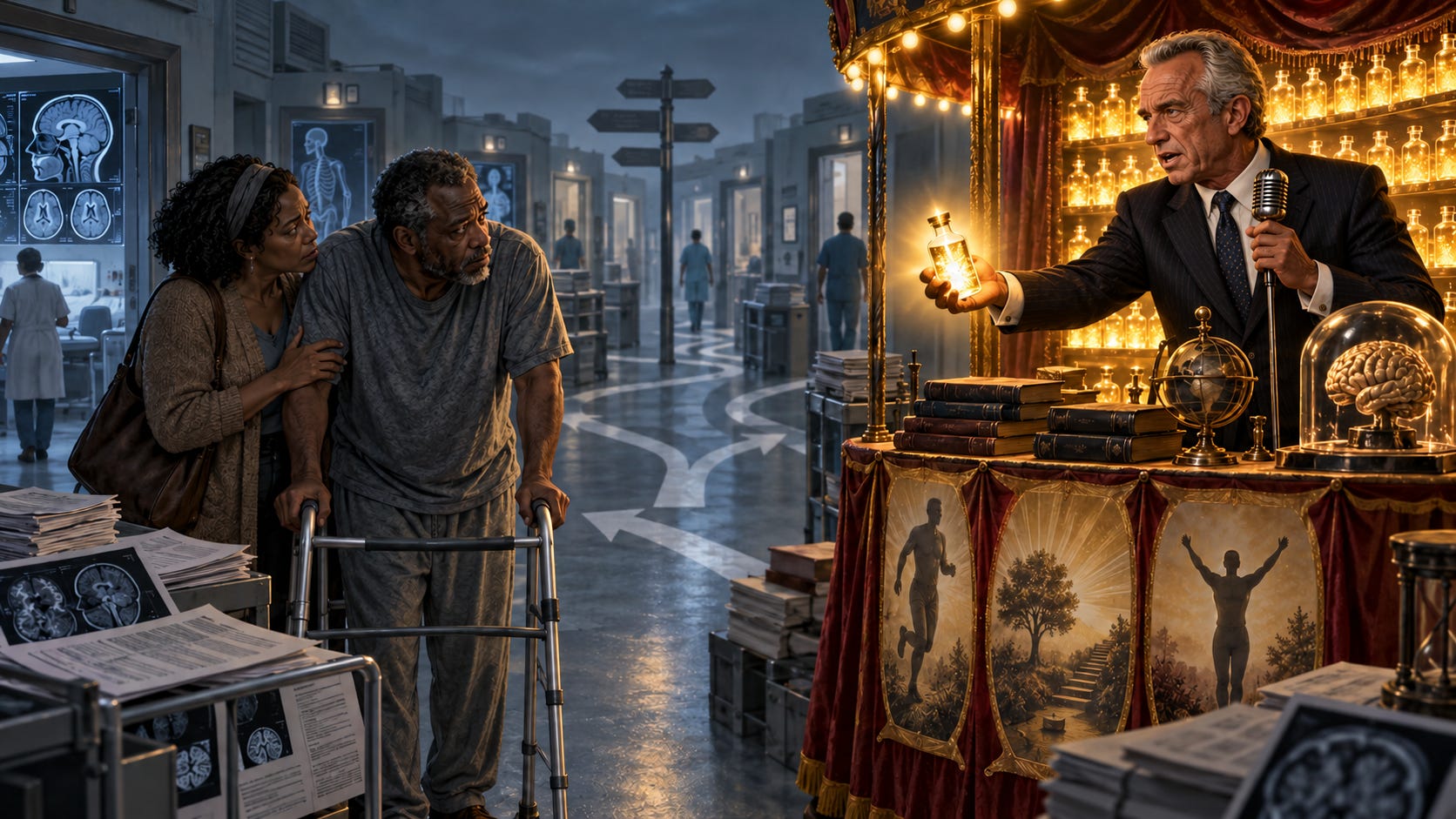
Two nights of speeches in Dallas produced a staggering volume of embarrassment, but before arriving at the main event, the also-rans deserve their due recognition. JD Vance informed the audience that inflation was far worse than reality dictates, conveniently omitting its sharp decline under his predecessor. Ted Cruz was soundly booed by his own party—at this stage less a political scandal than a load-bearing GOP tradition. Tim Scott offered his finest performance of synthetic sincerity for an audience that has never once mistaken him for authentic. Plenty of speakers humiliated themselves on stage, but none secured a reserved plot in hell quite like Robert F. Kennedy Jr.
Before proceeding, let me clarify: I am not here to canonize the medical establishment as an infallible priesthood. Institutional systemic bias is real, documented, and lethal. Ask any Black woman about maternal mortality in this country. Black women die from pregnancy-related complications at roughly three times the rate of white women, a disparity that persists regardless of income or educational attainment. It is not an economic failure; it is an epistemological one—a structural refusal to believe Black women when they articulate their own physical distress. Serena Williams, a elite athlete possessing world-class access to care, nearly died post-childbirth because a nurse dismissed her documented history of pulmonary embolisms as pain-medication-induced confusion. If an icon cannot command clinical credibility, what chance does anyone else have? This is not merely anecdotal. A 2016 University of Virginia study revealed that a disturbing percentage of white medical students and residents held false biological beliefs—such as Black patients possessing thicker skin or higher pain tolerances—which directly correlated with under-treating Black patients’ pain.
Discernment matters. Earned skepticism is an essential instrument of self-preservation. But here lies the scam: RFK Jr. does not equip people with tools for rigorous empirical evaluation. He hands them an intellectual shortcut wrapped in pseudoscientific performance art. “Do your own research.” “I’m just asking questions.” That is not skepticism; it is a cheap Halloween costume skepticism wears when it wants public trust without doing the actual lab work.
**I offer this critique as someone with a personal, astronomically expensive education in how vulnerable health-induced desperation makes a person. I was twenty-two the first time my legs gave out on me. The closest physical description I can offer is two overcooked al dente pasta noodles attempting to stabilize a two-hundred-pound frame. I did not realize it was a Multiple Sclerosis attack at the time. A few years later, the floor dropped out again, bringing the formal diagnosis nobody wants. My neurologist advised me to stay active and keep working out, identifying physical exertion as the primary defense against clinical decline. “Progression?” I asked. “Yes,” she replied. **“This is a debilitating condition, and your pharmacotherapy plus exercise are all that stand between you and functional deterioration.”
Then in 2022, the bottom fell out for a second time. I took a fall, acquired an unexpected appointment for brain surgery, and my health took a sudden, frightening turn for the worse. Over the following months, I sought out multiple neurologists at different times, hoping someone could offer a clear path forward. Instead, I got all the consensus of a Thanksgiving table discussing politics. Nobody could agree on what had actually transpired. One blamed the MS accelerating. Another insisted the fall was an independent actor that had sabotaged my gait entirely. Collecting conflicting diagnoses from a succession of individual experts with MDs on the wall is a special kind of psychological torture.
When you are sick, deteriorating, and modern medicine offers you a series of isolated shrugs, it triggers an acute existential grief. You get angry at your doctors for failing to play God; you get angry at yourself, wondering if some past lifestyle indiscretion summoned this fate; and you get angry at your loved ones, who are standing on the outside of your failing nervous system looking in. All of that grief and rage distills into a single, highly volatile substance: sheer desperation. And desperation makes a human brain remarkably easy to exploit.
Faced with Western medicine’s equivalent of a dial-tone, my wife and I began looking outside the domestic healthcare system. We found a stem cell clinic in South America called BioXcellerator. When I broached this with my doctors individually, the reactions ranged from polite encouragement to outright horror. I got into a particularly spirited debate with one specialist who warned me against the perils of “stem cell tourism.” I countered that I had actually reviewed the peer-reviewed literature on their protocols, that they weren’t selling magic beans, and—most importantly—that I was desperate enough to try anything short of essential oils and bloodletting. I wanted my legs back.
So, we dropped thirty thousand dollars across two trips to Colombia. The first trip was surprisingly promising. I was actually walking better before the stem cells even hit my system, thanks to their initial medication regimen, and for two weeks post-treatment I felt like a functional human again. The second trip, however, delivered zero results.
**The real eye-opener wasn’t the medical outcome; it was the waiting room. During that second trip, I met my fellow patients. Lovely people. Devoted family members. Also, as fate would have it, absolute black-belt, Olympic-level anti-vaxxers. My wife and I exchanged a look that translated roughly to: **What in the epidemiological hell did we just step into?
To be completely fair to BioXcellerator, the clinic’s actual physicians were not anti-vax; several actively urged patients to keep their immunizations up to date. But the patient lobby was a completely different story. Returning patients were cornering me to ask if my mobility loss started after a flu shot, declaring they would never touch another vaccine, and asserting that foreign stem cell doctors were the only medical professionals left on Earth who hadn’t been bought by Big Pharma. That paranoia didn’t originate in Colombia. It had been systematically injected into their minds long before they boarded the plane.
When the treatment ultimately failed to stick for me, friends and family demanded vengeance on my behalf. “Sue them! Report them to the BBB! They took thirty grand!” I had to tell everyone to stand down. BioXcellerator never guaranteed a miracle, and the treatment actually did work for others I met. I don’t regret trying it. But what chilled me to the bone was realizing how many of those desperate patients in that lobby traced their radicalization back to one specific origin point: Robert F. Kennedy Jr.